 24 Mar 2007

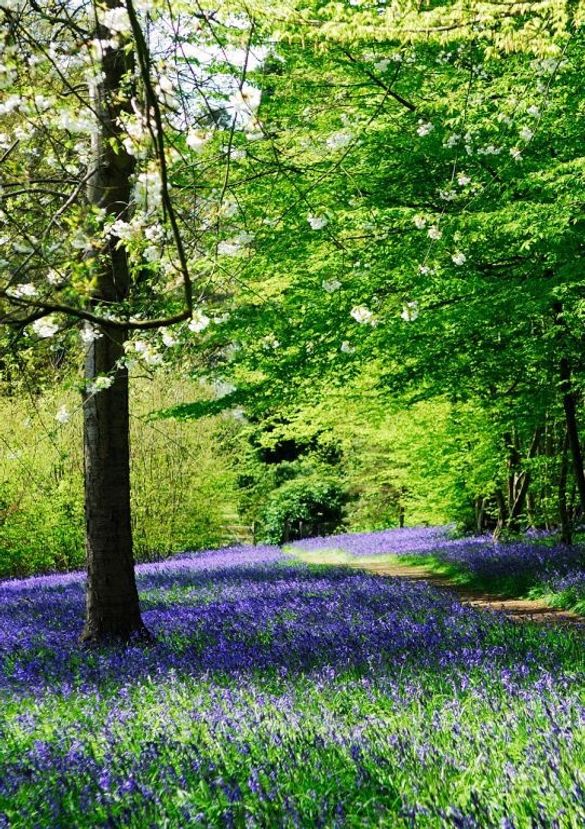
Kent is blessed with fine showings of bluebells each year and nowhere are they better seen than in the gardens of Hole Park, set between Cranbrook and Tenterden, near the pretty Wealden village of Rolvenden. The bluebells here are renowned for their spectacular display: a woodland walk takes visitors through the heart of a dedicated bluebell wood where spring blossom and catkins crown the native tree species which seem to float on a haze of violet blue.
In fact, so special are the bluebells that Hole Park is especially extending its normal opening times to allow visitors to appreciate their full glory. Normally Hole Park opens for a bluebell weekend, but this year, due to its popularity, it will open every day during one fortnight for a Bluebell Spectacular, from Sunday 22 April to Monday 7 May. As well as the bluebell woods, the rest of the gardens, some 15 acres in all, will be blossoming in late spring finery as rhododendrons and azaleas take over from tulips for a showy display of colour. The gardens are normally open Wednesday and Thursday afternoons between April and October and Sundays from April to July.
During the Bluebell Spectacular, there will also be other events at Hole Park. On Sunday 29 April, the Kent group of the National Council for the Conservation of Plants and Gardens (NCCPG) holds a plant fair, with around 15 specialist nurseries setting up for business in the stable yard. On Sunday 6 May, the Rolls-Royce Enthusiasts� Club hold their rally at Hole Park � a chance to see fine examples of Rolls-Royces and Bentleys in an appropriately stately setting.
For more information visit www.holepark.com or telephone 01580 241 344/241386.
-Ends-
Notes to Editors
1. Hole Park is situated 4 miles west of Tenterden on the B2086 between Rolvenden and Cranbrook. 2. Hole Park is open to the public every Wednesday and Thursday from 5 April until 31 October between 2pm and 6pm, and on Sundays and Bank Holiday Mondays from 1 April to 1 July between 2pm and 6pm. Admission is �4 for adults and 50p for children. 3. Self service afternoon teas with delicious homemade cakes are available at the gardens throughout the season, and a plant stall operates on Sundays and Bank Holiday Mondays. 4. A family owned estate, Hole Park has been owned by the Barham family for the past four generations. The gardens manage to combine formalised gardens with natural woodland. They cover some 15 acres and were developed, laid out and planted by Colonel Barham, the great-grandfather of the present owner, in the years between the two World Wars.
Hole Park is now owned and managed by Edward Barham, and much of what can be seen today is due to the contribution made by Edward�s father, David Barham, who has looked after the estate for the past 45 years and still takes an active interest in its future today. The garden is renowned for beautifully clipped topiary and great yew hedges which provide shelter for the lawns and splendid borders. The walled garden contains mixed borders, pools and a water garden. Marvellous climbing plants also provide a fine display here. The natural garden has bulbs, azaleas, rhododendrons and flowering shrubs. There is a woodland bluebell walk and, in the autumn, the foliage colour is spectacular. Hole Park has many fine trees and the garden is surrounded by superb parkland with wonderful views across the Kentish Weald.
Formal gardens surround the house. Walls and yew hedges, which are a particular feature of Hole Park, shelter broad expanses of lawns. Clipped entirely by hand, it is claimed that nowhere in the county can yews be seen trimmed to greater precision. Fountains and a swimming pool, the egg pond, the walled rose garden, herbaceous borders and wrought iron gates all contribute to make a series of gardens within a garden, united by the lawns, while outwards there are lovely views of the Weald over the surrounding 250 acres of finely timbered parkland.
At the rear of the house, beyond a beech hedge measuring six feet thick and 12 feet high, lies the Policy, massed with daffodils in April with its heathers, flowering trees and shrubs, banks of rhododendrons and its azaleas. Amongst the trees can be seen collections of birch, juniper, cypresses and fine oaks. Rhododendrons, camellias, magnolias and primulas are all here in abundance and further plantings are now being made to adjoining woodlands.
For more media information and photographs, or to arrange a guided tour, contact Caroline Edmunds at Pennington PR Tel: 01892 616647 Email caroline@penningtonpr.com