 31 Aug 2016

Should travelers come to Munich at least once in their lives? Absolutely, because the former residence of royals and metropolis of culture is conveniently located in the heart of Europe in a charming landscape at the foot of the Alps, and
because it offers everything that discerning city travelers could expect from a top urban destination: Top performance and top offers in the fields of art and culture, innovation and creativity always linked with a genuine experience, authenticity and inclusion.
Here is a list of ten reasons why a visit to Munich is a must at least once in every traveler's life:
1. Friendliness and Open-Mindedness
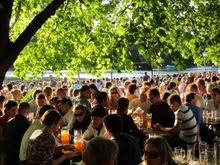
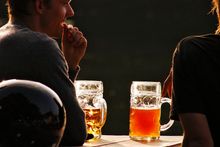
Munich locals welcome their visitors all year round and are happy to invite them to share in the benefits of their beautiful city. Munich boasts a tradition of a sense of community which excludes no one but unites people of all types and origins at a single table. This is particularly obvious during a gregarious get-together in a beer garden or while celebrating at the Oktoberfest. Munich's invitation to its guests to become involved in the life of the city is unique for a European metropolis.
2. Excellent Cultural Offer
Munich can supply culturally-minded visitors with a lavish offer. One of the most renowned opera houses in the world, top-class orchestras and a young, vivacious music scene await music aficionados. Just looking at the main exhibits in the collections at the Kunstareal (art quarter) of Munich's Maxvorstadt, the range spans several millennia: Starting in the Egyptian Museum with the double statue of King Nyuserre, the Barberini Faun in the Glyptothek, Dürer's “Four Apostles” in the Alte Pinakothek, Van Gogh's Sunflowers in the Neue Pinakothek, the Blue Horse in Lenbachhaus, Beuys' works in the Pinakothek der Moderne and in Lenbachhaus right up to Tatra 87, the predecessor of the Volkswagen beetle in the Neue Sammlung. In May 2015 another highlight was opened in the Kunstareal: the NS Documentation Center, a place of learning and remembrance about the dark history of National Socialism.
3. Excellent Infrastructure, Easy and Quick Access to all Sights
The Bavarian Metropolis with its 1.5 million inhabitants is Germany's third largest city. Munich lies virtually at the center of Europe and is easy to reach by high-speed train, motorway, or through a large award-winning international airport. All major sights are within walking distance from each other. Munich excels in all those things that make a place truly livable. It is clean, safe and service is friendly. The public transport system is exceptionally well-designed and efficient. As for the Alps, they are just a stone's throw away and attract day-trippers all year round.
4. Authentic Enjoyment
It is perhaps a sign of the importance that locals place on food and drink that they even define their geographical location by it. If you're reading this, congratulations! You've already made the first step to crossing the “Weisswurst Equator”. This imaginary border (the exact location of which depends on who you're talking to) separates Bavaria's culinary and cultural heartland from the rest of Germany. The delicious, plump white veal and herb sausages for which it is named are the archetypal Munich delicacy, and part of the unofficial “holy trinity” of the Bavarian capital, along with beer and “Gemütlichkeit” - that untranslatable notion of everything that is easy-going and laid-back in the Bavarian lifestyle.
5. Festivals and Events (Partying like the Natives)
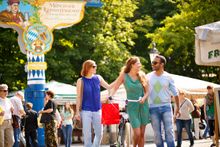
Munich's customs, its city festivals and markets have a very special flair. In the course of the year they testify to urban history and the traditions of craftsmen and The Maidult in the Munich Au quarter marks the beginning of the jumble market (Dult) season featuring three events. The Dult booths make the hearts of collectors race: On offer are antiquities, curiosities, dishware, books, art objects, clothing and bric-a-brac. The absolute highlight of the festival year is Oktoberfest, the greatest and best-known folk festival in the world. The festival year concludes with the Munich
Christmas Market at Marienplatz and numerous smaller Christmas markets in the city quarters.
6. Shopping
Munich's City – The heART of Shopping!
The Munich city center offers something for every visitor and any taste. With more than 1,000 stores extending over approx. 450,000 m² of sales floor, downtown Munich plays in the European “Champions League” of shopping destinations. From privately run stores in a charming quarter of the old town to metropolitan department stores, from former purveyors to the Bavarian court – which only exist in Munich – to international top labels and trendy newcomers, guests will find in walking distance whatever their hearts desire in what literally is Germany's greatest shopping center.
7. Sports
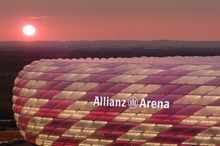
In addition to the rich culture of the city, Munich residents love sports. With great pride the Bavarian capital city presents itself as home of the record-holding soccer champion FC Bayern München. Munich boasts one of the most modern and unusual stadiums in Europe, the Allianz Arena. During the 2006 FIFA World Cup the Allianz Arena hosted the opening match and served as venue for six sold-out games with 396,000 visitors from all over the world. During this thrilling event Munich and its exceptional soccer stadium were the focus of international attention. The outer surface
and roofing of the stadium ring are constructed of thousands of diamond-shaped, airfilled cushions which, during home games, are illuminated in white, blue or red, the colors of Munich's two major soccer clubs FC Bayern and TSV 1860.
8. Royal Heritage
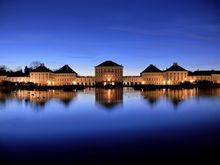
Munich, the city of cultural enjoyment and enjoyable culture, is also the city of palaces and boasts an imposing royal heritage. Almost 700 years of holding court have put a mark on Munich. The city palace, the Residenz, and Nymphenburg palace still testify today to the fact that for centuries the city was the center of power and focus of life for
the Bavarian rulers. Guests from all over the world admire the generous townscape of the former residence of royals. From Munich the dukes, electors and kings of the Wittelsbach dynasty controlled Bavaria's destiny from the 13th to the beginning of the 20th century. They left outstanding masterworks of architecture, such as the splendid buildings, boulevards and palaces of Munich. To the present day the cityscape bears the special mark of King Ludwig I's passion for architecture. While his famous grandson Ludwig II was primarily dedicated to building his dream castles Neuschwanstein and Linderhof in the surrounding countryside, King Ludwig I (1786 - 1868) was responsible for famous buildings, such as the Glyptothek, the Alte and Neue Pinakothek, the Residenz palace, the Field Marshal's Hall, the Triumphal Arch, and others, thus turning Munich into a major cultural hub in Europe. The Wittelsbach dynasty, however, not only shaped the architecture of the city but also placed the foundation for the unique interplay of music, theater and museums in the city.
9. The Top Ten Sights
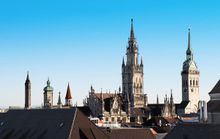
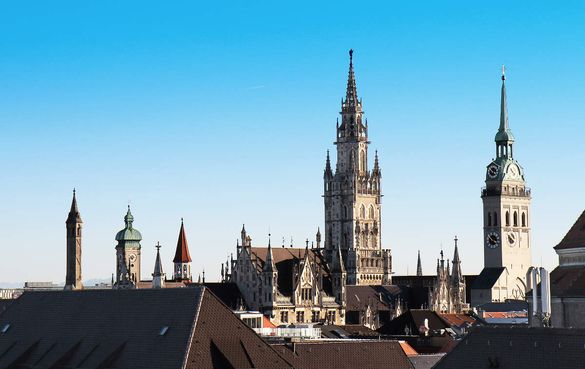
• Marienplatz and Frauenkirche (Church of our Lady), the center as well as the heart of the city. The bulbous domes of the Church of our Lady are Munich's landmark
• Hofbräuhaus, the world renowned and frequently imitated traditional inn in the old city of Munich
• Viktualienmarkt has developed from a farmers' market into a popular shopping place for gourmets without losing any of its traditional charm
• The Residenz, greatest city palace in Germany, until 1918 residence and seat of government of the Wittelsbach rulers
• The Bavarian State Opera looks back on more than 350 years of opera tradition in Munich
• English Garden with Eisbachwelle and Beer Garden at the Chinese Tower, one of the greatest central city parks in the world, with biking and walking paths,beer gardens and a standing wave for surfers
• Kunstareal (art quarter) with Lenbachhaus, Pinakotheken and Brandhorst, the close proximity and variety of holdings of the museums and exhibitions in the Kunstareal are unique
• Olympic Park, Munich's modern landmark and venue of the 1972 Summer Olympics
• Nymphenburg Palace, summer residence of the Wittelsbach rulers with a great park, small park palaces and Marstallmuseum of coaches
• BMW Welt, event and delivery center of the car manufacturer
10. Attractive Surrounding Area
The city owes its high leisure-time and recreational value to the numerous green oases, such as the English Garden, the floodplains which form the banks of the Isar River within the city limits as well as to the palace parks in the nearby surrounding area and to its proximity to the Alps and Upper Bavarian lakes, such as Starnbergersee, Ammersee, Chiemsee and Königssee, just to name a few. Germany's highest mountain, the Zugspitze, Berchtesgaden (Documentation Obersalzberg “Eagles Nest”), the Wieskirche – a UNESCO world heritage site – and the castles of
Neuschwanstein and Linderhof can be reached in less than two hours from Munich.
Contact - München Tourismus:
tourismus.sales@muenchen.de
www.simply-munich.com
Printable photographs to illustrate your reporting on Munich can be downloaded at
www.muenchen.de/fotoservice