 08 Dec 2015

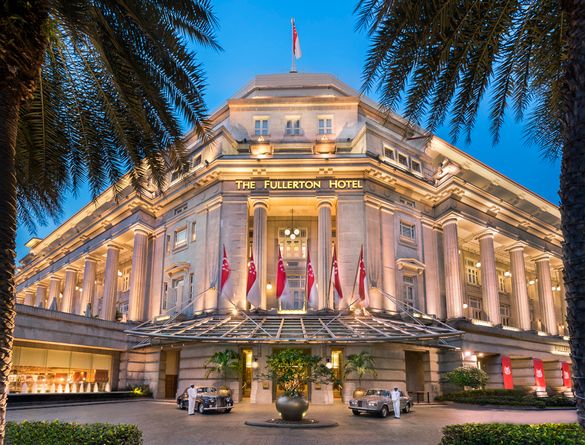
Singapore, 7 December 2015 – Today, the National Heritage Board (NHB) gazettes the former Fullerton Building (today known as The Fullerton Hotel) as Singapore's 71st National Monument, concluding a series of gazettes in celebration of Singapore's Golden Jubilee. This grand Neoclassical building situated at the mouth of the Singapore River was once Singapore's General Post Office, and housed several government departments, where some of Singapore's pioneer leaders began their careers. It has also been witness to several historic events during the Japanese Occupation and the post-war period.
2 Ms Jean Wee, Director of the Preservation of Sites and Monuments (PSM) division, NHB, says, “The former Fullerton Building is one of the most iconic colonial buildings in Singapore, standing at the mouth of the Singapore River and defining the Singapore skyline since the 1920s. Beyond its grand façade and beautiful architecture, it is filled with many priceless memories of our nation's growth throughout the years – from the former General Post Office to government offices, it has served multiple functions that mark the tumultuous times we have lived through, and the steps taken to build our country. As we celebrate Singapore's Golden Jubilee, we reflect on the trail history has left on our landscape, and, in turn, accord those that are nationally significant the highest form of preservation and recognition. 2015's gazettes of the former Fullerton Building, together with Jurong Town Hall and Istana Kampong Gelam as National Monuments, collectively add more architectural diversity, and, more importantly, many more layers of stories to our cultural legacy for future generations.”
Origins of the Former Fullerton Building
3 After its founding in 1819, Singapore had its first “post office” located in a room shared with the Master Attendant's Marine Office and the clerk to the Registrar of Import and Export. As Singapore's trade industry grew, the volume of mail increased. The post office, which had moved to its own building near the Town Hall (today Victoria Theatre) in 1854, became a separate department from the Marine Office in 1858. In the 1870s, it moved again, across the Singapore River, and settled on the site of the former Fort Fullerton (demolished in 1865).
4 Discussions for a new post office building took place before the First World War (1914–1918), and plans were set in motion after the war. In May 1920, Major Percy Keys, a government architect from the Public Works Department, was appointed as the architect for this project together with his assistant, Frank Dowdeswell. Construction of the new post office building took place between 1924 and 1928, and was declared open by Sir Hugh Clifford (Governor of the Straits Settlements, 1927–1929) on 27 June 1928. On that day, the governor named it “Fullerton Building”, in remembrance of Sir Robert Fullerton, the first Governor of the Straits Settlements (1826–1830), and whom the former Fort Fullerton was named after.
Architectural Merits
5 The former Fullerton Building's Neoclassical façade and prominent location reflected Singapore's role as the prime postal unit in British Malaya at that time. Made of reinforced concrete, the building possesses five frontages with a colossal two-storey Doric colonnade, creating a visually impressive façade. The façade encompasses ornate classical decorations created by Swiss sculptor Rudolf Wening and Italian sculptor Cavaliere Rudolfo Nolli, who was also responsible for the sculptural works at the former Supreme Court and College of Medicine Building.
6 The former Fullerton Building was designed to be multi-purpose, housing the General Post Office, Singapore Club, Chamber of Commerce, Marine Office and other government departments. At the time of its completion, the building also boasted modern facilities – 14 lifts in the building and automated mail-sorting equipment for the post office. The post office occupied the basement and the first two floors which served as sorting rooms, postal halls and offices. The upper floors were reserved for the Singapore Club's facilities which included a vaulted coffered ceiling, reputed to be the only one of its kind in Singapore. This unique feature can still be seen today.
Second World War and Independence
7 Throughout the history of Singapore, several noteworthy historical events took place in the former Fullerton Building. During the Second World War, the former Fullerton Building served as a hospital, providing makeshift operation rooms for wounded British soldiers in the days leading up to Singapore's fall. The British surrendered Singapore to the Japanese on 15 February 1942, after Lieutenant Arthur Percival (Lieutenant-General and General-Officer-Commanding Malaya) had informed Sir Shenton Thomas (Governor of the Straits Settlements) of the British military's decision to surrender, in the Singapore Club. Shortly after Singapore's fall, the Chinese community presented a $50-million cheque to Lieutenant-General Yamashita in the Singapore Club. This $50 million was an “atonement fee” which the Japanese demanded from the Chinese in Singapore and Malaya.
8 The former Fullerton Building was occupied by the Japanese military administration department during the war years, and reverted to the British government and the Singapore Club after the war. In the early years of Singapore's independence, some of Singapore's leaders began their careers in the government departments housed in this building, including the Inland Revenue Department (today Inland Revenue Authority of Singapore), Marine Department, Imports and Exports Department and the Ministry of Finance. Among the leaders were former Deputy Prime Minister Dr Goh Keng Swee who started out as the Minister of Finance in 1959; former President Mr S.R. Nathan who worked as a Seaman's Welfare Officer in the Ministry of Labour and later in the Labour Research Unit in the 1950s and 1960s; and former Prime Minister Mr Goh Chok Tong who worked in the Economic Planning Unit in the 1960s.
9 From the 1950s to the 1980s, the former Fullerton Building witnessed several political rallies that were held at the adjoining Fullerton Square. Huge crowds attended the rallies, including many which were delivered by our Founding Prime Minister Mr Lee Kuan Yew.
Preservation and Present Use
10 The Government announced in 1996 plans to turn the former Fullerton Building into a hotel. The Urban Redevelopment Authority (URA) gazetted it as a conserved building on 20 September 1996, and Sino Land – the Hong Kong arm of Far East Organisation – which had successfully bid for the site, helmed the building's transformation into a hotel between 1997 and 2000. Then-Prime Minister Mr Goh Chok Tong declared the building open as The Fullerton Hotel on 1 January 2001 at midnight.
11 Mr Giovanni Viterale, General Manager, The Fullerton Heritage, says, “This is a historic moment, and we are privileged and honoured that the Fullerton Building has been gazetted as Singapore's 71st national monument. Beyond its grand façade and beautiful architecture, the Fullerton Building is filled with countless and poignant memories of Singapore's growth through the colonial and pre-independence era till present day. It is a privilege to be operating in a building and precinct immersed so relevantly in Singapore's history and culture. Today, we mark a new chapter in the building's future. As we reflect on the legacy of the Fullerton Building, we also look forward to the future of providing new memories and experiences for our local and international visitors.”
12 The gazette of the former Fullerton Building joins the Jurong Town Hall (2 June 2015) and the Istana Kampong Gelam (6 August 2015) as NHB's list of gazetted National Monuments in 2015. Together, these three gazettes commemorate some of Singapore's key milestones as the country celebrates its Golden Jubilee. The Istana Kampong Gelam, formerly the seat of the Johor Sultanate, is a reminder of Singapore's historical links with the Malay world and Singapore's re-emergence as a flourishing port in the 19th century. Jurong Town Hall is an iconic testimony to Singapore's industrialisation drive in its early years of independence and Jurong's transformation from a swamp land into Singapore's first industrial town. The former Fullerton Building, a landmark which represents Singapore's status as the prime postal unit in British Malaya, has also witnessed many historic events as a landmark that has had prominence throughout the colonial, war, and post-war periods.
13 When a building is gazetted under the Preservation of Monuments Act, it is preserved with the highest form of recognition for its national significance. The evaluation of potential gazettes is based on a building or site's historical, architectural and social importance in Singapore's built heritage landscape.
14 As the most protected historic structures in Singapore, each National Monument has its own tailored set of Preservation Guidelines to guide monument owners on the preservation requirements. NHB's PSM division also conducts regular site inspections and works closely with the monument owners on restoring and maintaining the architectural features and intrinsic historical value of the National Monuments.
15 Please refer to Annex A for a complete list of Singapore's 71 National Monuments.
Please go to this link to download images and attachments:
https://app.box.com/s/f58guwqhingzfi09559lnbfnhp4ik0ri
– END –
For media enquiries, please contact:
Daphne Hi
Consultant
MSLGROUP in Singapore (Public Relations Agency Partner of The Fullerton Hotel Singapore)
Office: +65 6327 0263
H/P: +65 9817 3561
Email: daphne.hi@mslgroup.com
About National Heritage Board
The National Heritage Board (NHB) was formed on 1 August 1993. As the custodian of Singapore's heritage, NHB is responsible for telling the Singapore story, sharing the Singaporean experience and imparting our Singapore spirit. NHB's mission is to preserve and celebrate the shared heritage of our diverse communities, for the purpose of education, nation-building and cultural understanding. It manages the national museums and heritage institutions, and sets policies relating to heritage sites, monuments and the national collection. Through the national collection, NHB curates heritage programmes and presents exhibitions to connect the past, present and future generations of Singaporeans. NHB is now a statutory board under the Ministry of Culture, Community and Youth. Please visit www.nhb.gov.sg for more information.
About Preservation of Sites & Monuments Division
The Preservation of Sites and Monuments (PSM) division, under the National Heritage Board (NHB) and with advice from the PSM Advisory Board, guides the preservation of buildings, monuments and sites, which commemorates Singapore's heritage as defined under the Preservation of Monuments Act. The PSM division also leads NHB's joint efforts with National Parks Board to list the Singapore Botanic Gardens as Singapore's first UNESCO world heritage site. It also oversees the 100 heritage sites that have been marked by NHB.
PSM division's administration of the preservation gazette is complemented by its outreach objectives to promote a renewed appreciation and understanding of national monuments and their history, and to encourage people to relate to them as sites of memory that convey a sense of place, identity and belonging. To date, 71 structures have been gazetted as National Monuments. For more information on PSM division, please visit www.nhb.gov.sg/psm.
Annex A List of Singapore's National Monuments
|
Name of Building |
Date of Gazette |
|
|
1 |
Former Thong Chai Medical Institution (1892) |
28 June 1973 |
|
2 |
Armenian Church of St. Gregory the Illuminator (1835–36) |
28 June 1973 |
|
3 |
St. Andrew's Cathedral (Rebuilt 1856–64) |
28 June 1973 |
|
4 |
Former Telok Ayer Market (now Lau Pa Sat) (1890–94) |
28 June 1973 |
|
5 |
Thian Hock Keng (1839–42) |
28 June 1973 |
|
6 |
Sri Mariamman Temple (Rebuilt 1843) |
28 June 1973 |
|
7 |
Hajjah Fatimah Mosque (1845–46) |
28 June 1973 |
|
8 |
Cathedral of the Good Shepherd (1843–47) |
28 June 1973 |
|
9 |
Nagore Dargah (now Nagore Dargah Indian Muslim Heritage Centre) (1828–30) |
19 November 1974 |
|
10 |
Al-Abrar Mosque (1850–55) |
19 November 1974 |
|
11 |
House of Tan Yeok Nee (The Former Salvation Army HQ) (1885) |
19 November 1974 |
|
12 |
Tan Si Chong Su (1876–78) |
19 November 1974 |
|
13 |
Jamae Mosque (Rebuilt 1830–35) |
19 November 1974 |
|
14 |
Sultan Mosque (Rebuilt 1924–28) |
8 March 1975 |
|
15 |
St. George's Church (1910–13) |
10 November 1978 |
|
16 |
Hong San See (1908–12) |
10 November 1978 |
|
17 |
Sri Srinivasa Perumal Temple (Rebuilt 1961–66) |
10 November 1978 |
|
18 |
Abdul Gafoor Mosque (1907–27) |
5 July 1979 |
|
19 |
Siong Lim Temple (now Lian Shan Shuang Lin Monastery) (1902–08) |
14 October 1980 |
|
20 |
Raffles Hotel (1887–1907) |
4 March 1987 (Re-gazetted on 3 June 1995) |
|
21 |
Telok Ayer Chinese Methodist Church (1924–25) |
23 March 1989 |
|
22 |
Goodwood Park Hotel (Tower Block) (1900) |
23 March 1989 |
|
23 |
Former Convent of Holy Infant Jesus Chapel (now CHIJMES Hall) (1903) and Caldwell House (1840–41) |
26 October 1990 |
|
24 |
Istana and Sri Temasek (1867–69) |
14 February 1992 (Re-gazetted on 1 October 1993) |
|
25 |
Former City Hall (1926–29) |
14 February 1992 |
|
26 |
Victoria Theatre (1856–62) and Victoria Concert Hall (1902–05) |
14 February 1992 |
|
27 |
Former Parliament House and Annex Building (1826–27) |
14 February 1992, 26 June 1992 |
|
28 |
Former Supreme Court (1937–39) |
14 February 1992 |
|
29 |
Former Empress Place Building (now Asian Civilisations Museum) (1864–67) |
14 February 1992 |
|
30 |
National Museum (now National Museum of Singapore) (1884–87) |
14 February 1992 |
|
31 |
Former St Joseph's Institution – Main Building (1855–67), Chapel (1911–12) and Classroom (1906–07) (now Singapore Art Museum) |
14 February 1992 26 June 1992 |
|
32 |
Former Attorney-General's Chambers (now Parliament House Block C) (Rebuilt c.a. 1906) |
14 February 1992 |
|
33 |
Former Sun Yat Sen Villa (now Sun Yat Sen Nanyang Memorial Hall) (1900–02) |
28 October 1994 |
|
34 |
Yueh Hai Ching Temple (1852–1855) |
28 June 1996 |
|
35 |
Maghain Aboth Synagogue (1878) |
27 February 1998 |
|
36 |
Former Ministry of Labour Building (now Family Justice Courts) (1928) |
27 February 1998 |
|
37 |
Former Tao Nan School (now The Peranakan Museum) (1910–12) |
27 February 1998 |
|
38 |
Chesed-El Synagogue (1905) |
18 December 1998 |
|
39 |
Former Hill Street Police Station (1934–36) |
18 December 1998 |
|
40 |
Ying Fo Fui Kun (1881–82) |
18 December 1998 |
|
41 |
Central Fire Station (1908–09) |
18 December 1998 |
|
42 |
Former Nanyang University Library & Administration Building, The Former Nanyang University Memorial and The Former Nanyang University Arch (1954–56) |
18 December 1998 |
|
43 |
The Chinese High School Clock Tower Building (1925) |
19 March 1999 |
|
44 |
Prinsep Street Presbyterian Church (1930–31) |
12 January 2000 |
|
45 |
Former Admiralty House (1939) |
2 December 2002 |
|
46 |
Tan Teck Guan Building (1911) |
2 December 2002 |
|
47 |
College of Medicine Building (1926) |
2 December 2002 |
|
48 |
Former Cathay Building (now The Cathay) (1939) |
10 February 2003 |
|
49 |
Church of St. Peter and St. Paul (1869–70) |
10 February 2003 |
|
50 |
MacDonald House (1949) |
10 February 2003 |
|
51 |
RC Church of St. Joseph (1906–12) |
14 January 2005 |
|
52 |
Church of Our Lady of Lourdes (1888) |
14 January 2005 |
|
53 |
Church of Nativity of the Blessed Virgin Mary (1901) |
14 January 2005 |
|
54 |
Tou Mu Kung Temple (1919–21) |
14 January 2005 |
|
55 |
Former Ford Factory (now Memories at Old Ford Factory) (1941) |
15 February 2006 |
|
56 |
Former Raffles College (now NUS Campus at Bukit Timah) (1927–53) |
11 November 2009 |
|
57 |
Church of St. Teresa (1926–28) |
11 November 2009 |
|
58 |
Former Keng Teck Whay building (now Singapore Yu Huang Gong) (est 1831) |
11 November 2009 |
|
59 |
Command House (1939) |
11 November 2009 |
|
60 |
Former St. James Power Station (1926) |
11 November 2009 |
|
61 |
Bowyer Block (1926) |
11 November 2009 |
|
62 |
Former Singapore Conference Hall and Trade Union House (now Singapore Conference Hall) (1962–65) |
28 December 2010 |
|
63 |
Esplanade Park Memorials: Lim Bo Seng Memorial (1953-54), Tan Kim Seng Fountain (1882) and Cenotaph (1920–22) |
28 December 2010 |
|
64 |
Former Tanjong Pagar Railway Station (1929–31) |
8 April 2011 |
|
65 |
Civilian War Memorial (1966–67) |
15 August 2013 |
|
66 |
Chung Cheng High School (Main) Administration Building and Entrance Arch (1965–68) |
10 July 2014 |
|
67 |
Sri Thendayuthapani Temple (rebuilt 1980–83) |
20 October 2014 |
|
68 |
Alkaff Upper Serangoon Mosque (1931–32) |
19 December 2014 |
|
69 |
Jurong Town Hall (1971–74) |
2 June 2015 |
|
70 |
Istana Kampong Gelam (circa 1839–1843) |
6 August 2015 |
|
71 |
Former Fullerton Building (1924–28) |
7 December 2015 |
![[Media Factsheet] Gazette of former Fullerton Building.pdf](https://cdn.travmedia.com/allsites/pdf_thumbnail.jpg)
