 14 Dec 2021

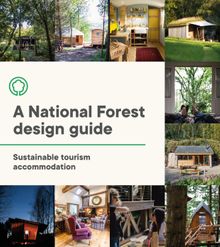
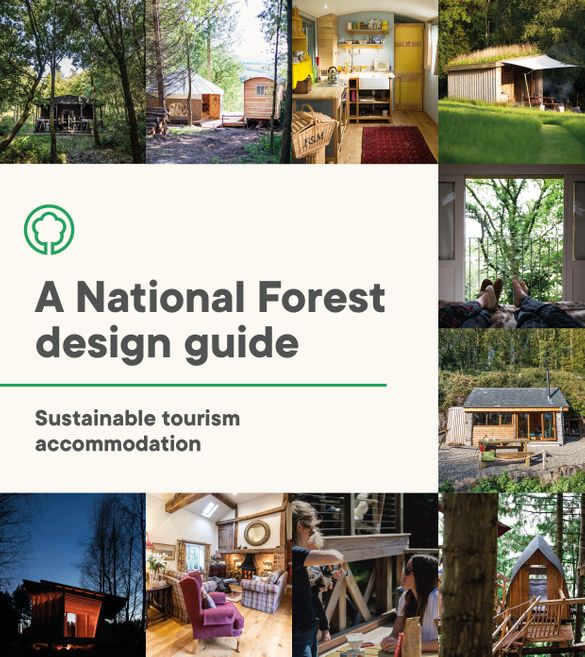
The National Forest Company (NFC) has launched a new guide to help landowners, developers and architects deliver environmentally friendly and sustainably designed tourism accommodation projects in the increasingly popular National Forest.
To accelerate the drive for sustainable tourism accommodation, the NFC has also launched a pilot programme of advice and support for landowners and businesses.
Produced in collaboration with eco-conscious tourism accommodation specialist Edward Busby, co-founder and partner of Crown and Canopy, and London's Arboreal Architects, the National Forest Design Guide for Sustainable Tourism Accommodation is available free of charge, online and in print. It complements the National Forest's existing tourism growth plan to develop the Forest as an exemplar sustainable tourism destination.
The NFC says that landowners and those looking for sustainable tourism accommodation development opportunities could find the non-designated landscape of the National Forest an attractive place to develop their plans, and the new guide aims to help take those ideas forward. The Forest's central location, which covers 200 square miles across the heart of England, means there is significant potential, providing rural businesses with excellent opportunities to attract new markets and convert day visits into overnight stays, as well as extending the season. COP 26 has highlighted the urgent need for lifestyle change in the face of the climate crisis. This, coupled with the growing trend in more environmentally friendly holidays, highlights a real business opportunity.
The guide addresses concerns that sustainability can seem complicated and too difficult or expensive to implement, setting out seven sustainable design principles as a menu of options.
These principles encourage design in harmony with the Forest character, health and wellbeing, support for the local economy and communities, ethical and sustainable building, promotion of low carbon travel, integration with nature and water management.
Following the advice should help protect businesses from the impact of climate change, future proof the development ahead of new legislation, increase the likelihood of securing planning permission, attract new and diverse markets and deliver an improved return on investment in the long term.
The NFC says it is creating a visitor economy that grows and sustains local employment, uses local and sustainable products and services, and provides facilities to enhance the wellbeing of communities and visitors.
NFC chief executive John Everitt said: “The aspiration is for the National Forest to be a landmark sustainable tourism destination, responsive to the urgency of climate change. Trees are a vital part of our response to the climate crisis, but we need to do more. We need to inspire people to embrace lifestyle choices that improve their carbon footprint, and we have produced this practical guide and associated programme of support to make it easier for landowners and developers to do this.”
Help and support available
To complement the design guide, the NFC has devised a new programme of support to help realise sustainable tourism accommodation plans in a way that is both good for the climate, people and wildlife, as well as delivering a strong business proposition.
It will provide flexible and tailored advice and support via email, phone or through a site visit by one of the NFC's specialist advisors appointed to help develop ideas in line with the principles outlined in the design guide. Grants will also be available to support projects that are ready to undertake full feasibility and business case development.
To help the NFC tailor its support, interested landowners and businesses are asked to complete a short form in order to gather the relevant information needed to get the best out of a site advisory visit. Forms can be submitted at any time, but the initial priority will be given to those submitted by 31 January 2022.
Copies of the design guide, other resources, the form for completion and an introductory video are available to download at nationalforest.org/tourism
Interested landowners or businesses can discuss their initial ideas in confidence with Richard Drakeley, NFC tourism development manager, by emailing rdrakeley@nationalforest.org
Ends
Media contact:
Carol Rowntree Jones, National Forest Company, 07870 568628 email: crowntreejones@nationalforest.org
For more information on the National Forest see nationalforest.org
Notes to editors
- The National Forest covers 200 square miles of the counties of Derbyshire, Leicestershire and Staffordshire. Its creation began in the early 1990s, a radical vision to bring the benefits of trees, woodland and multi-use forestry to lowland England, where thousands of people live and work.
- Latest figures (pre-Covid-19), show that annual visitor spend in the National Forest has increased by 36% since 2003, from £345m to £472m, and there has been a 35% increase in employment supported by tourism since 2003.
- The National Forest was the first broadleaf forest to be created at scale in England for 1,000 years and is now seen as one of the boldest environmentally led regeneration initiatives in the country. It has transformed a post-industrial Midlands landscape – scarred by coal mining and heavy industry - from black to green.
- Year by year, the National Forest has been steadily turning what was once one of the least wooded areas of England into a multi-purpose, sustainable forest. Nine million trees have been planted so far. Forest cover has increased from 6% to 22%, approaching double the national average for woodland cover. The aim is to reach around a third forest cover.
- Trees have been the catalyst for change and transformation. But today this is not enough. The planet needs more trees, but it also needs innovative solutions that benefit society, the economy and the natural environment equally. The National Forest is a positive response to the climate crisis and is putting in place the building blocks to deliver mitigation and adaptation to climate change, through its partnerships and its work to create wildlife habitats, reduce flooding, provide quality of life, clean air and store carbon, create space for outdoor education, for health and wellbeing, and for Forest-related businesses to thrive.
- The National Forest Company (charity no: 1166563) leads the creation of the National Forest, working in partnership with landowners, local authorities, businesses and its communities. It has strong support from government, politicians and the public, and continues to be supported by the Department for Environment, Food and Rural Affairs.
nationalforest.org