 11 Jun 2013

contact: Kathy Catron, 386-451-4213 KCatron@FloridasHistoricCoast.com
Golfers Paradise
A destination on every golfer's bucket list, Florida's Historic Coast has more than a dozen golf courses totaling about 95,000 yards. The most famous course, THE PLAYERS Stadium Course with its 17th Island Green at TPC Sawgrass in Ponte Vedra Beach, is where THE PLAYERS Championship takes place in May.
Another popular “stay and play” spot is at the Ponte Vedra Inn and Club, one of Florida's most historic seaside hotels and home of the Ocean Course and Lagoon Course.
At the World Golf Hall of Fame in St. Augustine, vacationers live out their golf fantasies on two great courses – the Slammer and Squire inspired by Gene Sarazen and Sam Snead, and the King and Bear, jointly designed by golfing greats Jack Nicklaus and Arnold Palmer. The World Golf Hall of Fame is the only place in the world where golf's greatest players are enshrined along with exhibits tracing the evolution of the game and players' personal memorabilia.
Thrill-Seekers
Adventure travelers will have plenty of stories to tell after a visit to Florida's Historic Coast. Put these activities on your “must conquer” list.
Hover over alligators and crocodiles on the challenging Crocodile Crossing zip line course at the St. Augustine Alligator Farm and Zoological Park.
Swim with dolphins at Marineland Dolphin Adventure.
Kayak the ocean and rivers through “real Florida” with St. Augustine EcoTours or Ripple Effect EcoTours.
Lock, load and fire a 17th century musket at The Colonial Quarter.
Take a sip from the Fountain of Youth.
Reel in the big one on one of several deep sea charter fishing boats .
Climb 219 stairs to the top of the St. Augustine Lighthouse.
Check off some rare and hard to spot avian species at one of many nature preserves and coastal parks.
Romance
Approximately 100 weddings take place each month on Florida's Historic Coast. Popular wedding locations include TPC Sawgrass, Casa Monica Hotel, the Lightner Museum, the Pena-Peck House, Hammock Beach Resort, Marineland Dolphin Adventure, Renaissance World Golf Village Resort, Ponte Vedra Inn & Club or any of the quaint Bed & Breakfast Inns.
You don't have to be getting married or renewing vows to have a romantic visit. Here are some tips sure to touch the heart.
The area's 42 miles of beaches provide the perfect, peaceful place to watch the sun rise.
See the sun rise from your own private oceanfront balcony at the luxurious Ponte Vedra Inn & Club.
The coquina sand of Ponte Vedra Beach makes for a stunning sunset stroll.
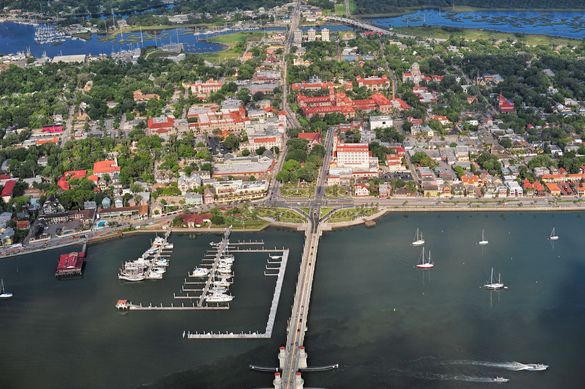
A walk along the Bayfront in St. Augustine at dusk is the perfect way to end the day.
Take in the panoramic view from the top of the St. Augustine Lighthouse.
The area's temperate climate allows for outdoor dining all year round.
Enjoy a private carriage ride through the historic streets of St. Augustine.
Romantic dining along Florida's Historic Coast ranges from classic fine dining, casual waterfront eateries with old Florida settings, leisurely meals at sidewalk cafés and eclectic bistros. Many of the area's restaurants feature unique culturally influenced selections, a bounty of fresh caught seafood and locally grown produce.
Dog Friendly
St. Augustine, Ponte Vedra and The Beaches has approximately 50 pet friendly accommodations, ranging in price point and type of accommodation, including the Bayfront Marin House Bed & Breakfast www.bayfrontmarinhouse.com , which was recently named one of the Top 10 places to spend the holidays by BedandBreakfast.com. You can see a complete list of pet friendly accommodations by selecting the pet friendly amenity in your room search at http://www.floridashistoriccoast.com/listings/hotels
Leashed dogs are welcome on designated areas of the beach. St. Augustine's Fountain of Youth is pet friendly http://www.fountainofyouthflorida.com/index.php and St. Augustine's historic district, including St. George Street, welcomes leashed pets.
In addition, there are more than 20 dog-friendly restaurants and cafes with outdoor dining options.
Culinary Paradise
Fresh Seafood, year-roundfarm-fresh produce, spicy favorites featuring the destination's signature datil peppers,
Spanish tapas and the very best in New World cuisine are just a few of the culinary delights enjoyed by visitors to
Florida's Historic Coast. The area's temperate weather means you can dine waterside and outdoors all year long.
The culinary culture here is a melting pot of flavors reflecting the influences of hundreds of years of Spanish, Irish, Greek, Italian, Brazilian, Cuban, French, Minorcan and British cultures that have settled on Florida's Historic
Coast. Even today, chefs come from around the world to open their own restaurants or to create inspiring dishes from the kitchens of our world-class resorts.
Foodies can find special events on Florida's Historic Coast year-round:
Noche de Gala (Night of the Ball) Feb. 23.
32nd Annual Lions Club Sea Food Festival March 1-3.
Hot Food 'N Spicy Blues Fest March 3.
18th Annual Rhythm and Ribs Fest April 5-7.
Taste of St. Augustine April 27.
Dine on the Wild Side May 12.
Taste of the Beach May 19.
Flavors of Florida's Historic Coast month-long prix fixe dining October.
Flavors Top Chef Cook-Off October 12.
Spanish Wine and Food Festival October 21-26.
29th Annual Great Chowder Debate Nov. 3.
Hispanic Heritage
Hispanics in the U.S. and abroad can experience the ultimate history and heritage vacation on Florida's Historic
Coast. Thanks to Spanish explorers, St. Augustine is the oldest continuous European settlement in what is now the United States. The destination is celebrating its Spanish history and culture in a campaign called “Vuelve a Donde Nació Nuestro Espiritu” – Back to Where Our Spirit Was Born. Learn more on Facebook.com/MiLatinoSpirit and on Twitter @MiLatinoSpirit.
In April of 1513, Spaniard Ponce de León and his men came ashore and claimed La Florida for Spain. La Florida in colonial times extended north to Canada and west to Mexico. Florida's Historic Coast, St. Augustine and Ponce Vedra, remains the only documented location for Juan Ponce de Leon's 1513 voyage. The only surviving navigational fix from the momentous journey was taken by his navigator, Anton de Alaminos, at noon on April 2, 1513. It showed his fleet was at a position of 30 degrees 8 minutes north latitude. That position is north of St. Augustine and just south of Ponte Vedra Beach. Although the exact location of the historic landing is not known, the most contemporary account of the expedition shows that Ponce and his crew came ashore the very next day to plant the flag of Spain.
The second major historical landing on Florida's Historic Coast took place on September 8, 1565, when Admiral
Pedro Menendez de Aviles came ashore and founded the city of St. Augustine. Menendez, his accompanying troops, men, women and children came ashore and participated in the first Christian Mass, led by Farther Lopez. The Mass took place on the North American continent and included a feast of Thanksgiving with the native Timucuan Indians. Since that day there have been people of European descent thriving in St. Augustine, making it the nation's oldest city.
Among the attractions that document and celebrate Hispanic heritage are the Colonial Quarter, Castillo de San Marcos, the Fountain of Youth, Mission Nombre de Dios, the Cathedral Basilica, the Government House, the Spanish Military Hospital, the St. Augustine Lighthouse, the Villa Zorayda, the Oldest House and many more monuments and buildings throughout Florida's Historic Coast.
Florida's Historic Coast has a full schedule of events from 2013 to commemorate Florida's 500th birthday. Commemoration events will continue through 2015 when the 450th anniversary of the founding of St. Augustine, the nation's oldest city.
African American Heritage
You may recognize St. Augustine for its Spanish and British cultural history, but did you know that the oldest city is the birthplace of African-American history? From its earliest days through the turbulent 1960s, African- Americans have played key roles in the story of St. Augustine. This vital contribution by people of color is well- documented, but not well-known.
The first recorded birth of a person of African descent in what would become the United States occurred in St. Augustine in 1606. The first people of African descent to make their homes in what is now the United States did not come here as slaves – they were officers, soldiers and sailors in the Spanish military of the 16th century.
The first legally sanctioned African-American town in the nation was founded in 1738 in Spanish Florida. Former slaves escaping their English masters founded Gracia Real de Santa Teresa de Mose, a military community, which is today known as Fort Mose.
Fort Mose Historic State Park is located three miles north of St. Augustine's city gate. On June 22, 2013, Battle of Bloody Mose Anniversary Commemoration will be held at the park. This is an exciting reenactment of the 1740
Battle of “Bloody Mose” which forced the British to retreat from Spanish Florida. www.floridastateparks.org/fortmose.
Freed at the end of the Civil War, former local slaves created the Lincolnville district of St. Augustine—an area that has been added to the National Register of Historic Places.
In 1963 and 1964, Civil Rights demonstrations in St. Augustine and the violent attempts to stop them gained national and international media attention. In St. Augustine's Plaza de la Constitucion, the Andrew Young
Crossing commemorates the June 9, 1964 Civil Rights march led by Young, and there is a monument dedicated to the St. Augustine Foot Soldiers who participated in the Civil Rights movement.
Visitors to St. Augustine can tour many other key sites and markers related to the turbulent struggle for civil rights with the aid of a self-guided cell phone tour available for download at www.accordfreedomtrail.org/sites.html.
Located midway between Daytona Beach and Jacksonville, Florida's Historic Coast includes historic St. Augustine, the outstanding golf and seaside elegance of Ponte Vedra Beach, 42 miles of pristine, Atlantic beaches – the same beaches that greeted Ponce de Leon in 1513 when he discovered and named La Florida, an area whose boundaries encompassed what would later become the eastern United States. For more information on events, activities, holiday getaway and vacation opportunities in St. Augustine, Ponte Vedra & The Beaches, go to the Visitors and Convention Bureau website at www.FloridasHistoricCoast.com, become a fan on Facebook at http://on.fb.me/13Sx56 or call 1.800.653.2489.