 30 Nov 2021

Tuesday November 30th
Montreal By Design
How Montreal's culture, lifestyle and rejuvenation has influenced the city's design and architecture.
There is no better example of how culture of a place is expressed through a city's design and architecture than Montreal: North America's first UNESCO City of Design. The city's architecture and design is often described as old meets new, historic meets modern, a blend of over 375
years of history. It's many cathedrals, heritage buildings and cobblestone streets still offer a look back at the city's past from both English and French colonial influence. Over time, the city continued to showcase its position as a centre for innovative design, with iconic structures like the Olympic Stadium and affordable housing project Habitat 67, which both still serve as functional legacies from hosting two major world events: the 1976 Olympic Games and Expo 67.
Today, the city's creative leadership, thriving tech scene, and massive artist community together are reinventing the city with new and innovative ways. From technology to transportation, music to murals, events to environment, food to fashion, every corner of the city is an opportunity to
connect with the fun, social and passionate spirit of Montrealers.
Art and Creativity
The city's buildings are a canvas for its artists. As a commitment to artistic expression, Montreal has actively promoted public art for over 60 years, thanks to a policy adopted by the Government of Québec in 1961 that required 1% of the total construction budget of a public building or site must be devoted to the integration of a work of art. As a result, some 3,500 public artworks in all regions of Québec. One example is Concordia University's public art program features over 40 artists and boasts one of the most diverse collections of public art of any university in Canada.
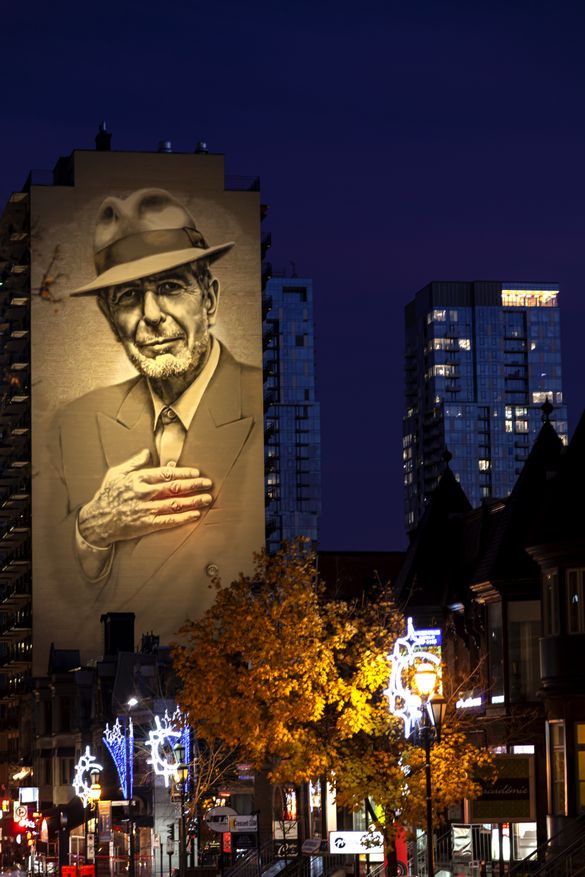
Across every corner of the city, murals bring colour and character earning it's title as the “mural city”. Montreal even has two festivals dedicated to the art form: Under Pressure, the longest running graffiti festival in North America and the Mural Festival, one of the largest street art festivals in the world. But the countless murals can be seen throughout the city year-round with Saint-Laurent Boulevard an excellent place to start. One can't miss the two large tribute murals to Montreal's own award-winning singer, songwriter and poet Leonard Cohen, including one that is 10,000 square-feet, rising 21 stories high.
Public squares are commonplace – gathering places for residents and visitors and a key element to Montreal's international reputation for its festive atmosphere and joie de vivre. The city hosts some 100 festivals and public events year round thanks to the purpose-built design of the public squares, including the Montreal International Jazz Festival, the largest jazz festival in the world that has featured over 500 concerts, 3000 musicians from 30 countries and welcomed 2 million visitors
The centre of the Jazz Festival and most of Montreal's largest spectacles is the award-winning Place des Festivals, which in 2009 completed a full redevelopment that included a 6,000 m2 public square, the largest array of interactive fountains in Canada, greening and planting of mature trees, and four lighting superstructures. The square, designed by Montreal architectural firm Daoust Lestage, links old and new neighborhoods and embodies the spirit of Montreal.
Geography and Environment
Part of the city's uniqueness is its geography – situated on an island, surrounded by the St. Lawrence River with a mountain at its centre. Even the name Montreal is derived from the mountain itself: “Mount Royal”.
The iconic mountain defines the city's skyline. Buildings can't be taller than Mount Royal, nor can they obstruct its view. The City of Montreal has established bylaws that limit heights of buildings so that they can't be higher than Mount Royal nor can new building construction or extension projects obstruct views of the mountain.
Montreal is ranked 10th in the world on the Sustainable Cities Planet sub-index, for its environmental policy and is one of the greenest cities in the world with 19 large parks covering nearly 2,000 hectares, and 1,200 neighbourhood parks. One element is Montreal's BIXI bike share network, which has more than 9,000 bikes and 680 stations across the city and neighboring cities. The bikes themselves have a clever design shaped as a boomerang, given how the bikes depart and return, which was led by Québec industrial design pioneer Michel Dallaire who also designed the Olympic Torch. Montreal boasts over 700km of bike paths.
A Biodiversity Corridor, one of the first projects of its kind to be implemented in an urban environment, was established in the Montreal borough of Saint-Laurent. The corridor covers an area of approximately 450 hectares and will link the existing biodiversity hubs in the area, connecting movements of plant and animal life as well as people. In 2021, the corridor won the Award of Excellence by the Canadian Society of Landscape Architects.
Colour Creativity
Innovative technology is lighting up the city, providing colour, animation and creative expression throughout many of Montreal's iconic and heritage buildings. The award-winning Cité Mémoire, one of the biggest urban lighting installations in the world, projects stories of famous as well as little-known Montrealers who have shaped the city and the world with the help of a free interactive mobile application.
Montreal's internationally renowned multimedia entertainment studio Moment Factory has transformed many of the city's landmarks into dazzling sensory experiences including AURA inside the interiors of the iconic Notre-Dame Basilica and the Jacques-Cartier Bridge, the world's first “connected” bridge where stunning light projections are illuminated based on real time social media activity, time of day, weather, seasons, traffic and other data sources.
Two International Events. Two Defining Architectural Legacies
In the span of a decade, Montreal welcomed the world with Expo 67 and the 1976 Olympic games. Two architectural legacies emerged from these international events, Habitat 67, Moshe Safdie's take on affordable urban housing, and the Olympic Stadium, French architect Roger Tallibert's bombastic sporting venue. Both are controversial representations of brutalist architecture, but remain topics of conversation and cherished architectural landmarks of the city.
Another legacy of the games, the Montréal Biodôme, was created from the velodome, and today allows visitors to walk through replicas of five ecosystems found in the Americas. Buckminster Fuller is the architectural engineer behind the geodesic dome. As a museum entirely devoted to
the links between society and the environment, it is a pioneering building in sustainable architecture. In 2014, Montreal architectural firm Kanva oversaw the Biodôme's expansion and it is one of four facilities making up the largest natural science museum complexes in Canada, and reflecting a city wide passion for environmental awareness and sustainable design. This past August, the New York Times named the Biodôme as one of the “25 Most Significant Works of Postwar Architecture”
Montreal's Architectural Resources
More than 25,000 professionals work in Montreal's lively design field, including over 3,000 companies which include design and architecture services. These numbers are responsible for 34% of the overall economic impact of the city's cultural sector and of Quebec's overall workforce.
And Montreal's institutions of higher education and cultural institutions are incubators of creative design, fueling this architectural talent:
The Universite de Montreal's School of Architecture offers Master's and PhD studies in architecture and urban design.
Design Centre of the Université du Québec in Montréal,offers bachelor's and master's degree program in environmental design
The Canadian Centre for Architecture is a museum of architecture and a research centre.
The CCA contains a large library and archives, and is host to various exhibits throughout the year. It is also home to a study centre open to the general public. The CCA provides educational programs and cultural activities.
Montréal's Museum of Fine Arts has exhibitions that combine various artistic disciplines, from fine arts, music and film, to fashion and design. Its collection, spread across five pavilions, features international art, world cultures, contemporary works, decorative arts and design, and Quebec and Canadian art.
Maison de l'architecture du Québec is a catalyst for architectural creativity dedicated to the development of Quebec and Canadian architecture through exhibitions, labs, workshops, education and other activities.
The Phi Centre is a multidisciplinary arts and culture space that offers programming at the intersection of art, film, music, design and technology and cultivates all aspects of creation, development, production and dissemination of art in all its forms. The space itself includes an art gallery, cinema, theatre, performance space, production facilities and more. Phi Centre started programming virtual reality titles in 2014 and has become a leading centre of the art form in the span of a few short years.
Showcasing Montreal's rich architectural heritage
Heritage Montreal: Since 1975, Heritage Montreal has worked to promote and protect the architectural, historic, natural and cultural heritage of Greater Montreal. Through its work, a number of urban tours have been created, showcasing the passion behind Montreal's love of
architecture:
The Golden Square Mile: here visitors will discover Montreal's golden age of manors and villas along the side of Mount Royal, and learn about the city's early illustrious businessmen and how their wealth was reflected in this district's architecture. Visitors will tour Chancellor Day Hall (1893) by American architect Bruce Price, the oldest manor in the Square Mile, and the Montreal Museum of Fine Arts, whose original building was designed by the Maxwell brothers, one of Canada's largest and most influential architectural firms of the time, and who were behind many of the city's upper-class residences.
The Quartier Latin: This area is undergoing a metamorphosis that will revitalize the neighbourhood after decades of decline. The architectural diversity of the neighbourhood can be experienced through institutions such as the old École des hautes études commerciales (1908– 1911), now the Gilles-Hocquart Building, the former Viger hotel and railway station (1898), an emblematic monument in full transformation, and the Judith-Jasmin Building (1976–1979), known for its integration of the Saint-Jacques Church's bell tower.
The Plateau: Cosmopolitan and colourful, The Plateau offers an exceptional variety of buildings, from working-class homes to institutions, and surprising contemporary residential architecture. As visitors stroll through two former villages, this tour unveils the many charms of Saint-Louis Square, a major work by architect Jacques Rousseau, the Maison Coloniale (1990), and Église Saint-Jean Baptiste, one of Montreal's most spacious churches (1903).
Dorchester Square: The recently restored Dominion Square is a symbol of prestige from the Victorian era, when Montreal became an unstoppable economic force in North America. It is testament to and a crucial element in the creation of a new downtown. Now connected with Place du Canada, these two urban parks comprise 11,000 m2 of green space amidst churches and superb buildings, old and new. Visitors will experience Windsor Station (1889) by architect Bruce Price, a veritable gateway to the new downtown and national historic site built in the Romanesque Revival style; the magnificent Sun Life Building (1913–18; 1923–26; 1929–31) by architects Darling & Pearson(see below); and the elegant CIBC Tower (1962) by architect Peter Dickinson.
Montréal 2030 Agenda for Quality in Design and Architecture
Sustainable city development: Contemporary Montreal designers and architects are using their creativity and sense of innovation to enhance Montrealer's quality of life and give new life to heritage buildings, while keeping the future in mind. The 2030 Agenda is a commitment by the City of Montréal to quality in design and architecture while addressing the challenges of the global climate emergency. With its guiding principles, it envisions a Montréal that is ecologically sustainable, economically viable, socially equitable, and culturally diversified. It also relies on a rich pool of over 27,000
design professions; the expertise and reputation of the Bureau du design, with a track record encompassing nearly 30 years of municipal actions promoting quality and design and architecture; Montréal's UNESCO City of Design status, renewed several times since 2006; and the forthcoming adoption of the Québec Architecture Strategy, which will take into account Montréal's status as Québec's main metropolis.
Examples:
Humaniti, is Montreal's first Smart Vertical Community, a fully connected environment where rich and multi-sensory human experiences are available everywhere, at all times, and at any height. Humaniti opened in June 2021 and is designed to promote the well-being of those who live in it, the dialogue between them, and the space they inhabit. Humaniti is also Montreal's tallest mixed-use community. It includes a luxury hotel, rental units, restaurants, boutiques, and public spaces.
Studio MMA is an architectural design studio founded in 1999 by Vouli Mamfredis and Rob Miners, at the forefront of sustainable architecture. Together they were on one of twelve winning teams selected to build a project for EQuilibrium, a nationwide initiative to build net zero energy healthy homes. They have also built three stores with MEC, a business at the forefront of green construction, and the first LEED certified home built for Habitat for
Humanity in Canada.
lain Carle is best known for crafting site sensitive houses using geometric forms, often in black timber. For the 2016 project La Charbonnière he employed the Japanese technique of shousugi-ban – an ancient system for charring wood. Bota Bota is a 57 year old ferry boat transformed into a Scandinavian Spa, in the heart of Montreal's old port. Created by Sid Lee Architecture, the engines were removed to create more space and the boat is permanently situated in its spot, connected to a geothermal loop underground for heat.
A distinctive side of Montreal's personality is its varied old housing stock. In between the rows lie beloved ruelles, or laneways. Life happens behind the backyards – where families spill out for barbecues, conversation, bikes and street hockey. It's this tight urban landscape that interests La Shed, a nine-strong studio that's carved a niche transforming old Montreal houses for modern living.
Introducing a few of Montreal's architectural masterpieces
Montreal City Hall is one of the most striking civic buildings in Canada and is considered among one of the best depictions of Napoleon III-style architecture. It's roof was inspired by Beaux-Arts architecture, a style originating in Paris. A large fire in 1922 gutted the building's interior, leaving only the outer walls standing. Architect Louis Parent led the reconstruction of the building which involved creating a new steel structure within the shell left standing.
Notre-Dame Basilica's interior is considered a Gothic Revival masterpiece with its numerous ornate carvings. One of the church's most stunning and unique features are stained glass windows that tell the story of Montreal's religious architecture, a departure from conventional stained-glass in churches that typically showcase biblical scenes.
Olympic Stadium was constructed to host the 1976 Summer Olympics. It features a striking retractable roof with cables supported by what remains the world's tallest inclined tower. Though controversial, the stadium has endured as one of Montreal's most recognizable structures and examples of Montreal's school of brutalist architecture. Roger Taillibert, the French architect who designed it, described his work as creating “poems in concrete.”
Habitat 67, with its blocky minimalism, is another famous example of Montreal's brutalist architecture.Designed by architect Moshe Safdie for Expo 67, more than 50 million people flocked to see the building within six months of its debut. Though it failed to revolutionize affordable housing in the way Safdie intended, it succeeded in launching his career.
The Sun Life Building is a monumental example of Fine Arts architecture built between 1913 and 1931. It played a central role in World War II as the site of 'Operation Fish,' the largest known movement of wealth in the world, which saw Britain move its gold reserves from then war-torn Europe into a vault far below the Sun Life Building. The gold was transported in boxes labeled “fish” to avoid detection. There, the gold was sold off on the New York Stock Exchange to cover Britain's war expenses.
St. Joseph's Oratory is one of Canada's largest churches and also features one of the world's largest church domes. The dome consists of two shells; one inner and one exterior, with a gap in between. The outer dome bears a structural resemblance to the Florence Cathedral, with eight arches, a lantern, a cross, and an octagonal drum. Perched atop Mount Royal's Westmount Summit, St. Joseph's Oratory is also one of the highest buildings in Montreal.
Fort de la Montagne comprises some of the oldest architectural structures on the Island of Montreal. Constructed in 1694, the fort was named a National Historic Site of Canada in 1970. The site consists of two two-story 13-meter-high (43 feet) stone towers that were part of the original Fort de la Montagne—a 17th-century French fortification and mission. Queen of the World Cathedral is another one of Montreal's impressive religious buildings. Situated in the downtown area, it stands as the third-largest church in the province of Quebec. The church is modeled after Saint Peter's Basilica in Rome, and the construction of this prominent Baroque Revival cathedral took place from 1870 to 1878 and from 1885.
Montreal World Trade Centre is located in the Quartier International. Completed in 1992, it's been described as a “horizontal skyscraper.” From the outside, the structure looks like a classic late-19th-century block of business buildings, but a glassed-in atrium actually encases them. With its combination of historic and modern architecture, there's even a piece of the Berlin Wall, which was given to the city in 1992, on public display in the building.
The Pointe-à-Callière Museum is one of the city's most prominent museums. Founded in 1992, its three pavilions sit on three archaeological sites, which each represent significant moments in the city's colonial histories. Some of the archaeological foundations uncovered during the construction of the museum remain as part of the Pointe-à-Callière's permanent displays.
Place Ville-Marie, designed by architects Ieoh Ming Pei and Henry N. Cobb, was inaugurated in 1962, The complex, which includes five office towers and a shopping centre, is a downtown architectural gem. Its signature cross-shaped tower, the tallest of its kind in Canada, is synonymous with the Montréal cityscape.
Port of Montreal's Grand Quay Designed by 20 year architectural firm NIpPasage, the Restoration project of Alexandra Pier upgraded the capabilities to better meet the needs of shipping lines and cruise passengers, who are choosing Montreal more and more as a destination. For Montrealers, the project integrates the pier into the urban environment and offers long anticipated access to the water. The landscaping highlights the pier's rich industrial site, and currently being constructed is a new observation tower.
Thought Leaders and Architectural Pioneers
Luc Laporte - Born in Montréal, where he worked all his life, Luc Laporte's legacy to the city includes projects that have left a defining mark on the urban character of Montréal. Laporte made a name for himself by building the interiors of some of the city's best-loved restaurants, notably L'Express, Leméac, Valois, Holder, Laloux, Café du Nouveau Monde (TNM), Via Roma, Restaurant de l'Institut (ITHQ).
Phyllis Lambert - As an architect and philanthropist, Phyllis Lambert has had a huge impact on raising the profile of Canadian architecture and design. She did an in-depth study more than 40 years ago of the history of the greystone buildings in Montreal from the 17th to the beginning of
the 20th centuries. This inspired her to found Héritage Montréal in 1975 and, four years later, the Canadian Centre for Architecture. Lambert also created the Greystone photographic series to reveal the relationship between city growth, architectural expression, and individuals. Thanks to her work, this series became “a catalyst for increased concerns about the conservation of the city's heritage. Greystone buildings create a unifying sense across the island of Montreal”.
Moshe Safdie - Trained at the McGill School of Architecture, Safdie's designs arae found across the world, from the Vancouver Central Library to the World Holocaust Remembrance Center in Israel. He is perhaps still best known for one of his early and most controversial builds - Habitat 67 in Montreal.
Julia Gersovitz - As an adjunct professor at McGill's School of Architecture, Gersovitz is one of Canada's foremost heritage architects and is recognized as a pioneer and top authority on the preservation of historic buildings.
Henry Cleige - Cleinge was fêted last year for his playful but finely detailed remodelling of the old Royal Bank, in Montreal.Situated in the city core, its grand banking hall has been transformed into modern offices for a tech startup, along with flexible workspaces and a café. It's open to the public, with the original brass teller stands adapted as dividers between private and open zones.
Kanva - In the tradition of Montreal's collaborative design style, KANVA describes itself as a 'collective' of architects. Its work is deliberately experimental, seeking to blur lines between technology, art and architecture.The practice was recently commended at the World Architecture Festival for its re-imagining of the Montreal Biôdome, and has won numerous Canadian architecture awards.To see how KANVA's thinking is impacting the city, look no further than Irène, its reworking of an old Montreal railway building. Aluminium panels with randomly placed shutters create a theatrical envelope to the upper three floors – now residential lofts.
Montreal - A Timeline reflecting a Global Leader in Design and Architecture
1991 -Montreal becomes the first North American city to create the position of a design commissioner, dedicated exclusively to the development and promotion of design and to raise awareness among private and public sector stakeholders of the benefits of good design.
2006 - Montreal is recognized by the international design community as a UNESCO City of Design. Rather than an official designation, it is an invitation to develop Montréal around its creative forces in design and architecture. UNESCO City of Design is a collective project that, to become a reality over time, demands that all stakeholders – elected officials, citizens, experts, entrepreneurs and designers – buy into it and make it their own.
2016-2019 -18 Montreal firms have either won or been shortlisted in international design and architecture competitions; more than 90 Montreal firms have been showcased at 12 international exhibitions.
2017 - Montreal hosts the World Design Summit bringing together experts in the fields of design, planning and architecture. The Montreal Design Declaration is signed, asserting the role design plays in shaping the world in line with the UN 2030 Sustainable Development Goals.
2018 - Create Montreal Design Action Plan commits $3.8 million to 1) support design and architecture as a diver of economic and cultural growth;2) develop local and international markets for Montreal designers 3) support quality in design and architecture; 4) raise public awareness of design and architecture; 5) support Montreal's commitments as a UNESCO City of Design and lead the Creative Cities Network
2018 - Place des Montrealaises, international design competition is launched to restore ties between the old city and its faubourgs, or immediate suburbs.
2020-2021 - During COVID, Montreal put out a call for creative proposals which resulted in 10 activations in various Montréal neighbourhoods, encouraging people to explore and boost local tourism. This extended to the creation of a pool of multidisciplinary teams in design with the capacity, availability, experience and skills to design and build 19 transitional urban development projects in public spaces, in particular on commercial streets.
Photo Credit - Mural of Leonard Cohen, Credit: Tourism Quebec
For more information please contact Ms.Nim Singh, Media & PR Manager, Destination Canada care of singh.nim@destinationcanada.com (Not for publication .
Images, story ideas are accessible through www.destinationcanada.com/media