 16 Sep 2014

So You Think You've Seen the Keys? Think Again!
FLORIDA KEYS — There's more to the Florida Keys than meets the eye, yet travelers often visit just once and think they've seen it all. With so many hidden gems and colorful locales, even frequent visitors can discover new experiences each time they return to the island chain.
When visitors choose the road less traveled, Card Sound Road, they'll cruise past Alabama Jack's, Card Sound's only restaurant and a popular local watering hole. This colorful Keys establishment has been called the home of the best conch fritters in the Keys and has a Key lime pie to marvel over as well. www.alabamajacks.com.
Travelers along Card Sound Road eventually head southwest on Route 905 to connect with U.S. Highway 1 and continue their Keys journey. Once in Key Largo, those seeking sweets can stop at Key Largo Chocolates, home of the Florida Keys' only chocolatier, located at mile marker (MM) 100.5 bayside. Self-described as a “grandma and grandpa operation,” Key Largo Chocolates infuses local Keys flavors to create handmade chocolate treats. www.keylargochocolates.com.
Art and nature enthusiasts alike can enjoy Kona Kai Resort, Gallery & Botanic Gardens, MM 98 bayside in Key Largo. This boutique property includes not only a beautiful inn but also one of the most sophisticated art galleries in South Florida, featuring world-renowned artists. Kona Kai Resort is surrounded by a lush botanic garden that captivates the senses and engulfs visitors in a tropical paradise. The Botanic Gardens at Kona Kai Resort are staffed by a full-time ethnobotanist and tours are offered regularly. www.g-k-k.com, www.konakairesort.com, www.kkbg.org.
On the third Thursday of every month in Islamorada, the Morada Way Arts & Cultural District hosts its Third Thursday Art Walk featuring national and Keys-based artists, art galleries and restaurants at Morada Way between MM 81 and 82. Attendees can discover and enjoy a stimulating blend of fine art, live music and culinary offerings. The area has emerged as a popular arts district whose galleries and restaurants welcome visitors throughout the year. www.moradawayarts.org.
Travelers can't miss the larger-than-life dolphin statue at Dolphin Research Center, MM 59 bayside on Grassy Key, but few realize that one of the first “Flippers” of television fame is buried beneath it. Tour the acclaimed nonprofit marine mammal research and education facility to meet its resident dolphins. www.dolphins.org.
Not far away is the Turtle Hospital, MM 48.5 in Marathon, the world's only state-licensed veterinary hospital dedicated to treating sea turtles. The hospital's two turtle ambulances are normally parked outside the facility, and tours are offered daily so visitors can learn about the hospital and its “patients.” www.turtlehospital.org.
Before you cross the Seven Mile Bridge and head to the Lower Keys and Key West, stop by the Pigeon Key Visitor Center, hop on the Pigeon Key Ferry and explore the tiny island that once housed workers who built Henry Flagler's historic Over-Sea Railroad in the early 1900s. While the rest of the Keys have evolved with the years, this tiny island has remained essentially unchanged and is now a national historic treasure complete with a small museum chronicling the railroad's construction. www.pigeonkey.net.
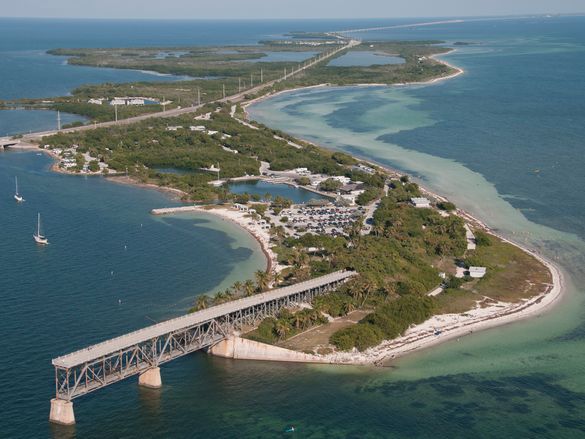
A portion of the Old Bahia Honda Bridge, a dramatic reminder of the historic Florida Keys Over-Sea Railroad, is a landmark at the 524-acre Bahia Honda State Park between MM 36 and 37. Pedestrians can stroll along the old bridge for a panoramic view of the park and surrounding azure water. www.bahiahondapark.com.
Driving toward Key West, take a right at MM 17 on Sugarloaf Key and find a weird structure called the Bat Tower. It was built by Richter Clyde Perky in 1929 as an attempt to control mosquitoes around his fishing resort. Perky then purchased a secret “bat bait.” Bats were supposed to be drawn irresistibly by the bait, adopt the tower as their home and leave it nightly to devour the area's mosquitoes. But the winged rodents never did make the strange structure their permanent home. These days, the Florida Keys' Mosquito Control effectively manages the pesky insects, but the Bat Tower still stands as an offbeat monument to a “batty” Keys idea.
Hidden from view at the gateway to Key West is the 15-acre Key West Tropical Forest & Botanical Garden. Situated just off College Road at MM 5 bayside, the garden features more than 6,000 plants and trees, and provides habitat for 35 butterfly species and more than 270 migratory bird species. Visitors can explore walking trails and boardwalk trails, a one-acre butterfly habitat, freshwater lake, wetland habitat and more. www.keywestbotanicalgarden.org.
Among the ruins of Key West's historic, never-used Civil War–era fort known as West Martello Tower is a beautiful garden featuring indigenous plants, rare palm trees and a butterfly garden. Located just past the intersection of Atlantic Boulevard and White Street, the fort is home to the Key West Garden Club and is called the Joe Allen Garden Center. www.keywestgardenclub.com.
The legacy of Key West's first millionaire, William Curry, lives on at the Curry Mansion Inn and Museum, located at 511 Caroline St. Today the home of innkeeper Edith Amsterdam, the grand Victorian-style mansion also is an intriguing museum listed on the National Register of Historic Places. It is said that Key lime pie was originally created in the Curry Mansion kitchen by Curry's private cook, known as Aunt Sally. The Curry Mansion Inn and Museum is a full-service inn and is open to the public for tours. www.currymansion.com.
For more Florida Keys & Key West travel information, including electronic brochures and videos, visit the Keys website visit the Keys website at www.fla-keys.com.
For personal service, call toll-free in the U.S. and Canada, 1-800-FLA-KEYS (800-352-5397).
Facebook · Twitter · Instagram · YouTube · Keys Voices
###