 11 Aug 2005

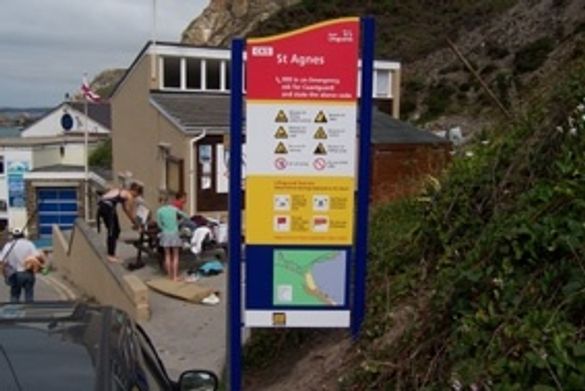
Visitors to UK beaches can look forward to the prospect of safer fun at the seaside as the RNLI�s new safety sign standard initiative begins to roll-out. The charity will unveil the first of its new safety signs along beaches at the popular holiday spots of Bournemouth (Dorset) and Carrick (Devon).
The Royal National Lifeboat Institution believes that as the new beach safety signage standard is adopted, it will lead to a reduction in the number of preventable accidents at the beach, and ultimately to fewer seaside deaths. The RNLI hopes it could become the �green cross code� of seaside safety.
RNLI statistics in the south and south west alone indicate that RNLI Beach Lifeguards and volunteer lifeboat crews have helped rescue more than 400* people just this week.
Currently there is no standard UK beach signage system in existence. Rather, the various beach owners (from local authorities to private landowners) make independent decisions about safety signage on their beaches under �duty of care� responsibilities.
The RNLI beach safety team spotted this deficit, and so developed and created a new safety sign standard and has been encouraging beach managers and owners to adopt it.
Steve Wills, RNLI Beach Safety Manager,explains:
�Signage is often questioned after a drowning and is subsequently highlighted by coroners and others as a means to reduce risk in the future. Sometimes it is noted that there has been a lack of safety information or that the information that was provided was poor at educating those visiting the beach.
�RNLI research also notes that a high level of confusion exists among the general public in the way they interpret beach safety signs. The RNLI believes that the new signage standard will ensure that key beach safety information is simple to understand � by both adults and children � and is presented in a uniform manner.
�We urge all beach operators and owners to adopt the new signage when they review their beach information and so help create a national standard. This can only enhance their reputation as safe destination providers. In fact, we would like to go further and suggest that beach owners contact us and begin to plan now for the introduction of the new beach signage system � even if they feel they won�t implement the scheme immediately � possibly due to budgetary constraints. At least they will be able to begin to plan now for safer beaches.
�Any local authorities, beach owners and managers who are interested in finding out more about the standard or how they can adopt the new system, can contact Steve Wills on 0845 122 6999 or swills@rnli.org.uk. All enquirers will be sent a free copy of the RNLI guide about the beach signage.�
More signs are set to follow as other local authorities, including Blackpool (Lancashire), Restormel (Cornwall) and North Cornwall, also adopt the new beach signage safety scheme.
The RNLI completed trials of the new beach safety signage at Weymouth (Dorset) and South Hams (Devon) last year.
RNLI volunteer lifeboat crews have 180 years� experience of saving lives while RNLI lifeguards have been patrolling beaches in the south of England since 2002.
Currently 59 beach areas are patrolled by RNLI Lifeguards. 2004 statistics reveal that on just these few beaches alone RNLI Lifeguards saved 53 lives and aided 9,041 people whilst dealing with a total of 8,010 separate incidents.
The British public will be reassured to know just how many highly trained RNLI lifeboat crews and beach lifeguards are looking out for them incase relaxation and fun turns to worry and anxiety. Now they may also be pleased to learn that the RNLI national beach safety signage standard could be to hand where there is no lifeguard presence.
Currently a standard for international beach signage is being devised, and the RNLI�s already developed UK standard is helping to forge this. So understanding the new beach signage should also ensure that UK citizens will stay safer when they holiday abroad at foreign beaches.
--END--
*Provisional statistics. Notes to editors
1. Please contact the RNLI press office on 01202 66 3184 / 3510 / 3127 / 3181 / 2218 to arrange interviews, photographs and media facilities or to enquire about future developments.
2. Anyone from the media interested in visiting an RNLI Beach Lifeguard patrolled beach during the summer season can do so by contacting the press officer on the above numbers.
3. Please find attached images of the new RNLI national beach safety signs at Carrick and Bournemouth. Also attached are pdf images of the new signs.
4. RNLI lifeguard statistics can be found at www.rnli.org.uk under beach lifeguards.
5. The RNLI provides the best possible lifeboats, equipment and training to ensure that its volunteer lifeboat crews and beach lifeguards can do their job in the safest and surest way.
6. The RNLI's annual running costs are around �119m � approximately �325,000 per day � and, as a registered charity, the organisation continues to rely on voluntary contributions and legacies for income.
www.rnli.org.uk