 18 May 2013

Florida Keys & Key West Booth at Pow Wow: #709
FLORIDA KEYS — Want to hunt the skittish gray ghost of the flats, the bonefish? Feel like testing your mettle against a reel-emptying blue marlin? Want to sit in a beach chair, sipping a cold cocktail while watching your popper dance in the current? Come to the Keys, where year-round fishing means a noteworthy or at least edible catch is possible virtually any time.
The tropical weather, nearby Gulf Stream and 120-mile-long arc of islands that comprises the Florida Keys create a fishing environment unique in the world.
Off the Keys' “outer” curve lies the Atlantic Ocean. Warm and shallow near shore, the sea reaches depths of more than 600 feet just 11 miles offshore of the Upper Keys. Near Key West, 600-foot depths are just five miles from shore. Travel another 12 to 15 miles south and the depths begin to approach 2,000 feet.
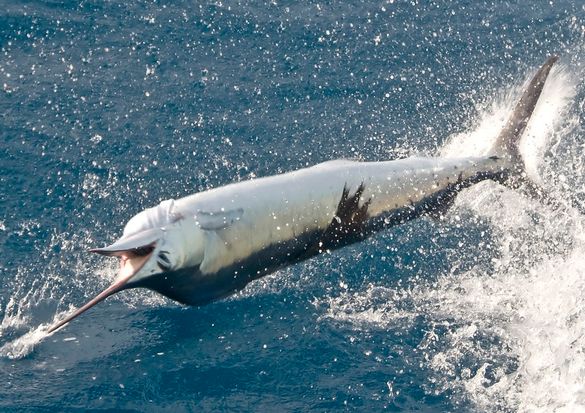
Deep-sea fishing, best accomplished with one of the Keys' experienced charter captains, targets some of the greatest sport fish in the world: blue and white marlin, sailfish and swordfish. In addition, high-speed thrills are delivered by rocket-like wahoo and kingfish. Exceptional table fare comes from the Keys' most popular summer visitor, the dolphin, also called mahi-mahi. This edible dolphin is not to be confused with the mammal that also is seen in the waters of the Keys.
Blue marlin fishing is generally best April through July. Sailfish season runs November through March. Most wahoo race through Keys waters during April, May, November and December. Kingfish are most active September to March and the best dolphin fishing starts around April and continues through September.
The latest craze in Keys offshore sport fishing is daytime angling for swordfish, a deep-water fish that has the stamina and strength of a bluefin tuna yet can leap like a marlin. Until recently, they were primarily targeted only during nighttime hours.
Now, thanks to pioneering efforts to fish at depths of 1,200 feet or more, Keys captains are successfully catching swordfish under the bright subtropical sun.
Closer to the reef, grouper and a variety of snapper are caught with lighter gear. Visiting anglers quickly learn that moving a grouper out from under a rock takes arms of steel and tackle to match.
Yellowtail snapper, regarded by many as the Keys' tastiest fish, are year-round residents. Grouper, also year-round residents, are best fished November through March.
Charter fleets dot the Keys from Key Largo to Key West. Boats range from 26-foot outboard-powered center consoles to 65-foot air-conditioned long-range sport fishers.
There also are a number of party boats throughout the Keys. These large vessels are built to take 20 or 30 people fishing. The boat operator typically supplies all the fishing tackle that's needed, along with bait and lots of know-how — so anglers can simply walk aboard and fish.
Florida Bay, edged by the “inner” curve of the Keys and the Florida mainland, is referred to by locals as the backcountry. It is home to five of the most sought-after game fish in angling circles: bonefish, tarpon, permit, redfish (red drum) and snook.
The largest bonefish in the world, ranging from 8 to more than 14 pounds, are caught within earshot of “downtown” Islamorada. Tarpon from 60 to 150 pounds are challenged along the entire length of the Keys, on flats and in deeper channels. Permit, for years exclusive to the Lower Keys and far north Key Largo, are showing up on flats everywhere in between.
The redfish and snook of the Keys usually require some coaxing out from their mangrove hideaways. Once hooked, these backcountry brutes will test even the most experienced angler.
Backcountry species are year-round residents of the Keys. The temperature-sensitive bonefish can be caught all year long, with the prime months being September through November. Tarpon come close to Keys bridges April through July. Permit are on the flats in the greatest numbers April through September. Redfish and snook fishing is best December through July.
For visitors, hiring a backcountry guide makes for a successful and educational day. The shallow, unmarked waters of Florida Bay can be confusing and potentially treacherous for the inexperienced.
A saltwater fishing license is required to fish in the Keys, even from area bridges or from shore. These can be purchased at many bait and tackle shops, online at www.myfwc.com or by calling toll-free 1-888-FISH-FLORIDA (888-347-4356). Anglers fishing on a charterboat or backcountry boat do not need a license, as they are covered by the captain's documentation.
Visitors also must abide by Florida state fishing regulations, which define size and bag limits and closed seasons. Current regulations can be found at most bait and tackle shops or online at www.myfwc.com/fishing/saltwater/regulations/.
For more Florida Keys & Key West travel information, including electronic brochures and videos, visit the Keys website at www.fla-keys.com. For Keys fishing information, visit www.fla-keys.com/fishing.
Keys social media sites include facebook.com/floridakeysandkeywest, twitter.com/thefloridakeys and youtube.com/floridakeystv.
For personal service, call toll-free in the U.S. and Canada, 1-800-FLA-KEYS (800-352-5397).
###
fla-keys.com/media
1-800-ASK-KEYS
Contact: NewmanPR/Andy Newman
Mobile: 305-542-6014