 19 Jan 2018

A new breed of 'shark' is emerging on the Great Barrier Reef – the 'real estate shark'.
These are not the magnificent gliding creatures that make up the Great Eight of the Great Barrier Reef, but the signs of new coral life settling on vacant 'real estate' where the Reef has been damaged.
Tourism Tropical North Queensland Chair Wendy Morris, a former marine biologist who has been diving the reefs around Lizard Island for more than 40 years, has photographed exciting new coral growth at the island's reefs which were impacted by a bleaching event in 2016.
The juvenile corals have been documented by the Lizard Island Reef Research Foundation and their growth rate will be tracked by James Cook University over the next two years.
“Competition for space on a reef is usually tight, so when 'real estate' becomes available after damage, there is an opportunity for new corals to settle and grow after spawning,” Ms Morris said.
“I was delighted to see colonies of Acropora, the staghorn corals whose branches grow several centimetres a year making them one of the most common and fastest growing groups of corals.
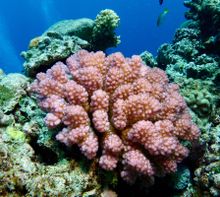
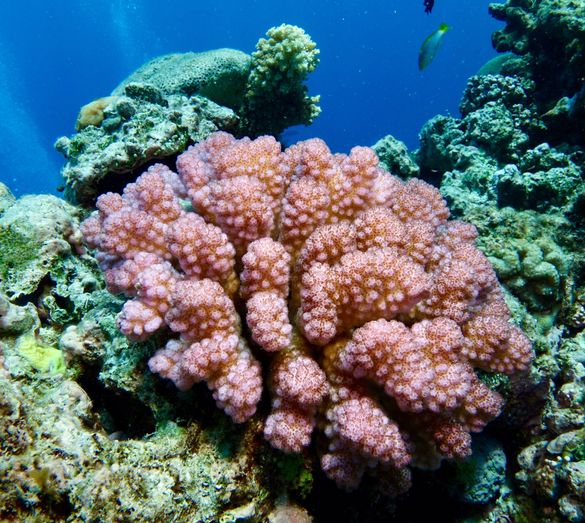
“Pocillopora or Cauliflower Coral is another pioneer at regenerating as this 'brooding' coral spawns frequently through the year, unlike most corals which spawn just once a year, usually after the full moon in November.
“Both pioneering species could be seen in the early stages of growth when I dived around Lizard Island in November.
“The new coral is the size of a pinhead and cements itself on the bare reef rock surface where it begins to grow new polyps as the colony increases in size.”
Reef and Rainforest Research Centre (RRRC) Managing Director Sheriden Morris said the sightings of new coral growth followed recent observations by the Australian Institute of Marine Science (AIMS).
“AIMS coral biologist Dr Neil Cantin and his team found of Acropora colonies with early signs of egg development in the shallow waters around Fitzroy Island during a survey in September,” she said.
Ms Morris said reefs were in constant flux in both time and space. “This is especially evident on the Great Barrier Reef which is bigger than Nevada and consists of a mosaic of more than 2900 reefs spread over 2300 kilometres,” she said.
“Within each reef are different zones exposed to open ocean, deep passages or calm embayments offering various conditions that favour different coral formations.
“Storms, crown-of-thorns starfish or coral bleaching can have very localised effects, with healthy coral surviving just a short distance from badly damaged areas.
“While coral has been damaged and some has died in impacted areas, these signs of regeneration demonstrate the Great Barrier Reef's resistance and ability to adapt.
“These signs of new life are a great start to 2018, the International Year of the Coral Reef.”
ENDS
Images courtesy The Reef Society.
Download from:
https://www.dropbox.com/sh/aq0345kbmziogdw/AADAJcOwoNOUrU5ygXaghEMxa?dl=0
Acropora colony 1&2: The white tips of a young Acropora or staghorn coral colony, probably less than a year old, can be seen alongside an older blue Acropora colony.
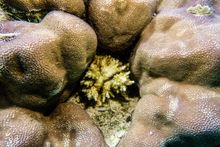
Acropora in boulder coral: A young Acropora colony has found space to start growing in the crevice of a Boulder Coral.
Cauliflower Coral Cod Hole: Pocillopora or Cauliflower Coral regenerating at The Cod Hole.
Giant clam Watson's Bay: Colourful marine life such as this giant clam is thriving at Watson's Bay near Lizard Island.
Mass coral spawning: Mass coral spawning of an Acropora colony.
Staghorn coral: A close-up of Acropora or staghorn coral.