 01 Sep 2015

WILLIAMSBURG, Va. – Visitors are transported to the past in authentically re-created settings at Jamestown Settlement and Yorktown Victory Center living-history museums, located in Virginia's Jamestown-Williamsburg-Yorktown Historic Triangle. Clothing worn by historical interpreters, the implements they use, and the settings in which they work are all based on information gleaned from 17th- and 18th-century documents, objects and images and archaeological research.
At the museums' costume shops, historical clothing pieces, including doublets, breeches, waistcoats, bodices, stays, skirts, shirts, caps, leggings and mantles, are custom-made of wool, cotton, silk, linen and leather. Extant period clothing, contemporary illustrations and written accounts provide sources for construction details, patterns and choice of fabrics. Clothing and accessories are carefully researched to represent the cultures, time periods and occupations depicted at Jamestown Settlement and the Yorktown Victory Center.
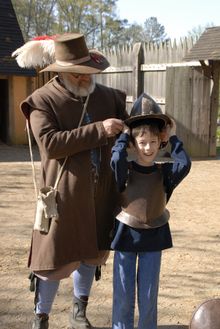
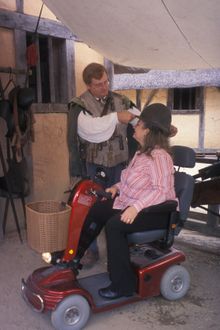
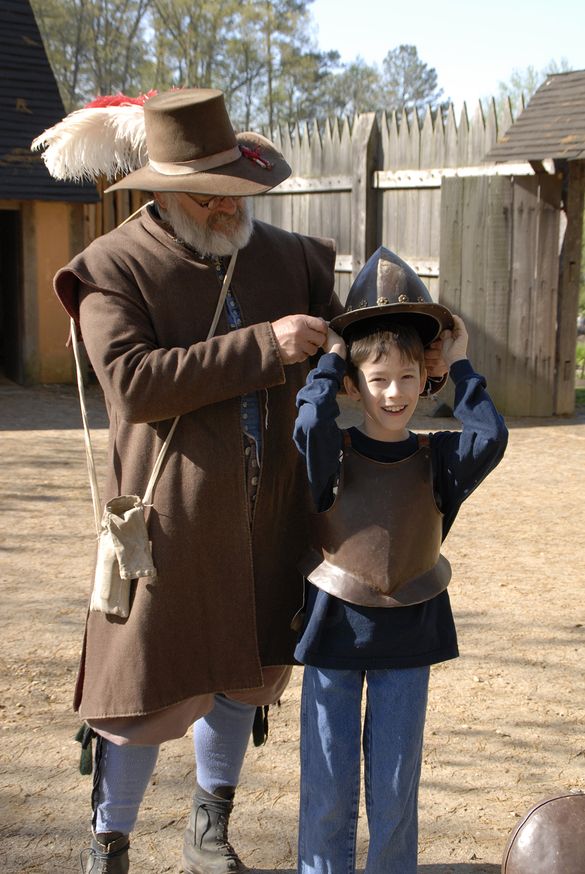
Visitors can get a sense of what it's like to wear garments of centuries past by trying on 17th-century-style armor at Jamestown Settlement's re-created 1610-14 fort and a military coat at the Yorktown Victory Center's Continental Army encampment.
Working matchlock and flintlock muskets and artillery pieces, tools, cooking utensils, navigational instruments and furniture are faithful copies of 17th- and 18th-century originals. While many of these objects are obtained from outside sources, skilled work performed in the museums' living-history areas – blacksmithing, carpentry, needlework, flint-knapping, weaving plant fibers into baskets and pouches, and producing dugout canoes – provides visitors an opportunity to learn about pre-industrial technology and produces many of the objects used there.
Jamestown Settlement
A Paspahegh site found archaeologically a few miles from Jamestown in the 1990s serves as the model for Jamestown Settlement's Powhatan Indian village. Six full-size buildings, made of sapling frames covered with reed mats, were re-created from the site, which dates to the early 17th century and is depicted in entirety in a scale model inside the museum exhibition galleries.
Architectural designs for the Susan Constant, Godspeed and Discovery, replicas of the three ships that brought America's first permanent colonists to Virginia in 1607, were based on the historically documented tonnages, or cargo capacities, of the original vessels and extensive research of 17th-century ships.
Buildings in the Jamestown Settlement fort, which reflects the business enterprise and military character of Jamestown during the years 1610 to 1614, are based on documentary research and archaeological findings at several early 17th-century Virginia sites. Two buildings, one interpreted as a storehouse and another representing the colonial governor's quarters, are patterned on evidence found by Preservation Virginia archaeologists at Historic Jamestowne, the original settlement site. Colonist William Strachey's description of the Jamestown fort in 1610 is the basis for the triangular palisade encircling the fort and for the size and interior furnishings of a building representing an Anglican church.
Yorktown Victory Center
Its layout and features drawn from General von Steuben's 1779 “Regulations for the Order and Discipline of the Troops of the United States,” the Yorktown Victory Center encampment represents a portion of an American regiment during the Revolutionary War. The setting includes soldiers' tents, officers' quarters, and an earthen “kitchen” for one company. There are several regimental features – quarters for a colonel, surgeon and quartermaster – as well as an area with makeshift shelters representing quarters for family members who followed the army.
Structures and interpretive programs at the Yorktown Victory Center's farm are based on inventory and tax records and studies of farm and family life in the Chesapeake Bay region during the Revolutionary period. The one-and-a-half story farmhouse, its frame set on wooden posts and covered with riven oak clapboards, is representative of a type of dwelling once common in eastern Virginia. The site also includes a log kitchen, barn where tobacco leaves are hung from poles to cure, crop field and garden.
A Year-Round Experience
Jamestown Settlement and the Yorktown Victory Center are open daily throughout the year except Christmas and New Year's days. Combination admission to both museums in 2016 is $21.25 for adults and $10.75 for ages 6 through 12.
Jamestown Settlement is located on Route 31 at the Colonial Parkway next to Historic Jamestowne, administered by the National Park Service and Jamestown Rediscovery (on behalf of Preservation Virginia). The Yorktown Victory Center, to become American Revolution Museum at Yorktown in late 2016, is located on Route 1020 in Yorktown near Yorktown National Battlefield.
For more information, call (888) 593-4682 toll-free or (757) 253-4838, or visit www.historyisfun.org.
###
Media Contacts: 8/2015
Susan Bak, (757) 253-4138, susan.bak@jyf.virginia.gov
Debby Padgett, (757) 253-4175, deborah.padgett@jyf.virginia.gov