 15 Oct 2004

When Medieval Times CEO Ken Kim was looking for a composer to create an entirely original score for the dinner attraction�s all-new show, he invited Daniel May to come see a performance. May, armed with a doctorate in music composition from Cornell University and more than a dozen years creating award-winning film scores, thought he was going to watch a passive Renaissance Faire. He soon realized how wrong he was.
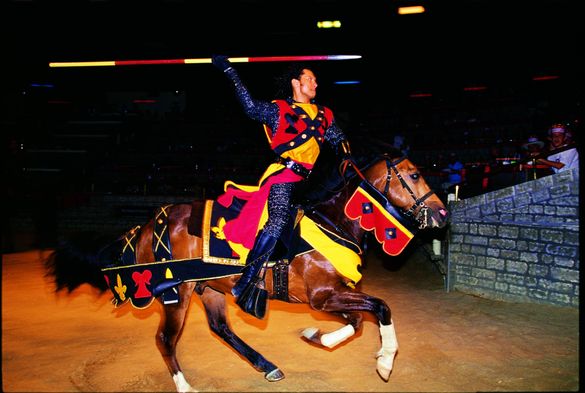
From the Entrance Pageantry to games of skill, jousting, the Queen of Love and Beauty, ominous messages from the Oracle, fights to the death and the glorious finale, the music was an integral part of creating the window in time that transported guests back to the 11th century. �I remember walking out of the Castle shaking my head, thinking �Wow! This is going to be a huge job,�� May said. The good news was Kim offered the job to him. The bad news was they needed the completed orchestration � two full hours and 108 separate pieces of music � in eight weeks. �A normal film score takes about eight weeks just to compose,� May said. �Orchestration and recording will add months.� He agreed to take on this gargantuan task when Kim promised him complete artistic freedom, as long as May delivered something powerful, with timeless classical undercurrents, that would be uniquely Medieval Times. The music would be recorded by the City Of Prague Philharmonic, and accompanied by a 60-voice professional Czech choir under the direction of fourth-generation Choirmaster Pavel Kohn.
May received input from several key Medieval Times corporate team members, including Tim Baker, director of stunts and choreography, and Leigh Cordner, creative director. �Tim requested rhythmic reference points with a driving groove to choreograph the Knights� battles. He needed energy and flexibility,� said May. Cordner, meanwhile, wanted the new script and music to allow enough time for operational flow � for instance, quick costume changes, moving horses in and out of the arena and serving a thousand hungry guests. May complied.
Just as the action in the new show represents the clash between darkness and light, the score does, also. �I definitely wanted a contrast to reflect the action in the area,� May explained, �So I divided the music into two spheres � light and dark. For the pageantry, the dressage and the games, where everyone is having a good time, the music is light, crisp and joyful.� That tone, May said, sets the stage for the contrasting element when treachery is revealed, and the King�s champions fight to the death. �It�s the classic mythological struggle of good against evil, set to music,� said May.
�This was the type of assignment a composer always dreams about but rarely gets the occasion to do � a big orchestral piece, no holds barred, fast, rhythmic and full-on,� May said. As he retreated into a �trench zone� through Christmas, only sleeping when he was tired and working through meals, his understanding wife and three-year-old daughter temporarily moved to a relative�s home. As long as he was awake, May recalls, he was furiously committing notes to paper.
As the days ticked by, May hired five orchestrators in different parts of the country to work on passages after they were composed. The Internet was an integral part of completing the project on time. May would e-mail the score to the orchestrators; they would complete their work and return it to him and he, in turn, would e-mail it on to Stanya, his orchestra contact in Prague. She would extract all the parts, print them, and place them in folders for the musicians.
May and his entourage traveled to Prague to bring the epic score to life. They could only use the famed Gallery Rudolfinum concert hall until 5 p.m. daily for one week, because concerts were scheduled each night. Undaunted, they got right to work. While May secluded himself in the recording booth to �hear the entire work as a global whole,� his brother Jonathan, conductor of the Orlando Youth Symphony Orchestra, served as something of an advocate for the musicians. When the brass players, for instance, developed swollen lips from hours of playing, it was Jonathan who insisted on a break. May�s musician father, one of the orchestrators, was also in Prague to assist during the dramatic recording sessions. �When you have 150 people involved in anything, there�s a combined humanity,� May said, �that makes it better than anything you could conceive. With that orchestra, that choir and that concert hall � it was very moving.�
Recording the epic score in Prague was important to May. �It�s a classic medieval city with a strong artistic soul,� he said. His hotel was built in the 1600�s, and after an exhausting day of recording, a group of them would visit a pub from 1580. �The vibe of the city and the opulent concert hall enhanced the performance of medieval music,� he said.
May insists the success of the original score will actually rests with the audio engineers at each of the seven Medieval Times castles. �A live show is different every time,� he said. �It�s going to take a real virtuoso performance on the part of the sound man to bring it all together.� The audio techs have 108 different cuts of music, and have to follow cues and activate each piece based solely on the action happening in front of them. Jousts, for instance, always start with both Knights on horseback, but the music must change when one Knight falls to the ground. �It was a mathematical challenge to figure out how to keep the music flowing while the action can change slightly from show to show.�
That was a new challenge for May, who�s received kudos for his film scores, like the I-MAX movies �Everest,� �Journey to Amazing Caves� and �The Living Sea.� Movie action doesn�t fluctuate, he said, and the movie soundtrack is frequently barely discernable under the dialogue. For the Medieval Times show, the music frequently replaces dialogue, and sustains a driving energy for the entire 90-plus minutes of action.
Now that his demanding project is completed and guests around the country are enjoying his latest work, May says the entire experience, from beginning to end, was frightening but invigorating. �It was like throwing a football from one end of the field to the other,� he said, �just blowing it out, and writing the music I always wanted to.� He says he never had time to be nervous � and he strongly believes it couldn�t have been any better, even with another six months to work on it. For that, he credits Kim�s trust in his professional ability, and the sheer personal joy he derived from the most challenging and rewarding assignment of his career.
The complete original score is available on CD at any of the eight Medieval Times gift shops or online at www.medievaltimes.com. The Medieval Times Dinner & Tournament spectacle unfolds daily inside a fully enclosed European-style castle. 0 for Adults is $45.95; Children 12 and under are $31.95. Admission price includes show, dinner and two rounds of select beverages. Sales tax and gratuities are additional. Reservations are required. Please call 1-888-WE-JOUST or 714-521-4740 for reservations or additional information. In addition to its Buena Park location, Medieval Times is also located in Kissimmee, FL; Dallas, TX; Lyndhurst, NJ; Schaumburg, IL; Myrtle Beach, SC; Toronto, Ontario, Canada and Hanover, MD. More information about Medieval Times is available on the company�s website at www.medievaltimes.com.
# # #
Media Contact: David Manuel +1 714-523-1100 dmanuel@medievaltimes.com