 08 May 2014

The Canadian Museum of Human Rights is the latest to adorn Canada's eclectic Skyline
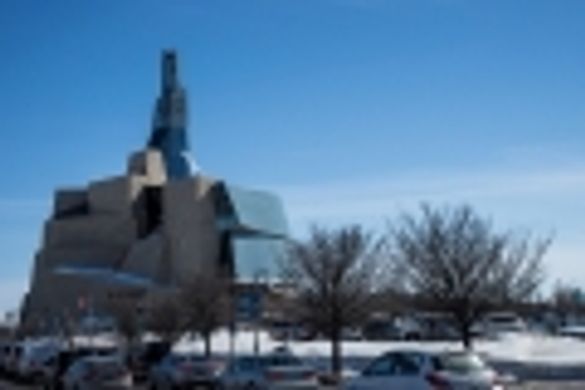
Take a walk through downtown Winnipeg, Manitoba, and you are strolling past a solid two centuries of perfectly preserved and brand spanking new architectural history. This prairie city's core has arguably the most eclectic assortment of building styles in Canada. Its newest gem, the Antoine Predock designed Canadian Museum of Human Rights (CMHR) with its 100 m (328 ft) tall Tower of Hope, towers above the rest, surpassing the neighbouring Esplanade Riel pedestrian bridge's graceful needle by 40 m (131 ft). The Museum is scheduled for opening in September 2014.
While both are short stuff compared with Canadian cities' skyscrapers, architecture here has always revolved around beauty, not size. The Exchange Districts early 1900s Chicage inspired terracota detailed buildings, downtown 1960's modernists, postmodern treasures such as teh CMHR and -out in the 'burbs - the glassy, triangular Winnipeg Mintplus the sweeping curves of the Investors Group sports stadium all prove aesthetics are what matters here. This holds true even in winter, when eye candy Warming Huts, chosen from top designs in an international challenge , dot the world's longest natural skating rink on the Assiniboine River.
Local architectural icon expert/author Frank Albo guides summer tours of the Freemason built Manitoba Tyndall stone Legislative Building's hidden symbols and secret meanings , while a summer walking tour along Kingsway, Harvard and Yale avenues, Ruskin Row and Wellington Crescent reveals Tudoe and Georgian style mansions
In late May, Heritage Winnipeg throws an Open House, so people can view downtown Victorian, Beaux Arts neoclassical, Rennaissance revival, Romanesque and Chicago School buildings. The passenger rail Beaux Arts-era Union Station, opened in 1911, designed by the same architects of New York's Grand Central Station. Whilst across the street, the perfectly restored Fort Garry Hotel looms, Manitoba's sole example of Chateau style architecture. The Bank of Montreal at Portage and Main fused its original 1913 Romanesque structure with a 1980's slim, 22 storey granite faced tower, while more early 1900 gems are found along Main Street to the north. The baroque style onion domed Russian Orthodox churches sprinkled around the city's north end mark the pre first World War influx of Ukranian immigrants.
Mid '50's and '60's dreamers left their marks in Winnipeg, spinning Bauhaus into what is now called Winnipeg Modernism. The 1960's vintage Centennial Concert Hall, Manitoba Museum, Royal Manitoba Theatre Centre and City Hall campus make up a Modernist Cluster on north Main Street.
Gus da Roza's 1970 Tyndall Stone Winnipeg Art Gallery at the edge of the downtown resembles a giant ship's prow. Adjacent to the gallery, the 1926 vintage Hudson Bay building was - when it opened- Canada's largest reinforced concrete building. Across the street, the Winnipeg Clinic looks like a modernist hiccup jostled by post modern office buildings. In St. Boniface, Etienne Gaboury's 1968 Scandinavian Expressionist Paroisse de Precieux - Sang (Church of the Precious Blood) scrolls upward.
When hunger strikes , step into the 60's for a meal at Rae and Jerry's Steak House or grab a "Goog Special" at the summertime Bridge Drive In (the city's iconic icecream take out joint). Or lunch at the Esplanade Riel's Chez Sophie. You've earned it! And you're not even part way through Winnipeg's building bucket list...
Looking for more visual inspiration from Manitoba. Visit the CTC Brand canada Library through www.keepexploring.ca/media
For more media information please contact Ms. Nim Singh, Canadian Tourism Commission on 0208 389 9983 singh.nim@ctc-cct.ca (not for publication)