 27 Jun 2013

Trento’s New Science Museum (MUSE) opens this July
THE ‘MUSE’ – MUCH MORE THAN A MUSEUM
Fresh from the success of The Shard in London, Western Europe’s tallest skyscraper, architect Renzo Piano follows it up with the MUSE in his native Italy. Trento, the capital of the Trentino Dolomites, has pulled off a coup in securing the services of this visionary architect. The daring project does not disappoint its creator: “We’ve spent a decade on this project, from the museum to the regeneration and re-envisioning of the district. In Italian terms, it’s a miracle that the project has been accomplished so smoothly, without a slip up, thanks to superb teamwork.”
The Renzo Piano-designed project puts Trento on the international map. Far more than a Science Museum, this is a bold statement of intent. The region realises that investment in culture reaps rewards. The results go beyond a cutting-edge museum and the regeneration of an old industrial district. The museum sits at the heart of a new urban park, residential and entertainment zone that will reshape the city. The project also reconnects the city with its mountainous landscape. Shifting views of Monte Bondone will tempt visitors to explore the Dolomites peaks.
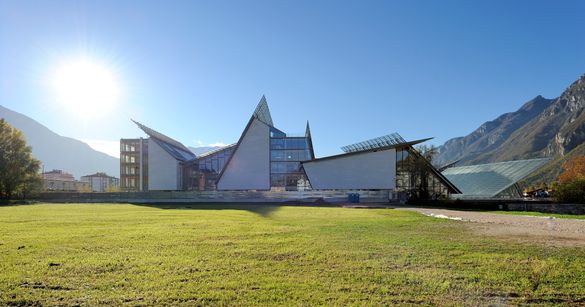
The Science Museum is deeply rooted in the Dolomites, presenting glaciers and extreme Alpine experiences as part of its remit. With its jagged, futuristic forms, even the design of the building seems like a tribute to the surrounding mountains. But MUSE aspires to be much more than a museum. Expect a major visitor attraction, a multimedia experience and a beacon of scientific excellence. As a bold research centre, MUSE also harbours lofty planetary ambitions, exploring everything from the birth of the solar system to Alpine eco-systems, sustainability and global warming. Its more concrete aim is to reposition Trento as a dynamic cultural and scientific centre on the world stage.
➼RENZO PIANO, THE ARCHITECT
Renzo Piano is responsible for re-designing Genoa, his native city, for giving Paris the Pompidou Centre, and for leaving his mark on London with the Shard. Now he brings his vision and humanity to the Trentino Dolomites. According to fellow architect Richard Rogers, "Renzo is a great humanist, who combines the social, political and the technological so brilliantly.”
As befits a project trumpeting the sustainability message, the museum is a standard-bearer for renewable energy. “We use two-thirds less energy than normal,” confirms Renzo Piano. Solar panels are in use, as are rainwater cisterns and even geothermal energy.
The Futuristic building is as exciting as you would expect in design terms. When asked about his inspiration, Renzo Piano responds: "If you ask what is a constant with me it is this idea of making a building fly – creating something with zero gravity.”
Even so, Piano realises the building is radical and that he’s forging the future: “The best architecture takes time to be understood. Judge it in 10 years' time."
➼A MUSEUM FOR THE THIRD MILLENNIUM
The exhibitions favour a hands-on approach to science, at once educational but engaging. This jagged peak of a building is designed to be explored vertically. The visitor starts at the top, as if on a mountain, and descends to the rainforest below, in the process learning how habitats change according to altitude.
Expect extreme sensations. See how it feels to leap from a rock face on a paraglider. You could be pitched into the icy atmosphere of a 3,000-metre peak - or feel as if you are hurtling down snowy slopes like an extreme skier.
This is a sensory journey through science and nature, with a full bag of multimedia tricks. Touch a glacier with your own hands. Walk through a tropical greenhouse and listen to the sounds of the rainforest. Mingle with dinosaurs in an area that still displays fossilised dinosaur footprints.
The exhibition traces life in the Dolomites from the days of the dinosaurs, featuring fossils, rock paintings, and prehistoric arms found in situ, as well as presenting Neanderthal Man. Stilt dwellings on Lake Ledro date from around 2000 BC, attesting to the presence of local Neolithic and Bronze Age settlements. The evolutionary story is brought home with the largest exhibition of dinosaurs in the Alps. Fossilised footprints from these creatures have long been an attraction on a walking trail south of Rovereto. Now, there are dinosaur footprints here that become part of the full dinosaur story, with authentic finds counterpointed by engrossing multimedia displays.
➼MUSING ON THE MUSE
The museum’s messages are inextricably bound up with Alpine heritage, broader environmental issues and sustainable development. Although the museum presents the natural world through the prism of science, this is science applied to ethical, social and global issues. The museum explores the relationship between nature, science and society and also considers the impact of science on everyday life.
Wherever possible, MUSE begins with the local and extrapolates from that. The museum aims to follow the precepts of glocal: act locally, think globally.
This ambitious project is proof of Trentino’s commitment to contemporary architecture and cultural investment. The MART, Rovereto’s Modern Art Museum, was the flagship project of a decade ago and Trentino has chosen the same architect, Mario Botta, to design a future city library.
THE FAN
Museum Director Michele Lanzinger expects the complex to be “interactive, attractive and memorable. It celebrates our planet, in all its complexity, and the means needed to save it, a realisation that has only slowly dawned on humankind.”
DESTINATION DOLOMITES
Make a date with the MUSE: opening 27 July 2013 in Trento
MUSE, the Science Museum: www.muse.it (MUSE is an acronym of MUseo delle ScienzE – Science Museum)
New City Pass: The TrentoRovereto Towns of Culture Card covers all public transport and museum access in Trento and Rovereto plus welcome drinks and wine-tasting tour – and costs 20 euro for 48 hours www.trentorovereto.it.
-Ends-
For further information please contact:
Stefania Gatta
Tel: 020 7399 3555
Email: stefania.gatta@enit.it