 31 Jul 2014

Visitors to Northamptonshire this summer will get a unique opportunity to see brand new public art installations in diverse outdoor venues including the beautiful natural habitat of the Nene Valley.
Following successful European installations in Catalonia, Spain in June and Mayo, Ireland in July, the CHANGING TRACKS project will be launched in the UK on 15 August 2014. It will enable visitors and other new audiences to engage with contemporary art by placing the artworks in a non-traditional, outdoor exhibition spaces.
FOR PRESS AND MEDIA ONLY:
The launch event for CHANGING TRACKS will take place at 11am on Friday 15 August 2014 at Stanwick Lakes, Stanwick, Northants, NN9 6GY. For press and media interested in previews of the artworks or attending the launch of CHANGING TRACKS, please contact Caroline Spence (0116 262 0728 or caroline@fu-media.co.uk ) or Simon Gribbon (07584 088353 or simon@sandstarcomms.com ). Further details can be found in the attached PDF. Itineraries can also be arranged for press to include the artworks and other tourism/short break activities in Northamptonshire including bike hire, champing and local food and drink, plus accommodation.
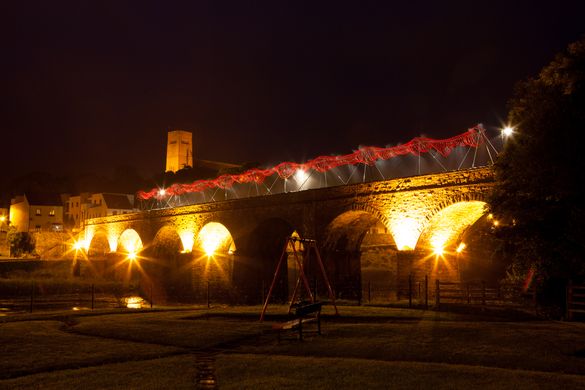
The series of public artworks, from leading artists from the UK, Ireland and Spain - Noah Rose, Aideen Barry and Xevi Bayona, respectively - will be situated on or adjacent to disused railway lines which are now used as walking or cycle paths. The landmark installations will be ambitious in scale, including railway tracks extending 12 metres into the air, and will explore the changing use of disused railway lines and reveal the hidden heritage, industry and local stories associated with the former railway lines.
These unique and highly ambitious artworks will remain in situ until early November in the UK. The CHANGING TRACKS installations will build on Northamptonshire's strengths as a visitor destination to offer a must-see temporary attraction this summer.
As well as attracting new visitors to the county, the three separate temporary artworks will engage with a wide range of leisure and recreational users such as walkers, cyclists, families, fishers, and local community groups including heritage, schools, colleges and local tourism businesses.
Northamptonshire is famous for its historic homes such as Althorp, the resting place of Princess Diana, and Boughton House recent film set for the BAFTA and Oscar award-winning Les Miserables, Silverstone, the home of the F1 British Grand Prix, and its rich industrial footwear heritage, as well as emerging destinations including the Nene Valley, a haven for wildlife and bird lovers.
Covering more than 41,000 hectares, the Nene Valley extends for around 35 miles between Northampton and Peterborough, incorporating the River Nene and bordering the ancient Rockingham Forest.
The closest railway station to the sites is Wellingborough which connects to London St Pancras, Leicester, Nottingham and Sheffield) and they can also be reached via the A45, A14 and A6 by car. For more information about CHANGING TRACKS, please visit www.changingtracks.eu
Notes to editors:
CHANGING TRACKS has received funding from the Education, Audiovisual and Cultural Executive of the European Commission (EACEA) as part of the EU Culture Programme 2007-2013. It is supported by Northamptonshire County Council, UK, Mayo County Council, Ireland and Consortium Transversal Cultural Activities Network, Spain.
CHANGING TRACKS was initiated by Northamptonshire County Council, who as the lead co-ordinator, secured funding for the project from the European Commission. This is the first European-funded arts project to be held in the county and follows the successful London 2012 Cultural Olympiad programme in Northamptonshire.
About the artists:
Aideen Barry's range of artistic expression, from performance, film, sculpture and drawing explores human behaviour, specifically manifestations of anxiety, and strange areas between amusement and discomfort. For CHANGING TRACKS she draws inspiration from a 19th Century publication 'Hints for Lady Travelers' by Lillian Campbell Davidson which offers both useful and (now) ridiculous advice for the independent female traveller. Barry makes strange both the landscape, found history and the experience of being a Flâneuse through her jaunts through the topographies and records of the three sites in this project. Barry will present stop motion video projections which can be seen at unexpected intervals along each of the three cycling/walking tracks and potentially other site specific installation and performative outcomes. One of the main manifestations of the project will be a limited edition interactive publication which will be made available at specially selected spaces at each location.
Salford-based artist, Noah Rose specialises in making work for public spaces and has worked in over 80 locations across the UK, Ireland and Europe. His artistic practice encompasses sculpture, drawing and a range of hybrid three-dimensional work including sculptural typography, architectural metalwork, street furniture and micro-architecture.
Noah's proposal is a 'Museum of Interconnected Events'. The 'museums' will be sculptural installations, incorporating some new media content, each a beautifully designed and made object. The collection will function as an outdoor museum/ gallery creating a sense of intrigue and a desire to 'collect' them all amongst the walkers, cyclists, etc along each route. The 'event cabinets' will contain a variety of artifacts that may include salvaged objects found locally, archival photographs or other documents relating to the impact of the railways on their surroundings, local species diversity and local legends or cultural traditions.
The Catalan artist and architect, Xevi Bayona is well known for his spectacular multimedia installations. His contribution to Changing Tracks aims to present challenging, large scale temporary sculpture, which in some locations may include an upturned railway carriage which may enclose a living tree. In other locations there may be railway tracks installed that leave the ground creating monumental vertical installations. Audience interaction and light may also feature in the finished artwork. This artwork will reference how the introduction of the railways changed both landscape and lifestyle.