 20 Apr 2006

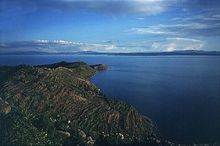
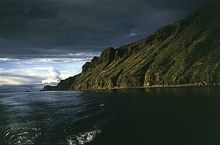
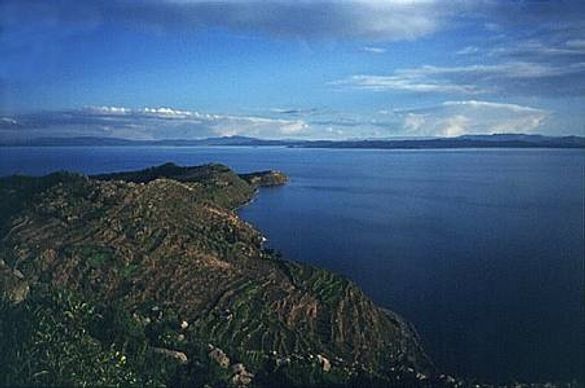
Lake Titicaca, nestled in the vast highland plain of the Puno region in Southern Peru and west of Bolivia, is the world's highest navigable lake lying at 12,500 feet (3,820 m) above sea level in the Andes Mountains. The ancient Andean civilizations of the Quechua and Aymara, the two most important ethnic groups of ancient Peru, believed the lake was sacred, and legend has it that the founders of the Inca Empire, Manco Capac and Mama Ocllo, emerged from its waters.
The origin of the name Titicaca is unknown. It has been translated as "Rock Puma", allegedly because of its resemblance to the shape of a puma hunting a rabbit, combining words from the local languages Quechua and Aymara, and as "Crag of Lead" as well.
Lake Titicaca, a tectonic lake, formed a vast inland sea together with the lakes of Arapa and Yapupampa thousands of years ago. Titicaca averages between 460 and 600 feet (140 and 180 m) in depth, but the bottom which tilts sharply toward the Bolivian shore, reaches its greatest recorded depth of 920 feet (280 m) off Isla Soto in the lake's northeast corner. More than 25 rivers empty their waters into Titicaca.
Very popular among tourists and scientists alike, Government of Peru declared Lake Titicaca a Natural Reserve in October 1978. Lake Titicaca is home to numerous species of birds and water fowl, a few species of fish, and seven amphibians, including a unique species of a giant frog. Lake Titicaca's fish life consists principally of two species: killifish (Orestias) and catfish (Trichomycterus). In 1939, and subsequently, trout were introduced into Titicaca.
Accessible via the city of Puno, visiting Lake Titicaca is an ideal eco-tourism adventure combined with a step back to Peru�s ancient past. Located in the Plateau of Collao, Puno, considered a town of legends, it offers visitors magnificent pre-Hispanic funerary monuments made of stone in the shape of circular towers, chullpas (tombs), colonial churches and rusty ichu-covered natural landscape projecting a spectacular view of the way of life in the high Andean tableland or Peruvian altiplano. Day excursions from Puno are available to the different small islands, Inti, Uros, Taquile, Suasi and others. Different options are available for tourists to experience the unique way that locals live and work every day.
Tourists can fly into Juliaca near Puno on daily flights from Lima and Arequipa or by railroad from Cusco and by land following the Lima-Arequipa-Juliaca-Puno route. Flights are also available every other day from Cusco. Puno offers a variety of accommodations. Taquile Island offers family-run lodgings and Suasi Island has an eco-lodge. On Anapia, the local inhabitants provide lodging to visitors in their own homes. The best months to visit are April to September; rainy season is January through March. However, on February 2 the Virgin of the Candlemas Festival, the most important festival in the region takes place, which is celebrated for a full week with continuous folk dancing of hundreds of different styles.
For more information about Lake Titicaca, call 1-866-661-PERU (in the U.S.) or visit www.peru.info.