 15 Jan 2009

Appeal launched to raise vital funds for Keats-Shelley House, museum for the Romantics in Rome, Italy
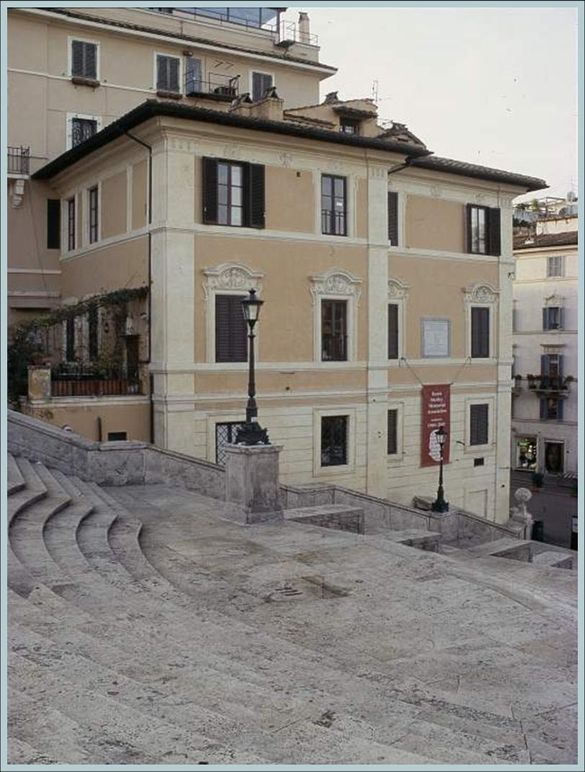
The Keats-Shelley House in Rome opened as a museum in 1909 and has been lovingly maintained by the Keats-Shelley Memorial Association ever since. The Keats-Shelley Memorial Association was founded in 1903 under royal patronage and exists to commemorate Keats, Shelley and the other English Romantics who spent much of their time in Italy, especially Byron and Leigh Hunt, and to stimulate interest in Romantic poetry. The house features in the forthcoming Jane Campion film about Keats� life and also featured in Antony Minghella�s The Talented Mr Ripley.
Looking to the Future
As the Keats-Shelley House approaches its Centenary in 2009, the Keats-Shelley Association is launching an appeal to fund two essential building projects � one to create a storage facility in the 18th-century cellar, and the second, to create an exhibition space, shop, ticket desk, public bathroom, tearoom and terrace on the first floor. This will greatly improve access to the museum and will add immeasurably to the comfort of the growing number of visitors � now 22,000 each year. The Keats-Shelley Association is also looking to build a substantial endowment fund of �1 million, to assure the long-term future of the House.
About Keats-Shelley House
The Keats-Shelley house is a permanent memorial to Keats and Shelley � and contains one of the finest libraries of Romantic literature in Europe, as well as a superb collection of manuscripts, paintings, sculpture and memorabilia.
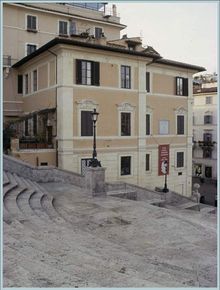
When Keats came to Rome in 1820, the house in which he lodged � the Casina Rossa � was a deep Roman red. It stood at the foot of the steps leading up to the church of the Trinita dei Monti, one of the prettiest squares in Rome. Artists, writers and poets were drawn to it like magnets. By the end of the 19th Century, the house was derelict and threatened with demolition. But it had also become popular with foreign visitors as a shrine to the Romantics in general and Keats in particular.
Dickens, Coleridge, Thackeray and the Brownings were among those who visited. J. Pierpont Morgan, the millionaire philanthropist, was among the first to contribute to a fund to protect the house, and Mark Twain also took part in an event to raise money at the Waldorf Hotel which raised $2,000. The Keats-Shelley Association is now responsible for safe-guarding its future.
Andrew Motion, Poet Laureate and biographer of Keats, stated today:
�The Keats-Shelley house in Rome is one of the world�s best-loved places of literary pilgrimage, and an increasingly important resource for scholars of Romantic literature. For both reasons it deserves the most generous support.�
Harriet Cullen, Chair of the Keats-Shelley Memorial Association, said: �If we can reach 2,000 people who will each donate �500, we will have achieved our endowment target.�
-Ends-
Notes to Editors: � The Keats-Shelley Memorial Assocation was founded in 1903 under royal patronage and exists to commemorate Keats, Shelley and the other English Romantics who spent much of their time in Italy, especially Byron and Leigh Hunt, and to stimulate interest in Romantic poetry. It has its own museum, the house in Rome where Keats died, now the Keats-Shelley House, near the Spanish Steps, and looks after the graves of Keats and Shelley in the Protestant Cemetery. In the UK, the Association publishes an annual learned journal, The Keats-Shelley Review, which is also widely distributed in the US. The competition winners� work is published in this each year. KSMA also runs a programme of poetic events.
For more information on the Keats-Shelley House Centenary Appeal or to arrange an interview with Andrew Motion to speak about the Appeal, please do not hesitate to contact Sophie Rochester at sophie@sophierochester.co.uk or telephone 07968 352213.