 19 Sep 2019
Tags: whales, Hervey Bay, Fraser Coast, Fraser Coast Tourism and Events

This year marks the 30th anniversary of the establishment of a marine park in Hervey Bay and the beginning of a regulated whale watching industry that is now one of the most advanced in the world in the protection of the species and the habitat.
Declared in 1989, two years after the first commercial whale watching began on 1 September 1987, the Hervey Bay Marine Park was set up “ to conserve the natural resources and tidal lands and waters of Hervey Bay as well as the humpback whales that migrate close to the land and stop in the Bay between August and November”.
From August to December the park became a Whale Management and Monitoring Area, regulating human activities in the vicinity of humpback whales and monitoring the effect of this activity to ensure their protection.
It was from these early beginnings that the State Government, scientists, conservationists and the Hervey Bay whale industry worked together to set up a whale watching Code of Practice which has been copied around the world and still underpins the local industry today.
Eventually, the park was enlarged to include areas to the south to Tin Can Bay and in 2006 was renamed the Great Sandy Marine Park, covering an area of about 6000 square kilometres.
The very first time whales were spotted in the Bay is a prominent part of the region’s history and the beginning of an incredible tourism journey, which remains a clear and treasured memory for those lucky enough to be there at the time. The story still unfolding today with Hervey Bay vying to be declared the first Whale Heritage Site in the world.
According to whale watching pioneer, Jill Perry, commercial whale watching began in Australia after an unexpected whale sighting by her husband Brian and some fishing mates aboard their motor vessel Tasman Venture.
“While out fishing they saw what they thought to be logs in the water which then turned over and revealed themselves to be whales,” said Jill. “They soon dropped their rods and picked up cameras”.
David Weatherford, a fishing friend on the boat that day recalls that “within minutes, whales began dancing in the water on all sides, performing and inviting us to share their piece of paradise.
“At first I think most of us were a little cautious, feeling that if one hit the boat we could be in trouble.
“Each whale went completely under and up the other side. In between their frolicking and dancing, they would stick their heads out of the water, hold their position and just look at us as if to say look at how beautiful I am.
“On the way back to Urangan, which took many hours, I spent about an hour alone on the top deck with owner Brian Perry. I do believe this was where his idea of whale watching was born,” said Weatherford.
When told what happened and Brian’s immediate thoughts of starting commercial charters, Jill Perry was quick to dismiss his enthusiasm. “I thought the idea of commercial whale watching charters – people paying to watch whales – was crazy!”
However, her scepticism was not permanent. A few days later Jill put a small advertisement in the weekly Observer newspaper that said: “Brian & Jill Perry of the Tasman Venture are thinking of running a whale watch trip next Tuesday. Anyone interested should phone their office.” No price or phone number was included as this was not an ad, just a free article on page 5.
“Within a week there were six boats going out daily with full boat loads of people wanting to see the whales,” she said.
However, spotting the humpbacks was not so easy. There were fewer whales when the industry first kicked off and the boats were much slower in getting to the the best whale watching grounds in Platypus Bay.
Help came in the form of pilot and current owner of Hervey Bay Whale Watch, John Peaker, who worked with the Perrys in helping to guide the boat to the whales he was easily able to spot in the shallow, clear waters of the bay on flights to Orchid Beach on Fraser Island.
He used an ingenious and simple method to guide the boat to the whales – toilet rolls! Out the window went the roll with John holding one end so there was this unmissable stream of paper in the sky. More toilet rolls meant the whales were further out. Perhaps not so environmentally acceptable today, but it worked then.
“Communication between boats and planes wasn’t easy then,” said John. “There were no mobile phones and boats and planes had radios that operated on completely different frequencies.
“Handheld VHF radios were relatively new, not readily available and were quite expensive.
“Once we spotted the whales we would fly back to circle the boat, get the attention of the crew and drop toilet rolls. One roll for every two miles to the whales, seems strange now thinking back. How times have changed.”
Academic and advisor for international programs with Pacific Whale Foundation, Dr Paul Forestell, credits Hervey Bay with launching whale watching in Australia.
“In the 1960s whales were hunted almost to extinction. In the mid 1970s in Australia whaling had just finished and the number of whales was reportedly only 600,” said Dr Forestell.
It was not long after this that research on whale behaviour in Hervey Bay was undertaken by several scientists, including by Trish and Wally Franklin who took over half a million photos as part of their Oceania Project. The Franklins created a database of whale behaviour and migration patterns which played a role in helping to save the species.
According to Dr Forestell the first research groups in the bay included Pacific Whale Foundation, University of Sydney, the Oceania Project and Southern Cross University. PWF continues to carry out research each season and now has the largest database of Hervey Bay humpback visitors, showing the same whales return each year and proving length of stay, which is up to 10 days.
“Other than the early researchers there were mainly only fishing boats”, according to Dr Forestell.
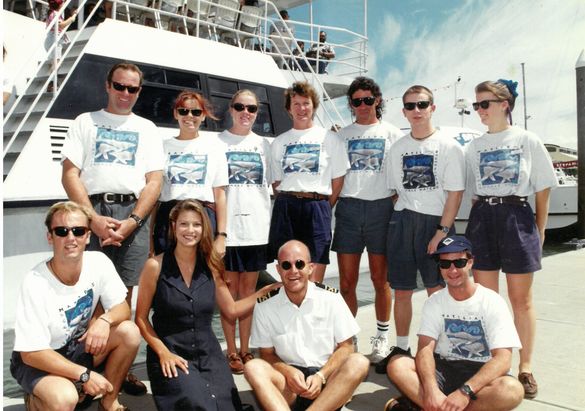
The arrival of fashion identity (and Elle’s sister) Mimi McPherson with Matilda II in 1989 put commercial whale watching on the map, along with her partnership with then captain, Andrew Ellis, a current Fraser Coast Tourism & Events employee.
“Busloads of visitors from Sydney and Brisbane would come to go on her boat. It was a very professional set up with skippers in uniform on a beautiful big boat.
“Andrew and Mimi worked closely with local researchers such as myself and Andrew was there when we first saw Migaloo, the famous albino whale.”
Dr Forestell says “there have been three iterations of the marine park over the years with different regulations and focus. At first, permits were based on how big a boat was, how fast it travelled how many trips per day. Approximately 20 permits were issued.
“ This has transitioned to 10 active permits today.”
“The whale watching fleet was instrumental in the establishment of the marine park by working with government, conservationists, scientists and Hervey Bay park management which issued the permits that evolved from the Hervey Bay Marine Park into the Sandy Straits Marine Park.”
Dr Forestell will be one of the many expert speakers talking about the conservation of the ocean and whales at the World Whale Conference being held for the first time in Australia, in Hervey Bay from 8-11 October.
Tickets are on sale now for the conference. For more information or to buy a ticket for the conference please visit https://www.worldwhaleconference.com/
ENDS