14 May 2020
Tags: Saint Petersburg, St. Petersburg, Russia, Travel to Russia, cultural tourism, Cultural travel, Museums, Hermitage, Winter Palace, Amparus Tour, Amparus Tour Operator

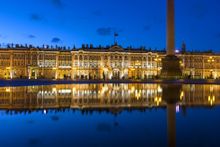
Almost everyone has heard about the Hermitage Museum in Saint Petersburg. When saying “Hermitage”, we usually think of the famous Winter Palace, don't we? However, only a few know that there exist several different “Hermitages” in our northern capital. Let's take a closer look…
The museum complex includes 7 buildings which play different roles and perform different functions. Besides the Winter Palace, the State Hermitage complex includes:
1. The Great (Old) Hermitage
This building, designed to house the library and the Palace collections, looks very modest, laconic and even austere – next to pretentious and colorful facades of the Winter Palace. Today, the Great Hermitage houses collections of Italian art of the 13-18th centuries, including the famous Raphael Loggias which copy the Gallery in the Papal Palace in Vatican.
2. The General Staff Building
The General Staff Building is divided into 2 parts: the eastern wing houses the collections of the State Hermitage and temporary exhibitions of modern art. The western wing hosts the headquarters of the Western Military District. The two parts are separated by a picturesque triumphal arch, which links Palace Square to Nevsky Prospekt (through Bolshaya Morskaya Street).
3. The Building of Menshikov Palace
The Menshikov Palace is located on Universitetskaya Embankment of Vasilyevsky Island. Designed in the Petrine Baroque architecture style, the Palace is one the oldest and the first stone building in Saint Petersburg. In 1981, it becomes a branch of the Hermitage Museum and houses Russian history and culture exposition of Peter the Great period.
4. The Small Hermitage
The building of the Small Hermitage was constructed next to the Winter Palace by the Russian architect Yuri Velten in 1764-1766. Why is it called “Small”? The Russian Empress Catherine II, famous for her “obsession” with the court's entertainments, hosted numerous festive events which she called “small hermitages”. Nowadays, its main and most known exhibit is the famous Peacock Clock, located in the Pavilion Hall.
5. The New Hermitage
10 giant granite Atlantes figures are standing fearlessly at the entrance of the New Hermitage, supporting its magnificent portico. Their granite straight faces today look a bit concerned – as if they ask where are the dozens of annoying tourists with cameras and selfie sticks? They are so used to their constant attention! The statues are magnificent indeed – 5 meters high each one. But don't be fooled by their fit bodies and athletic grace. These granite guys are older than your great-grandmother! The Atlantes were created in 1846 and installed in 1848 (after almost 3 years of hand polishing). 150 Russian stonecutters were involved in the work – which means 15 masters per each sculpture! Quite impressive, isn't it?
It's supposed to be good luck to rub a big toe of one of Atlantes: that should bring happiness to your family life. That's why so many newly married couples are coming here to perform this ritual (which often annoys local guides working with their groups nearby).
6. The Hermitage Theatre
The Theater was built by the order of the Empress Catherine II in 1787. Many great artists have performed in the Hermitage Theatre, such as Mathilde Kschessinska, Anna Pavlova, and Fyodor Chaliapin… Nowadays, the Hermitage Theatre continues to host performances; during the intermission, you can enjoy art exhibitions in the theatre foyer.
7. The Winter Palace
The Winter Palace is the principle building of the Hermitage Museum complex – and the most recognized one. Built in the Baroque style, the luxurious green-and-white Palace is an important symbol of Saint Petersburg. Together with Palace Square, it forms a unique architectural complex – depicted on the numerous postcards and souvenirs. In normal times, the halls of Winter Palace are full of tourists, and it usually takes long hours to wait in the queue (if you have no reservation). It is much easier to arrange your trip with a tour operator and book your tickets in advance – for example, with Amparus Tour – once the pandemic is over!