 21 May 2013

Florida Keys & Key West Booth at Pow Wow: #709
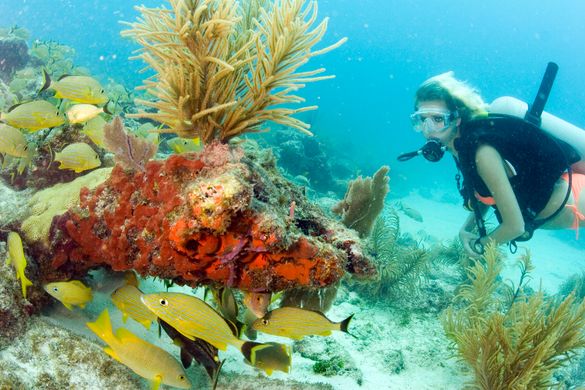
FLORIDA KEYS — Famed around the globe, the clear, warm waters of the Florida Keys attract almost 800,000 scuba and snorkel aficionados annually. There's no better place to learn how to get “up close and personal” with the undersea environment.
The combination of vivid coral reefs teeming with exotic sea creatures and a wealth of professional snorkel/dive operators means the Keys are a ready-made vacation paradise for those ready to jump in the water and start exploring, even as first-timers.
Snorkeling requires just a mask to see underwater, a snorkel for breathing and fins for propulsion — all easily rented or affordably purchased — and can be experienced with minimal instruction.
Scuba diving is more complex, requiring sophisticated equipment and instruction by certified professionals. Instruction generally lasts from one day for an introductory lesson to five days for comprehensive open-water certification.
Whether visitors indulge in scuba or snorkel, the coral reefs of the Florida Keys provide spectacular scenery and an exhilarating encounter with nature.
To maintain the Keys' status as the world's most popular dive destination, the region's offshore environment has been the focus of conservation efforts for more than a generation.
The Florida Keys National Marine Sanctuary, established in 1990, encompasses the coastal waters of the entire island chain from northernmost Key Largo south to the Dry Tortugas, a group of tiny islands 70 miles west of Key West.
Keys conservation efforts began in 1960 when widespread public support laid the foundation for John Pennekamp Coral Reef State Park off Key Largo, named for a late Miami newspaper editor who championed local environmental preservation.
The undersea park's adjacent waters, all incorporated in the marine sanctuary, feature the 9-foot-high “Christ of the Deep,” a 4,000-pound bronze statue installed as an underwater shrine. Created by Italian sculptor Guido Galletti, the statue stands on a 20-ton concrete base in approximately 25 feet of water.
A duplicate of the “Christ of the Abyss” situated in 50 feet of water off the coast of Italy, the “Christ of the Deep” was a gift to the Underwater Society of America from industrialist and undersea sportsman Egidi Cressi. It has become one of the most photographed underwater sites in the world and is a popular spot for underwater weddings.
The 510-foot Spiegel Grove, a retired U.S. Navy Landing Ship Dock, is the third-largest vessel ever intentionally sunk to create an artificial reef. An excellent multilevel dive, the huge ship attracts legions of fish and other marine life. The ship can be viewed by scuba divers, snorkelers and even glass-bottom boat passengers. The Spiegel Grove is about six miles off Key Largo in 130 feet of water. Several mooring buoys provide convenient tie-off points for boaters.
Experienced scuba divers also can explore two vintage sister Coast Guard cutters, the Bibb and the Duane, sunk as artificial reefs off Key Largo in 1987. Positioned just south of Molasses Reef, the 327-foot vessels rest on white sand in 120 feet of water. Diving either of these wrecks requires experience and should be attempted only with a Keys-based dive-charter operator.
A sunken Spanish galleon that dates back to 1733 is the focus of the San Pedro Underwater Archaeological Preserve off Islamorada. Little remains of the underwater wreck after more than 275 years, but it's still a favorite of snorkelers and divers. Seven concrete cannon replicas and an 18th-century ship's anchor were added by curators to enhance the site's atmosphere.
Off Marathon, undersea favorites include the wreck of the Ivory Coast, the obscure remains of a sunken slave ship run aground in 1853; the Thunderbolt, a 188-foot cable layer that served as a research vessel for exploring the electrical energy in lightning strikes, and Sombrero Reef, marked by a large, lighted tower. A notable historic dive site is an artificial reef created from the center span of the old Seven Mile Bridge, originally part of the Keys' historic Oversea Railway.
The Lower Keys are noted for Looe Key Reef, home to large numbers of reef fish and rated by many as one of the most spectacular shallow-water dive experiences possible. Looe Key also is the site of the quirky annual Lower Keys Underwater Music Festival for divers and snorkelers.
Just west of Looe Key lies the 210-foot island freighter Adolphus Busch Senior, an artificial reef that's a popular dive site as well as habitat for marine species.
Key West, replete with luxurious resorts, fine dining and renowned shopping, also offers nearby offshore reefs for snorkelers and wrecks that are frequented by area dive-charter operators.
They include the 65-foot-long Joe's Tug, which rests upright in 65 feet of water surrounded by coral formations; the Cayman Salvager, a 185-foot Coast Guard buoy tender that provides diving opportunities at 70 to 90 feet; and the Gen. Hoyt S. Vandenberg, the world's second-largest vessel ever sunk as an artificial reef. The Vandenberg, which lies in nearly 150 feet of water seven miles off Key West, is recommended for advanced and wreck-certified divers.
For divers and snorkelers with an interest in art, Keys metal sculptor Ann Labriola's Stargazer project rests about five miles southwest of Key West in 22 feet of water. Alive with marine life, the 200-foot-long creation is composed of 10 individual steel structures weighing between 2,000 and 8,000 pounds each, with holes cut out in patterns of star constellations.
For scuba enthusiasts seeking specialty education in the sport, many dive operators in the Florida Keys offer training programs in underwater photography, videography and deep-water technical diving.
While the vast majority of divers will never need it, the Florida Keys has a $1.2 million custom-built hyperbaric chamber at Mariners Hospital in Tavernier. The facility comfortably accommodates five patients at once for the treatment of decompression illness. Patients can listen to music or watch television while being treated.
For more Florida Keys & Key West travel information, including electronic brochures and videos, visit the Keys website at www.fla-keys.com.
Keys social media sites include facebook.com/floridakeysandkeywest, twitter.com/thefloridakeys and youtube.com/floridakeystv.
For personal service, call toll-free, in the U.S. and Canada, 1-800-FLA-KEYS (800-352-5397).
###
fla-keys.com/media
1-800-ASK-KEYS
Contact: NewmanPR/Andy Newman
Mobile: 305-542-6014