 19 Mar 2014

FLORIDA KEYS —Visitorsfrom around the world are drawn to the Florida Keys to experience the island chain's priceless natural resources. Protection of those resources has been an ongoing effort for more than a century, demonstrating the region's commitment to environmental stewardship and preservation for future generations.
It began in 1908 when the Key West National Wildlife Refuge was designated. The refuge incorporates more than 2,000 land acres, all designated wilderness, as well as more than 200,000 acres of marine waters co-managed with the state of Florida.
Accessible only by boat, the refuge is largely composed of unpopulated islands and marine waters located immediately west of Key West. A few islands have sandy beaches that provide critical nesting habitat for sea turtles.
Many of the refuge's beaches, including those at the Marquesas Keys, are open during daylight hours for wildlife-oriented recreational uses such as wildlife observation, nature photography and environmental education. The waters around the refuge's islands and flats are prime territory for fishing, wildlife viewing, diving and snorkeling.
For information, visit www.fws.gov/nationalkeydeer/keyWest/.
The Key West National Wildlife Refuge, along with the Great White Heron National Wildlife Refuge established in 1938, are the last of the offshore raccoon-free islands in the Lower Keys that provide safe nesting and breeding areas for great white herons and other migratory birds and wildlife. White herons are North America's largest wading bird and, according to the U.S. Fish and Wildlife Service, are found only in the Florida Keys and on the South Florida mainland.
Stretching from Key West to just north of the Seven Mile Bridge in the Middle Keys, the refuge features more than 375 square miles of open water and islands in the Gulf of Mexico. Visitors' primary access is by kayak, canoe or shallow-draft boat, although the refuge manages lands on Upper Sugarloaf and Lower Sugarloaf Keys that are accessible by car.
For information, visit www.fws.gov/nationalkeydeer/greatwhiteheron/.
For several decades, leaders and citizens of Big Pine Key and the Lower Keys — located from the west end of the Seven Mile Bridge to just outside Key West — have advocated the responsible use and preservation of the abundant terrestrial and marine wildlife there. That commitment to conservation has earned the region the title of the Natural Keys.
The Lower Keys are home to the National Key Deer Refuge, established in 1957 to protect and preserve habitats for wildlife, most notably the diminutive Key deer. A subspecies of the Virginia white-tailed deer, Key deer average 60 to 90 pounds when fully grown.
Today the refuge encompasses more than 9,000 acres of prime Key deer territory ranging from Bahia Honda Key to the eastern shores of Sugarloaf Key, out to the edge of the Gulf of Mexico. It also is a stopping point for thousands of migratory birds each year, and a winter home for many North American bird species including the roseate tern and peregrine falcon.
Within the refuge are two interpretive nature trails. The Jack C. Watson Trail, named after the first refuge manager and a passionate protector of the Key deer, winds through pinelands into a tropical hardwood hammock. A second wheelchair-accessible route meanders through pine rocklands to a small wetland area.
For information, visit www.fws.gov/nationalkeydeer/.
The continental United States' only living coral barrier reef, the third largest barrier reef in the world, parallels the 126-mile chain of the Florida Keys. The extraordinary reef ecosystem, much like a tropical rain forest, supports a unique diversity of plants and animals.
To protect a portion of the reef, John Pennekamp Coral Reef State Park was dedicated in 1960 asAmerica's first underwater preserve. Today, visitors to the park have numerous opportunities to observe abundant wildlife through recreational and educational experiences. They include scuba diving, snorkeling, kayaking a water trail and walking along a boardwalk through plentiful tropical hammocks of wild coffee bushes and gumbo limbo, strangler fig, tamarind and mahogany trees.
For more information, visit http://www.floridastateparks.org/pennekamp.
Pennekamp is included in the Florida Keys National Marine Sanctuary, widely regarded as a national treasure, which was established in 1990 by the United States government.
The sanctuary encompasses 2,800 square nautical miles of coastal and oceanic waters and submerged lands. Not only does this area surround the entire land mass of the Florida Keys, it also includes vast stretches of Florida Bay, the Gulf of Mexico and the Atlantic Ocean.
The existence of the sanctuary enables management of the region's special ecological, historical, recreational and esthetic resources. Within its boundaries lie mangrove islands, historic shipwrecks filled with rare artifacts, tropical fish and other marine life.
Divers and snorkelers from all over the world are drawn to the Florida Keys to view the extraordinary reef ecosystem within the sanctuary.
For more information, visit www.floridakeys.noaa.gov/.
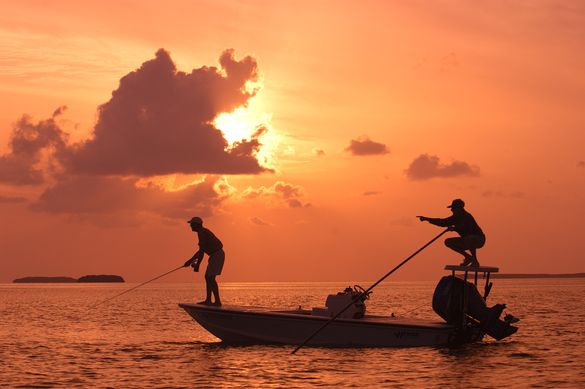
The Keys' commitment to conservation also extends to fishing practices. Catch-and-release fishing, followed by size and bag limits and bans on gill nets and fish traps in state waters have enabled fish stocks to stabilize and grow.
It was in the Florida Keys that the catch-and-release ethic became a way of life for saltwater anglers. Backcountry game fish such as bonefish, tarpon and permit were the first species to be released on a regular basis. Soon to follow were snook and redfish, though a few are still kept for food.
On the ocean side of the island chain, local charterboat captains were the original leaders in releasing billfish — marlin, sailfish and swordfish. Today's Keys captains are leading the way in releasing extra “food” fish like dolphin (mahi-mahi), grouper and snapper. They teach their anglers to “limit their kill” instead of “killing their limit.”
As a result, pelagic (migratory ocean fish), flats and reef species are plentiful throughout the Keys, and world records attest to healthy and productive fisheries.
Like the creation of wildlife preserves and sanctuaries, the promotion of environmentally responsible angling is a crucial element in the Keys' longstanding commitment to conserving and protecting the region's natural resources.
For more Florida Keys & Key West travel information, including electronic brochures and videos, visit the Keys website at www.fla-keys.com.
Keys social media sites include facebook.com/floridakeysandkeywest, twitter.com/thefloridakeys and youtube.com/floridakeystv.
For personal service, call toll-free, in the U.S. and Canada, 1-800-FLA-KEYS (800-352-5397).
###