 25 Sep 2008

Bahrain�s national carrier Gulf Air has, with other leading airlines, Boeing (NYSE:BA) and Honeywell�s UOP, a refining technology developer, established a group to accelerate the development and commercialization of sustainable new aviation fuels.
With support and advice from the world�s leading environmental organizations, the World Wildlife Fund (WWF) and Natural Resources Defense Council (NRDC), the Sustainable Aviation Fuel Users Group makes commercial aviation the first global transportation sector to voluntarily drive verifiable sustainability practices into its fuel supply chain.
The group�s charter is to enable the commercial use of renewable fuel sources that can reduce greenhouse gas emissions, while lessening commercial aviation�s exposure to oil price volatility and dependence on fossil fuels. The airlines supporting the sustainable fuels initiative include Air France, Air New Zealand, All Nippon Airways, Cargolux, Continental Airlines, Gulf Air, Japan Airlines, KLM, SAS and Virgin Atlantic Airways. Collectively, they account for more than 15 percent of commercial jet fuel use.
"We welcome the aviation sector's will to reduce their greenhouse gas emissions, and appreciate their efforts to ensure the sustainability of their biofuels sourcing," says Jean-Philippe Denruyter, WWF Global Bioenergy Coordinator and Steering Board Member of the Roundtable on Sustainable Biofuels. "By teaming up with the Roundtable on Sustainable Biofuels, the aviation sector can build on an existing solid multi-stakeholder process that will reinforce this initiative.�
All group members subscribe to a sustainability pledge stipulating that any sustainable biofuel must perform as well as, or better than, kerosene-based fuel, but with a smaller carbon lifecycle. The user�s group pledged to consider only renewable fuel sources with minimal impacts to the biosphere: fuels that require minimal land, water and energy to produce, and that don�t compete with food or fresh water resources. In addition, cultivation and harvest of plant stocks must provide socioeconomic value to the local communities.
�Gulf Air has always been a pioneering airline, and this agreement underlines our commitment to actually tackling climate change through the introduction of clean and green technologies,� says Gulf Air Chief Executive Officer Mr. Bj�rn N�f.
�Gulf Air�s goals for innovation, sustainability, and greener flying are bold and comprehensive. By being actively involved in this biofuel initiative, Gulf Air believes it can play a key role in addressing today's environmental challenges, and help build a better future for our children, the local community and the world.�
Gulf Air�s Chief Strategy Officer Tero Taskila, who is heading the biofuel initiative as part of the airline�s newly-launched corporate social responsibility initiative agreed.
"Our long term CSR vision combines economic benefit with conservation and sustainability. The biofuel programme is one of our first initiatives towards achieving our vision which we hope in the long run will result in substantial return on investment for all the stakeholders" says Mr. Taskila.
"Airlines that have introduced next generation sustainability programmes have already seen substantial cost savings while efficiently managing their carbon footprint."
The group has announced two initial sustainability research projects. Yale University�s School of Forestry & Environmental Studies, through funding provided by Boeing, will conduct the first peer-reviewed, comprehensive sustainability assessment of jatropha curcas, to include lifecycle CO2 emissions and the socio-economic impacts to farmers in developing nations. Similarly, NRDC will conduct a comprehensive assessment of algae to ensure it meets the group�s stringent sustainability criteria.
Both species may potentially become part of a portfolio of biomass-based renewable fuel solutions that, through advanced fuel processing methodologies developed by energy sector leaders such as UOP, can help aviation diversify its fuel supply.
"This taskforce comes at just the right time to help airlines cut costs and decrease their greenhouse gas emissions," said Liz Barratt-Brown, NRDC senior attorney. "If done right, sustainable biofuels could lower the airlines' carbon footprint at a time when all industries need to be moving away from fuels with high levels of global warming pollution, especially high carbon tar sands and liquid coal."
ENDS
For further information please contact Gulf Air Corporate Communications on:
Abby Smith on + 44 7748840932
Or
Alec Peck on +973 17338228 or +973-39404490
About Gulf Air
Gulf Air was founded in 1950. Today, it is owned by the Kingdom of Bahrain, and is the only truly pan Gulf carrier in the region. The airline�s network stretches from Europe to Asia and covers 42 cities in 27countries. The current fleet of Gulf Air consists of 29 aircraft.
On January 17th Gulf Air Board of Directors confirmed the appointment of Bj�rn N�f as the Chief Executive Officer for Bahrain�s national carrier.
Mr. N�f, who brings across the broad experience in aviation industry, has been instrumental in implementing the new revamped network launched on July 1 and is also the commander of a major alignment program to turnaround Gulf Air. The plan entails a simplified and more efficient organization structure; an improved network with lower connection times and better service to key destinations, better on-board product, better customer service on the ground and a better punctuality, which has been improving under his command.
The new network, based on a "wave" model, offers as many as 588 flights every week in the Middle East with more non-stop flights than any other airline.
The airline is also planning to re-fleet itself over the next five years to further strengthen its presence. It recently signed a deal worth nearly US $ 6 billion with Boeing Co. to purchase up to 24 Boeing 787 aircraft and another deal with Airbus for 35 aircraft, including A320s and A330s.
The airline aims to become the carrier of choice. Gulf Air�s onboard service caters high quality products and services, including the innovative, unique and award winning Sky Chefs and Sky Nannies.
Some of the notable recognition include:
Best Onboard Catering in First Class 2007 (Sky Trax Awards)
Best Onboard Catering in First Class 2006 (Sky Trax Awards)
Best Onboard Catering in Business Class 2006 (Sky Trax Awards)
Best Business Airline 2006 (British Travel Awards)
Best Onboard Service 2006 (Gold) (Mercury Awards)
Best Onboard Catering in First Class 2005 (Sky Trax Awards)
Best Onboard Catering in Business Class 2005(Sky Trax Awards)
Best designed in-flight magazine 2005 (American Creativity Awards)
Middle East Leading First Class Airline 2005 (World Travel Awards)
World�s Leading Airport Lounge 2005 (World Travel Awards)
Middle East region�s best airport restaurant for its restaurant in Bahrain
International Airport lounge 2005 (PAX International Readership Awards)
Official Airline and Sponsor of the Gulf Air Bahrain Grand Prix 2008
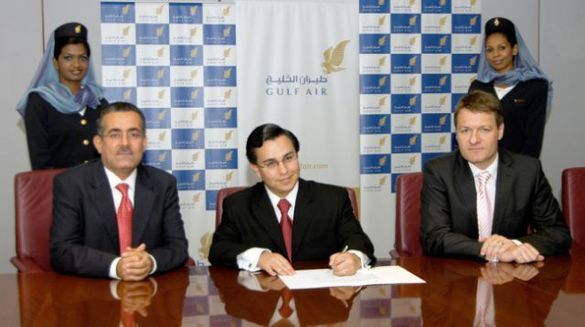
Photo Caption 1 (From Left to Right): Gulf Air Deputy CEO Ismail Karimi, Jorge A Molina, Regional Marketing Director, Middle East / Africa, The Boeing Company and Mr Bj�rn N�f, Chief Executive Officer, Gulf Air signing a Sustainable Aviation Fuel Users Group Memorandum of Understanding and Sustainability Pledge.
Photo Caption 2: Tero Taskila, Chief Strategy Officer
If you require any further information please do not hesitate to contact me.
Kind regards.
Abby Smith PR Manager Europe Gulf Air + 44 7748840932 Gulf Air Public Relation