 16 Jun 2016
Tags: Edgar Degas New Orleans, Degas House, Edgar Degas House Creole Impressionist Tour, Champagne with Degas (30 Min N.O. City Tour Add-on), Edgar Degas Home in New OrleansDaily Tours, Daily Tours New Orleans, Tours New Orleans

Impressions of Degas
Edgar Degas' New Orleans experience never came up in my art history classes or in museums. The connection baffled me. What brought the great French Impressionist to New Orleans, and what did he do there?
Degas House—now a lovingly restored bed-and-breakfast, museum and event venue—remains one of the city's best-kept secrets. Even many New Orleans' natives don't know about Degas House.
It wasn't until I tracked down owner David Villarrubia, a former international airline pilot who grew up in the historical Esplanade Ridge neighborhood, that the puzzle pieces fell into place.
Catalyst for Impressionism
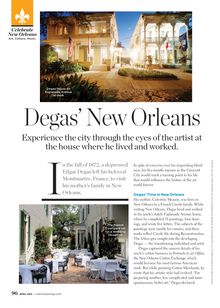
In 1872, weary from fighting in the Franco-Prussian War, dealing with failing eyesight, and depressed after losing his best friend and the love of his life, Degas took a break to regroup. He left Paris to visit his mother's birthplace and Creole family in New Orleans.
During his visit, Degas stayed in the family's stately home on fashionable Esplanade Avenue. Inspired by this most exotic of American cities and still developing his painting style, Degas was extremely prolific, creating 18 paintings during his four-and-a-half-month visit.
The city's crisp, bright light and atmospheric conditions impacted Degas' work and contributed to the evolution of his vision. In a letter from New Orleans to fellow artist James Tissot, Degas wrote: “I am preparing another less complicated and more spontaneous, better art... This is my present style.”
Degas was the only French Impressionist ever to visit America, and many art historians believe the turning point in his artistic career took place in Degas House. Some even suggest New Orleans was an art incubator for Impressionism.
After Degas' artistic epiphany, he returned to Paris, where he and Monet cofounded the Impressionism Movement. Within a year of his return, Degas and his new works received critical acclaim at the first exhibition by the artists who would later be known as Impressionists. And the rest is history.
The Past Comes Alive
“Art history actually changed in this house—this was the turning point of Degas' professional life and why it is so important,” said Villarrubia. It's also the only place in the world where Degas lived and painted that an aficionado can visit, sleep or marry in today.
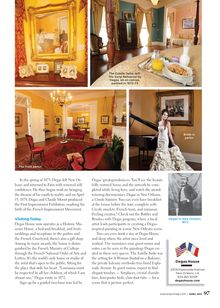
Guided tours are given twice daily by Degas' great-grandnieces, Joan Prados and Marie Estelle Moyer. Every painting featured on the tour has a recognizable part of the house in it. The sisters point out architectural details and decor that served as backdrops for family paintings.
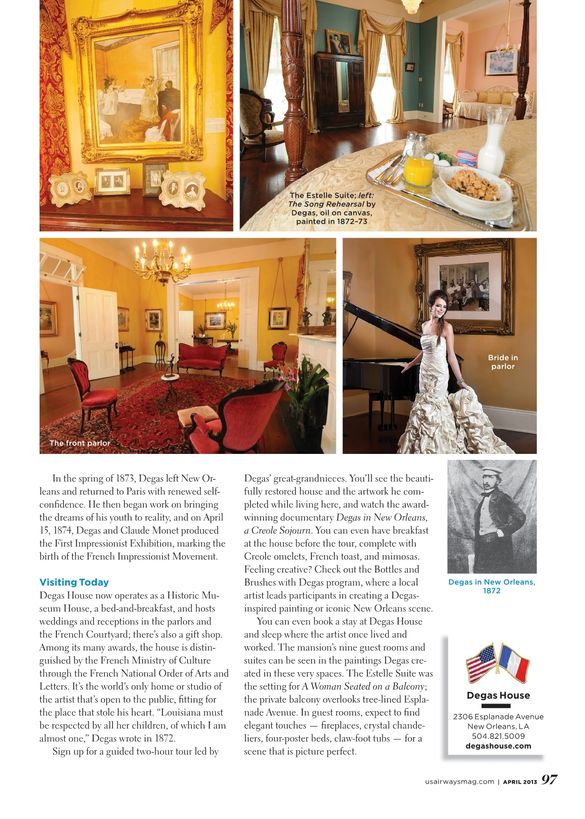
Rooms and suites are named for family members who lived in them. The popular Estelle Suite, with soaring 12-foot ceilings, a fireplace and private balcony, is most often requested by brides. It's named for Degas' cousin, who was one of his favorite models. He also painted Woman Seated on the Balcony, with Estelle's sister Mathilde serving as model, on the suite's balcony.
The two-hour Edgar Degas House Creole Impressionist Tour starts with a documentary on Degas in New Orleans. Next comes a history-packed house tour, followed by a walking tour of the surrounding historical district's highlights. It's all accented by rich, sometimes juicy, gossip-filled commentary by Prados and Moyer.
Aided by a 10-foot-tall, hand-painted family tree, the sisters dish the inside scoop on a soap-opera-worthy saga. They share glimpses into the colorful family's convoluted history, from high art and social standing to scandalous affairs. By the time they're finished, the family makes the Kardashians look boring.
Guests have the option of further indulging in the Gourmet Creole Breakfast tour package with Bananas Foster French Toast or overstuffed Crawfish Etouffee Omelettes.
Whether staying in Degas House or simply visiting, this is the side of Degas a visitor won't ever see in museums, and it's certainly a colorful addition to art history's annals.
The Degas Experience
Degas House is just the beginning of the Degas Experience. About a mile northwest on Esplanade Avenue, in the New Orleans Museum of Art, visitors can view 15 of his original works, including bronzes, paintings and pastels. Portrait of Estelle, painted in Degas House, is considered the collection's crown jewel and is usually on view.
For a taste of Degas' New Orleans, visitors can enjoy lunch al fresco at the Cafe Degas, located between Degas House and the museum. It's a charming bistro serving traditional French fare, such as escargot, onion soup, crepes and creme brulee.
Also worth a stop is the magnificent Garden District mansion where Degas' wealthy uncle, Michel Musson, lived before the cotton market crashed after the Civil War and the family lost its fortune. The flamingo-pink house on Third and Coliseum is just a few blocks from Sandra Bullock's mansion.
Finally, a Degas Experience would be incomplete without paying respects at the Musson family tomb in St. Louis Cemetery No. 1—a stop on New Orleans Tours' popular Cemetery and Voodoo Tour.
Michelle Newman is a freelance writer and designer from San Antonio.