 12 Mar 2014

Easter is a special time in Italy, a joyous spring event that brings together religious traditions and culinary delights, an occasion to celebrate with family or take advantage of the warm spring weather to travel and explore something new.
Being the centre of Christianity a lot of emphasis is placed on the religious aspects of Easter. However the visitors to Italy at this time can enjoy delicious Easter eggs of all shapes and sizes (many artisan made), Easter Colomba (dove) cake, seasonal dishes such as young lamb and artichokes.
Here are some of the most famous events occurring at Easter time:
EASTER MARKET IN TRENTO
Trento , 10 – 21 April 2014
Trento, famous for its Christmas market, has now launched an Easter Market. From 10 to 21 April, the Piazza Duomo will be teeming with stalls selling handicrafts, chocolate eggs, colomba cakes and other delicacies all linked to Easter in the Dolomites.
GOOD FRIDAY PROCESSION ON PROCIDA ISLAND
Procida Island, Gulf of Naples, 18 April 2014
The Good Friday procession on the Island of Procida in the Gulf of Naples is a tradition that started in the late 17th century. The Confraternita dei Turchini (group of island men dressed in sky blue cloaks) carry in a procession allegorical floats representing the various stages of the Cross from the oldest part of Procida to the port of Marina Grande. The floats are hand-made each year by the Confraternita’s men, the statue of the dying Christ is carried last to close the procession which is marked by sound of drums and trumpets.
LA SEMANA SANTA IN ALGHERO (SARDINIA)
Alghero – Easter Week – 14 – 20 April 2014
Alghero celebrates Holy Week according to the rites of an ancient Spanish tradition dating back to 1501. The celebrations will open on Tuesday with the "Dimas Sant 'with the procession of Sorrowful Mysteries, on Thursday "Dijous Sant" the Via Crucis is held, on Friday "Divendres Sant" there is the rite of “desclavamant ", the taking down of the body of Christ from the cross and the deposition. The “Dissabte Sant “, Saturday is the holy day of the vigil until Easter Sunday, when the Risen Christ will meet the Virgin among doves and fireworks.
MADONNA CHE SCAPPA (THE DASHING MADONNA) in Sulmona, Abruzzo
Sulmona, Abruzzo, Easter Day 20 April 2014
This event takes place every year the morning of Easter Day in the spectacular Piazza Garibaldi, crowded with people. The members of the Confraternita Santa Maria di Loreto, carry the statues of St Peter and St John in a procession to the Church of St Philip. The church’s door then opens and the statue of the Virgin Mary is carried out, wearing a back cloak, a sign of mourning. Half way, she “meets” the statue of her Son, she “dashes” towards him, letting her cloak fall, revealing a bright green dress.
SACRED REPRESENTATION OF GOOD FRIDAY
Valmontone – Rome – 18 April 2014
The procession on Good Friday, has taken a typically theatrical role with performances drawing inspiration from medieval times. The "Sacred Representation "of Valmontone refers to this style and is over a century old. The actors recite texts based on the Holy Scriptures. The story starts from the New Testament, continues with the reconstruction of the Nativity and follows the events of Christ's life. The Via Crucis and deposition from the Cross concludes the procession.
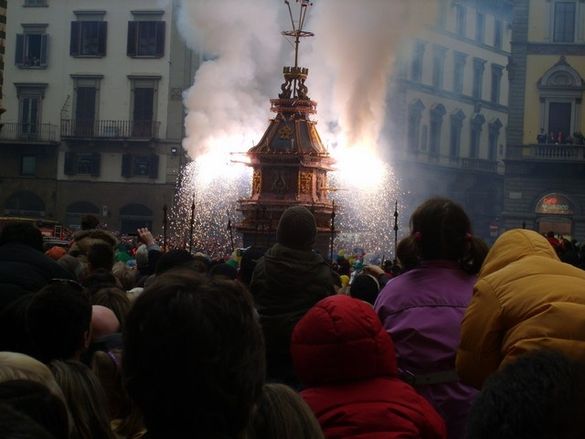
THE EXPLOSION OF THE CART
Florence - Easter Sunday –20 April 2014
Tradition says that during the first Crusade of 1096 the Florentine knight Pazzo de 'Pazzi was the first man who planted the banner of the Cross on battlements of Jerusalem and as a gift he received some fragments of the Holy Sepulchre. Upon his return to Florence the stones were used to start the Sacred Fire of Holy Saturday, and were paraded through the city as homage to it in a richly decorated chariot. Nowadays, on Easter Sunday a large wagon is pulled by white oxen in a procession in the streets of the centre of Florence to the front of the cathedral.
THE RITES OF PASSION IN BARILE (BASILICATA)
Barile - Potenza – Good Friday – 18 April 2014
In Barile, the Via Crucis is interpreted with great intensity by its actors. Along the route of the Way of the Cross there are several stages built to represent the various episodes of the Passion of Christ. Alongside the authentic re-constructions of the Gospel stories, there suddenly also appear fantasy figures related to our ancestral fears. The "Negro" representing a stranger, the "Gypsy" character a dark symbol of wealth that hides evil and danger are very important figures of popular collective atonement.
RITES AND PROCESSION OF THE SICILIAN EASTER TRADITION
Trapani - "The Procession of the Mysteries" - Good Friday – 18 April 2014
The Procession of the Mysteries is held in Trapani from 2pm of Good Friday and continues for almost twenty-four hours until the Saturday. It is the longest religious event in Italy and one of the oldest. This event consists of the transport of 20 groups of statues (Sacred Mysteries) representing the various stages of the Via Crucis through the city. The statues were made between the 17th and 18th century.
Modica - Ragusa - "MARONNE vasa vasa" – Easter Sunday – 20 April 2014
The Easter morning in Modica, a spectacular procession takes place with two parades that walk along the streets of Ragusa with statues of Christ and the Virgin Mary.
Adrano-Catania - "The Devils" - Easter Sunday – 20 April 2014
On Easter Sunday in Adrano a representation called "The Devil" takes place every year. This is a folklore event were Good and Evil are represented; the Devils are led by Lucifer on one side and Paradise on the other. This representation is focused on the triumph of Good and of Light in the world.
Prizzi-Palermo - "The abballu de li diavuli" - Easter Sunday – 20 April 2014
"The Abballu de daivuli" is a representation of grotesque and frightening masks of zinc dressed with red robes, the devils, which run thourgh the village on Easter Sunday trying to trap as many souls as possible until the afternoon, when after the meeting of the Virgin Mary with the Risen Christ the devils will be harnessed and carried by angels to the Virgin Mary.
-Ends-
For further information please contact:
Stefania Gatta
Tel: 020 7399 3555
Email: stefania.gatta@enit.it