 19 May 2004

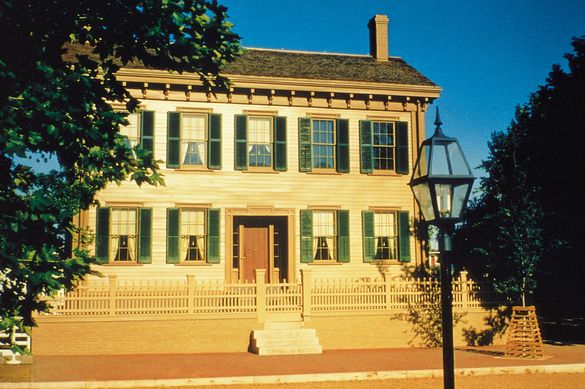
Lincoln Home-The only home Abraham Lincoln owned, this 1838 frame house is located in the four-block National Historic Site. In the spring of 1844, Abraham and Mary Todd Lincoln purchased the house for $1,200 cash, plus a lot west of the public square valued at $300. The house, 1� stories in the Greek Revival style, was constructed with wooden pegs and hand-wrought nails. Three of Lincoln�s four sons were born and one died in this house. In 1856 the house was enlarged, including raising the roof to a full two stories, to accommodate the growing family. The home today contains furnishing appropriate to the period when occupied by the Lincolns, including some pieces original to the Lincoln family. Lincoln�s Home is the only national historic site in the state.
Lincoln-Herndon Law Offices-Abraham Lincoln practiced law in this building from 1843 until 1852, first with Stephen P. Logan and later with William H. Herndon. Today visitors can see a restoration of his law offices. This building also housed the only Federal Court in Illinois between 1840 and 1855. Those offices have also been restored and furnished. A multi-media presentation describes some of cases tried by Abraham Lincoln in this Court and portrays the lives of the famous men who worked in this building.
Lincoln�s New Salem-Abraham Lincoln spent six years of his early adulthood in New Salem. It was here that he clerked in a store, chopped wood, enlisted in the Black Hawk War, served as postmaster and deputy surveyor, failed in business, and in 1834 was elected to the Illinois General Assembly. Today this recreated village has 23 authentically reproduced buildings, including Rutledge Tavern, a carding mill, the Lincoln-Berry Store, Miller�s Blacksmith Shop, the village school, and log homes.
Lincoln Tomb-Abraham Lincoln was buried in Oak Ridge Cemetery in Springfield on May 4, 1865. A tomb was later built with public contributions at a cost of $18,000 and dedicated in 1874. A few days before the formal dedication, Lincoln�s coffin was moved to a white marble sarcophagus on the floor in the center of the burial chamber. Years later following the tomb�s reconstruction, Lincoln�s body was placed in a steel and concrete vault beneath the floor of the chamber. Mary Todd Lincoln and three of the four Lincoln sons are also buried in the tomb. Lincoln�s Tomb, with its dressed granite exterior rising 116 feet, is located in a 320-acre historic cemetery. Every Tuesday evening from June through August, the 114th Reactivated Civil War Infantry Unit performs a flag retreat ceremony, presenting the flag to an audience member.
Old State Capitol-The Old State Capitol, built in 1837, is considered a perfect example of Greek Revival architecture, as well as one of the most historic buildings west of the Alleghenies. The rooms are furnished in the period of 1840 to 1860, with many objects relating to famous people who frequented the building, such as Stephen A. Douglas, Abraham Lincoln, and Ulysses S. Grant. It was here on June 6, 1858, that Lincoln delivered his famous �House Divided Speech.� After Lincoln�s assassination in 1865, his body lay in state in the House of Representatives. The painting of George Washington behind the dais is one of nine artifacts known to have been in the original building.
State Capitol-Constructed in the 1860s, the Capitol is the current home of the Illinois Legislature and houses many state government offices. It rises 461 feet above the city, took 21 years to complete, and cost $4.5 million. The building, which has several huge paintings, also contains the Hall of Governors and a bronze figure representing Illinois welcoming the world to the Colombian Exposition of 1893. The Howlett Building is part of the Capitol Complex and was erected to commemorate the 100th anniversary of the state�s admission to the Union. Flags carried by Illinois regiments during the Civil War, Spanish-American War and World War I have been preserved and are displayed in the Hall of Flags.
Dana-Thomas House-This is one of the best preserved and most complete of Frank Lloyd Wright�s early �Prairie� houses. It was constructed in 1902-1904 for Springfield socialite and female activist Susan Lawrence Dana. The house contains more than 100 pieces of original Wright-designed furniture, as well as 250 examples of art glass doors and windows and approximately 200 original art-glass light fixtures. The dining room, which can seat 40, and the studio/gallery/ballroom are two of the most-photographed spaces in the history of American architecture.
Thomas Rees Memorial Carillon-This is one of the largest and finest of the world�s carillons. The site of numerous public concerts, the International Carillon Festival is held here each June. The Carillon is open for tours that provide a spectacular view of Springfield from the highest point of elevation in the city. Within the open tower lay 66 bronze bells cast by a 300-year-old bell foundry in the Netherlands. The bells have a range of 5� chromatic octaves, all played manually on a keyboard located in the carilloneur�s cabin. The bells weigh a total of 73,953 tons, with individual bells ranging from 22 pounds to 7� tons.
Lincoln Depot-Abraham Lincoln bade farewell to Springfield and boarded a train for Washington, D.C. from this historic depot on February 11, 1861. His famous parting words, �To this place, and the kindness of these people, I owe everything...�, are said to rank in eloquence with the Gettysburg Address. The depot offers re-created waiting rooms, historic photographs and a lively slide show depicting Mr. Lincoln�s 12-day train journey to Washington DC and his inauguration. Contains music of the period and spiced with political cartoons and editorial jabs at the newly elected president, it realistically portrays the turmoil facing the new leader of a country on the brink of civil war.
Lincoln Memorial Garden-Designed by Jens Jensen, an internationally known landscape architect, this woodland garden is dedicated as a living memorial to Abraham Lincoln. It consists of 77 acres along the shores of Lake Springfield, devoted entirely to plants, trees and flowers native to Illinois. There are five miles of nature trails, a nature center offering educational exhibits and workshops, and a gift shop. Seasonal festivals, including Indian Summer Festival, Holiday Market, and Maple Syrup Time, celebrate the ever-changing beauty of nature.
Edwards Place-Built in 1833, the Edwards Place is the oldest house on its original site in Springfield and is currently a historical museum, art gallery, art school and library. The house contains many furnishings and decorative pieces typical of a fine Victorian house of the 1800s. Abraham Lincoln gave several political speeches from the porch balcony, while the spacious grounds provided the perfect setting for political rallies at which both Lincoln and Stephen Douglas spoke.
Executive Mansion-The Illinois Executive Mansion has the distinction of being the third oldest continuously occupied Governor�s Mansion in the Nation. Seven U.S. presidents have been received here and several men who either had been or would become president have been guests, including Abraham Lincoln. The Executive Mansion is a museum, containing many priceless works of art, including the Lincoln Table, created in 1864 from more than 20,000 pieces of inlaid wood, and a smiling bust of Abraham Lincoln for which he posed for artist Thomas D. Jones. The Mansion is also a home filled with the memories of the lives and families of many Illinois governors and those who came to visit.
###
Media Contact: Sharon Johnson +1 (217) 789-2360, ext 136 sjohnson@springfield.il.us