 26 Feb 2014

David Bowie is presents the first international retrospective of the extraordinary career of David Bowie -- one of the most pioneering and influential performers of our time. More than 300 objects, including handwritten lyrics, original costumes, photography, set designs, album artwork, and rare performance material from the past five decades are brought together from the David Bowie Archive for the first time.
The exhibition demonstrates how Bowie's work has both influenced and been influenced by wider movements in art, design, theater, and contemporary culture and focuses on his creative processes, shifting style, and collaborative work with diverse designers in the fields of fashion, sound, graphics, theatre, and film. The exhibition's multimedia design introduces advanced sound technology by Sennheiser, original animations, and video installations to create an immersive journey through Bowie's artistic life. This exhibition was organized by the Victoria and Albert Museum, London, and is on view at the Museum of Contemporary Art (MCA) Chicago from September 23, 2014 to January 4, 2015.
The exhibition takes an in-depth look at how David Bowie's music and radical individualism has both influenced and been influenced by wider movements in art, design and contemporary culture. The exhibition also demonstrates how he has inspired others to challenge convention and pursue freedom of expression. The exhibition explores the broad range of Bowie's collaborations with artists and designers in the fields of fashion, sound, graphics, theatre, art and film.
On display are more than 60 stage costumes including Ziggy Stardust bodysuits (1972) designed by Freddie Buretti; Kansai Yamamoto's flamboyant creations for the Aladdin Sane tour (1973); and the Union Jack coat designed by Bowie and Alexander McQueen for the Earthling album cover (1997). Also on view is photography by Brian Duffy, Terry O'Neill, and Masayoshi Sukita; album sleeve artwork by Guy Peellaert and Edward Bell; cover proofs by Barnbrook for the latest album The Next Day (2013); visual excerpts from films and live performances, including The Man Who Fell to Earth (1976) and Saturday Night Live (1979); music videos such as Boys Keep Swinging (1979) and Let's Dance (1983); and set designs created for the Diamond Dogs tour (1974). Alongside these are more personal items such as never-before-seen storyboards, handwritten set lists and lyrics as well as some of Bowie's own sketches, musical scores and diary entries, revealing the evolution of his creative ideas.
Exhibition Overview
The exhibition offers insight into Bowie's early years and his first steps towards musical success. Tracing the creative aspirations of the young David Robert Jones (born 1947 in Brixton, London), it shows how he was inspired by innovations in art, theatre, music, technology and youth culture in Britain in the aftermath of World War II. Pursuing a professional career in music and acting, he officially adopted the stage name 'David Bowie' in 1965 and went through a series of self-styled changes from Mod to mime artist and folk singer to R&B musician in anticipation of the shifting nature of his later career.
On display are early photographs, LPs from his musical heroes such as Little Richard, and Bowie's sketches for stage sets and costumes created for his bands The Kon-rads and The King Bees in the 1960s. This opening section concludes with a focus on Bowie's first major hit Space Oddity (1969) and the introduction of the fictional character Major Tom, who would be revisited by Bowie in both Ashes to Ashes (1980) and Hallo Spaceboy (1995). Inspired by Stanley Kubrick's 1968 film 2001: A Space Odyssey, the single was released to coincide with the first moon landing and was Bowie's breakthrough moment, granting him critical and commercial success as an established solo artist.
The exhibition moves on to examine David Bowie's creative processes from song writing, recording, and producing to designing costumes, stage sets, and album artwork. Working within both established art forms and new artistic movements, this section reveals the scope of his inspirations and cultural references from Surrealism, Brechtian theatre and avant-garde mime to West End musicals, German Expressionism and Japanese Kabuki performance.
On view are some of Bowie's own musical instruments, footage and photography of recording sessions for Outside (1995) and 'Hours…' (1999) as well as handwritten lyrics and word collages inspired by William Burroughs' 'cut up' method of writing that have never previously been publicly displayed.
David Bowie is chronicles his innovative approach to creating albums and touring shows around fictionalized stage personas and narratives. 1972 marked the birth of his most famous creation; Ziggy Stardust, a human manifestation of an alien being. Ziggy's daringly androgynous and otherworldly appearance has had a powerful and continuous influence on pop culture, signaling a challenge of social traditions and inspiring people to shape their own identities. On display is the original multi-colored suit worn for the pivotal performance of Starman on Top of the Pops in July 1972, as well as outfits designed for stage characters Aladdin Sane and The Thin White Duke. Costumes from The 1980 Floor Show (1973), album cover sleeves for The Man Who Sold the World (1970) and Hunky Dory (1971), alongside press cuttings and fan material, highlight Bowie's fluid stylistic transformations and his impact on social mobility and gay liberation.
The final section celebrates David Bowie as a pioneering performer both on stage and in film, concentrating on key performances throughout his career. An immersive audio-visual space presents dramatic projections of some of Bowie's most ambitious music videos including DJ (1979) and The Hearts Filthy Lesson (1995), as well as recently uncovered footage of Bowie performing Jean Genie on Top of the Pops in 1973, and D.A. Pennebaker's film Ziggy Stardust and the Spiders from Mars: The Motion Picture (1973). A separate screening room shows excerpts and props from Bowie's feature films such as Labyrinth (1986) and Basquiat (1996). In addition, this gallery traces the evolution of the lavishly produced Diamond Dogs tour (1974), the design of which was inspired by Fritz Lang's film Metropolis (1927) and George Orwell's novel Nineteen Eighty-Four (1949).
The tour combined exuberant choreography and a colossal set design, taking the combination of rock music and theater to new heights. On display are previously unseen storyboards and tour footage for the proposed musical that Bowie would eventually transform into the Diamond Dogs album and touring show. An area has been dedicated to the monochrome theatricality of Bowie's Berlin period and the creation of the stylish Thin White Duke persona identified with the Station to Station album and tour (1976). It also investigates the series of experimental and pioneering records he produced between 1977 and 1979 whilst living in Germany, known as the Berlin Trilogy. David Bowie is concludes with a room of towering projections of footage from his signature concert tours as well as the costumes that defined them.
Publication
The exhibition is complemented by a richly illustrated book edited by Victoria & Albert Museum curators Victoria Broackes and Geoffrey Marsh. It includes contributions from leading academics and experts in musicology and cultural history. This publication is the first to draw in full from the David Bowie Archive.
Curators
The exhibition was originally organized for the Victoria & Albert Museum, London by curators Victoria Broackes and Geoffrey Marsh. Victoria Broackes is the Head of Exhibitions for the Department of Theatre and Performance at the V&A. Geoffrey Marsh is the Director of the Department of Theatre and Performance at the V&A. At the MCA, the exhibition is curated by Michael Darling, James W. Alsdorf Chief Curator.
Tour
Victoria & Albert Museum, London: March - August 2013
Art Gallery of Ontario, Toronto: September - November 2013
Museum of Image and Sound, Sao Paulo, Brazil: January - April 2014
Museum of Contemporary Art, Chicago: September 2014 - January 2015
Philharmonie de Paris | Cité de la Musique, Paris: February - May 2015
Groninger Museum, the Netherlands: December 2015 - March 2016
David Bowie in The Kon-rads, photograph by Roy Ainsworth (1963)
David or 'Davie' Jones, as he was then, became heavily involved in London's burgeoning music scene at a young age. Before leaving school at the age of 16, he had already joined the band The Kon-rads, playing saxophone and singing vocals. Demonstrating the experimental energy that has driven his solo career, Bowie spent the 1960s trying out different musical, artistic and sartorial styles and performing with several different bands. In 1965 he changed his stage name to David Bowie. The exhibition features several objects from Bowie's early career including sketches of set, costume and poster designs created for his first bands and footage of early performances.
Ziggy Stardust jumpsuit designed by Freddie Buretti (1972)
On July 6, 1972 David Bowie performed Starman, the first single from his album The Rise and Fall of Ziggy Stardust and the Spiders from Mars, on BBC One's Top of the Pops. This pivotal performance was crucial in making Bowie a music star and is acclaimed as a watershed moment which changed rock music and youth culture forever. Appearing on national television with flame-orange hair, make-up, multi-coloured clothing and red patent boots, Ziggy's otherworldly look and sexual ambiguity created a seismic shift in pop culture. The exhibition features the original suit and boots created by Freddie Buretti and designed in collaboration with Bowie, who took inspiration from the costumes worn by the 'droogs' street gang in Stanley Kubrick's film adaptation of A Clockwork Orange (1971).
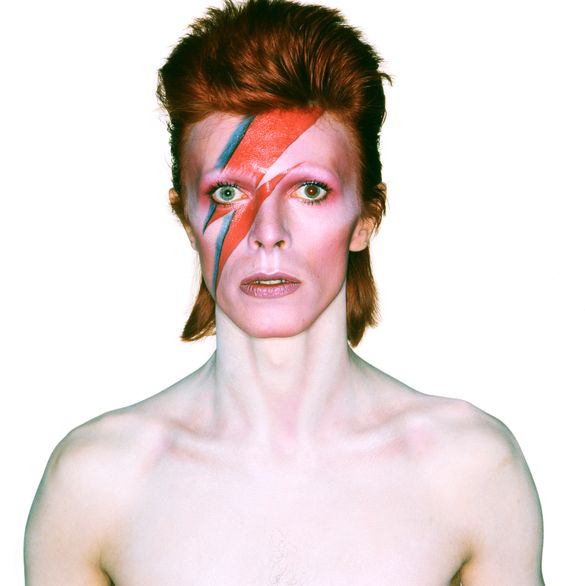
Brian Duffy photograph of David Bowie for the Aladdin Sane album cover (1973)
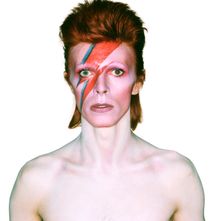
Influenced by contemporary performance art and theatrical traditions, David Bowie was drawn to create dramatic, fictionalised stage personas. His sixth studio album marked the birth of the 'schizophrenic' character Aladdin Sane who was a development of the space-age Japanese-influenced Ziggy Stardust. To create the compelling album cover image, Bowie collaborated with photographer Brian Duffy, Celia Philo and make-up artist Pierre Laroche. The result was one of the most recognizable images in popular culture; a 'lightning flash' design which has been reproduced in multiple forms world-wide and referenced by celebrities including Lady Gaga and Kate Moss. On display is Brian Duffy's contact sheet from the Aladdin Sane album cover shoot.
Cut up lyrics by David Bowie for 'Blackout' from “Heroes” (1977)
David Bowie is an active participant in every stage of his artistic output from songwriting, recording and producing to designing costumes, stage sets and album artwork. As part of the creative process he often adapts techniques from other creative practices and artists. Examples include the 'cut up' method of writing introduced to him by William Burroughs and the 'Oblique Strategies' cards developed by Brian Eno and Peter Schmidt, which were used on occasion to inspire new ideas and approaches during recording sessions. Featured in the exhibition are handwritten lyrics for songs including Fame (1975), “Heroes” (1977) and Ashes to Ashes (1980), recording notes and Bowie's personal instruments.
Kansai Yamamoto bodysuit for the Aladdin Sane tour, photograph by Masayoshi Sukita (1973)
Bowie first saw the work of Japanese fashion designer Kansai Yamamoto at the exhibition Kansai in London in 1971. He could not afford the original designs so copied the look instead, recruiting friends such as Natasha Korniloff and Freddie Buretti to create cheaper versions of Yamamoto's signature bodysuits and platform boots. After the success of Ziggy Stardust, Bowie approached Yamamoto and commissioned a set of even more flamboyant stage costumes for the Aladdin Sane tour in 1973. These outfits, inspired by the style of Japanese samurai and kabuki actors, are outrageous, sculptural and eye-catching. The exhibition features several Kansai Yamamoto costumes including the black and white striped bodysuit and a white cloak with Japanese kanji lettering spelling out 'David Bowie'. A flamboyant suit from Yamamoto's 1971 exhibition which he gifted to the V&A at the time is also on display.
Terry O'Neill photograph of David Bowie in promotional shoot for Diamond Dogs (1974)
Over the past 50 years Bowie has collaborated with numerous internationally acclaimed photographers to capture the style and energy of his music and stage performances. The exhibition features the original contact sheets for the Diamond Dogs promotional shoot taken by Terry O'Neill. The contact sheets depict a seated Bowie relaxed in a Spanish Cordoba hat, unperturbed by the enormous, rearing dog to his right and reveal the piece of meat towards which the dog was leaping. Also on display is striking performance and fashion photography taken by photographers including Brian Duffy, Frank Ockenfels, Herb Ritts and John Rowlands.
Set model for Diamond Dogs tour, designed by Jules Fisher and Mark Ravitz (1974)
Released in 1974, David Bowie's album Diamond Dogs marked the end of his Glam Rock period and heralded a radical shift in style. It was promoted by a US tour directed and choreographed by Bowie and Toni Basil, with a set created by designers Jules Fisher, Mark Ravitz and set engineer Chris Langhart. The stage set and album evoked a dystopian urban underworld, informed in part by Bowie's reading of George Orwell's novel Nineteen Eighty-Four (1949) and William Burroughs' The Wild Boys: A Book of the Dead (1971). It was one of the most lavish rock shows ever created and a pioneering development in rock theatre. The exhibition showcases the stage set model, alongside the Diamond Dogs album sleeve painting by Guy Peellaert, touring costumes, previously unseen footage from the tour and storyboards by Bowie for a proposed musical that was eventually transformed into the album and stage show.
Photo collage of manipulated film stills from The Man Who Fell to Earth, directed by Nicolas Roeg, featuring David Bowie (1975-76)
As well as achieving international success as a musician and performer, David Bowie has had an extensive acting career. As a young man Bowie studied avant-garde mime under the tutorship of mime-artist and choreographer Lindsay Kemp. In 1976 Bowie starred in his first feature-film The Man Who Fell to Earth directed by Nicolas Roeg. Bowie's charisma and air of other-worldliness were ideally suited to the role of an extraterrestrial, Thomas Jerome Newton, who becomes stranded on Earth. Roeg cast him after watching the Bowie documentary Cracked Actor (1974), reputedly waiting eight hours to talk over the project with Bowie who had forgotten the appointment. The cover artwork of Bowie's next two albums Station to Station and Low both incorporate stills from The Man Who Fell to Earth showing Bowie in character. The exhibition features excerpts from the film in a specially designed screening room.
Natasha Korniloff Pierrot costume designed for the Scary Monsters… (and Super Creeps) album cover shoot and the Ashes to Ashes music video, photograph by Brian Duffy (1980)
One of Bowie's long time collaborators is the costumier Natasha Korniloff who created a number of outfits for Ziggy Stardust shows including the Rainbow Theatre concerts (1972) and The 1980 Floor Show (1973). Korniloff also designed the Pierrot costume featured on the album cover for Scary Monsters… (and Super Creeps) (1980) and worn by Bowie in the pioneering Ashes to Ashes music video, co-directed with David Mallet. The exhibition includes the original silver Pierrot costume and storyboards hand-drawn by Bowie for the Ashes to Ashes music video.
John Rowlands photograph of David Bowie performing as The Thin White Duke on the Station to Station tour (1976)
The Thin White Duke is a stage persona identified with Bowie's album Station to Station (1976). Dressed with stylish simplicity in white shirt, black trousers, waistcoat, with slicked-back blonde hair and a packet of Gitanes cigarettes, The Thin White Duke evoked the atmosphere of 1920s Berlin. Inspired by the West End production of Cabaret (1968) starring Judi Dench, the stage set for the Station to Station tour was bathed in stark white light emphasising The Thin White Duke's monochrome theatricality. Costumes for the tour were designed by Ola Hudson, some of which are on display.
David Bowie self-portrait in pose also adopted for the “Heroes” album cover (1978)
In the late 1970s Bowie left the pressures of stardom in L.A. behind and moved to Berlin, together with Iggy Pop, in search of new inspiration and a life of relative anonymity. There he started work on the pioneering series of albums known as the Berlin Trilogy. Low (1977), “Heroes” (1977) and Lodger (1979) were recorded in collaboration with Brian Eno and Tony Visconti, and are among Bowie's most experimental albums introducing electronic music, improvisation and a new range of sonic effects into his repertoire. The exhibition looks at influences such as Dadaism, German Expressionism and cabaret on Bowie's work during his Berlin years and features postcards, flyers and paintings produced during this period.
Alexander McQueen Union Jack coat designed in collaboration with David Bowie for the Earthling album cover, photograph by Frank W Ockenfels 3 (1997)
David Bowie's style has had a significant impact on fashion worldwide and throughout his career he has shown a unique ability to anticipate future trends. He has worked with many fashion designers including Alexander McQueen, Hedi Slimane, Giorgio Armani, Thierry Mugler, Issey Miyake and Kansai Yamamoto. The exhibition features the original Alexander McQueen Union Jack coat worn on the Earthling album cover (1997) and designed in collaboration with Bowie. This coat combines elements of classic British design, represented by the Union Jack and expert tailoring learnt by McQueen on Saville Row, with an iconoclastic and subversive punk aesthetic.
# # #
This exhibition is organized by the Victoria and Albert Museum, London. Lead support for the Chicago presentation of the exhibition is provided by Kenneth and Anne Griffin, Helen and Sam Zell, and Margot and George Greig. Major support is provided by Signature Group Holdings, Inc. / Helen & Sam Zell. Additional generous support is provided by Robert and Sheryl Bellick, and Cari and Michael Sacks. Sound experience by Sennheiser. Air transportation is provided by American Airlines, the Official Airline of the Museum of Contemporary Art Chicago.
The Museum of Contemporary Art Chicago is a nonprofit, tax-exempt organization accredited by the American Alliance of Museums. MCA Chicago is generously supported by its Board of Trustees; individual and corporate members; private and corporate foundations; and government agencies including the Illinois Arts Council, a state agency, and the City of Chicago Department of Cultural Affairs and Special Events. Museum capital improvements are supported by a Public Museum Capital Grant from the Illinois Department of Natural Resources. The Chicago Park District generously supports MCA programs. The MCA is a proud member of Museums in the Park and receives major support from the Chicago Park District. Air transportation is provided by American Airlines, the Official Airline of the Museum of Contemporary Art Chicago.
The MCA is located at 220 E. Chicago Avenue, one block east of Michigan Avenue. The museum and sculpture garden are open Wednesday through Sunday from 10 am to 5 pm and Tuesday from 10 am to 8 pm. The museum is closed on Monday. Tuesdays are Community Free Days with free admission for Illinois residents. Suggested general admission is $12 for adults and $7 for students and seniors. Children 12 years of age and under, MCA members, and members of the military are admitted free. Information about MCA exhibitions, programs, and special events is available on the MCA website at mcachicago.org or by phone at 312.280.2660.