 30 Sep 2020
Tags: Canada, Explorecanada, National Parks, Nature, Highest Tides, Bearwatching, highest mountain, Largest Lake

Check out Canada's Superlatives
With physical distance the new normal, Canada's National Parks are welcoming domestic visitors eager to soak in the healing powers of nature in remote destinations, while learning more about the spectacular wilderness and wildlife that is being protected for future generations. With 48 national parks spread across the country from coast to coast to coast, each one offers insights into the land and cultures of their regions.
Below are just four examples and more information can be found on Parks Canada's website for when the time is right.
World's highest tides
Fundy National Park (New Brunswick) offers a look at some of the hardiest sea creatures in the world.
High drama: One of Fundy National Park's most thrilling experiences is witnessing the temperamental tides in the Bay of Fundy. From the park, visitors can easily see the dramatic effects of the tides on the shoreline and local weather, with the difference between high and low tide being as much as 12 metres.
Sea creatures galore: When the Bay of Fundy's massive tides recede, they leave behind a vast intertidal zone – endless mudflats where a wide variety of sea creatures make their home. Here visitors can pull on rubber boots and pick their way through fields of mud, sand and seaweed to discover barnacles, rock crabs, dog whelk sea snails, limpets, periwinkles and other crustaceans. The zone also serves as a buffet for flocks of tiny semi-palmated sandpipers and other shorebirds that stop to feast on the sea animals that the tides leave behind.
Super-tough guys: And the sea creatures to be discovered are some of the hardiest on earth. As their environment is always fluctuating, especially closer to shore, the intertidal zone can be a difficult place to live. At high tide creatures are living in saltwater. At low tide, they could be living in freshwater from rain or runoff, or completely dried out from the sun. Depending on the season, they might also have to contend with huge temperature fluctuations, waves and even ice. Many creatures have adapted to withstand these harsh conditions. To avoid drying out in low tide, species like crabs and snails will hide out under rocks or in moist crevices, while barnacles and mussels will close up tightly, holding small amounts of seawater in their shells. It brings tidal pooling to a whole new level.
World's largest freshwater lake:
Lake Superior National Marine Conservation Area (Ontario) also treats visitors to epic storm watching.
New designation: There's a reason Lake Superior is referred to as an inland ocean, as it is as vast as it is gorgeous. Called Gitchi Gummi, or “The Big Lake,” by the Anishinaabe people of the region, the Lake Superior National Marine Conservation Area will soon be recognized as one of the largest protected areas of freshwater in the world. Guided tours are recommended as Lake Superior has the erratic weather patterns similar to the ocean and is large enough to create its own weather. But the views and geology are worth a potentially stormy experience.
Ancient history: Over 10,000 years ago, thick ice covered Lake Superior. With the last major glacial retreat, debris formations known as moraines remained covering the underlying bedrock. The region also features unique geological formations such as columnar basalt outcroppings, geodes, and stromatolites (fossilized blue-green algae which are major constituents of the fossil record from the earliest periods of life on earth). Some of the world's oldest known rocks, about 2.7 billion years old, can be found on the Ontario shore wearing the scars of the many winter storms which attract storm chasers to Lake Superior from around the world.
Stormy weather: These storms—given the name "gales" through the lyrics of a famous song written and sung by Canadian singer Gordon Lightfoot—occur when cold, dry air from Northern Canada converges over the Lakes with warm, moist air from the Gulf of Mexico. The result is one of nature's most unpredictable storm nurseries. And seen from the shoreline and treated with respect, storm chasers are rarely disappointed.
Massively big:
Kluane – high in the mountains of southwest Yukon – is a land of extremes. The park is home to Canada's highest peak (5,959-metre Mount Logan) and 17 out Canada's 20 tallest mountains. And at 21,980 square kilometres, it is nearly four times larger than Banff, Canada's oldest national park. So impressive is the region that the United Nations has declared it a world heritage site and it is the largest internationally protected area on the planet. Between the massive mountains lie the largest non-polar glacial icefields in the world, while below the icefields there are broad U-shaped valleys that provide an essential homeland for the park's wild creatures, including a rather unique grizzly bear.
Small in stature: In this remarkable land where everything seems big, Kluane grizzly bears are not. These Yukon grizzlies are about two-thirds the size of their cousins in the more productive southern and coastal regions of British Columbia and Alaska. Their size is a result of food supply. While southern grizzlies have access to salmon and other readily available sources of protein, the bears of Kluane—although still carnivorous—depend almost entirely on berries and other types of vegetation. And the vegetation is thick thanks to the ancient glaciers that feed the Alsek River flowing through the sprawling Alsek Valley. Dall sheep, mountain goats, caribou, and wolves join the grizzlies and black bears in roaming various parts of the massive park.
Varied adventures: Travellers from around the world visit this remote northern park to traverse alpine passes on backcountry odysseys, raft past calving glaciers, and mountain bike along old mining roads and trails.
World's largest dark sky preserve:
Wood Buffalo National Park (Northwest Territories/Alberta) offers unprecedented star gazing.
Starry, starry nights: Restricted artificial light brings the constellations to life and sets the Milky Way aglow at Wood Buffalo National Park, Canada's largest park and the world's second largest protected area. The Royal Astronomical Society of Canada designated Wood Buffalo National Park the world's largest Dark-Sky Preserve in 2013. This designation preserves habitat for almost a dozen owl species, bats and other nocturnal animals.
It does a body good: A dark sky preserve restricts artificial light to not only promote astronomy and protect wildlife, it is also good for human health. Being exposed to artificial light at night breaks the circadian clock, while being in the darkness resets it. When camping, the darkness of a park is actually helping our circadian clock function more naturally. A better circadian clock means a better sleep, which contributes to better overall health. Restricted artificial light also benefits visitors as constellations come to life and the Milky Way spills across the horizon.
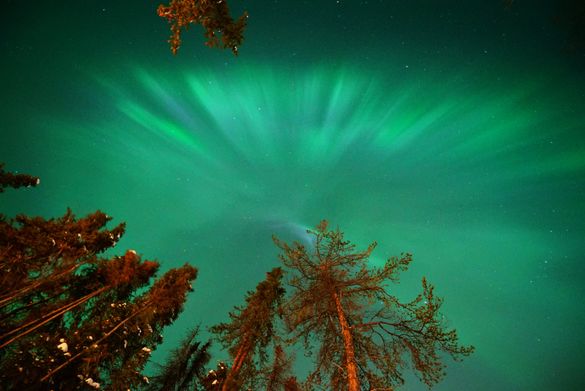
Sense of awe: Flare activity on the sun can spread the reds and greens of the Aurora Borealis (or Northern Lights) across the night sky. Late August and September offer longer - but still warm! - nights for Aurora viewing. The cold, often crystal-clear nights of December, January and February also offer amazing viewing opportunities. Campers enjoy a vast night sky filled with constellations. Wolves, owls and loons are often heard as visitors gaze at this astronomical portrait far from the urban glare.
….and speaking of stargazing:
Turning off the lights to see clearly: Parks Canada protects more dark skies than any other agency in the world. Thirteen Parks Canada parks have dark sky designations: 12 are Dark-Sky Preserves and one is an International Dark Sky Park. Grasslands National Park is the darkest Dark-Sky Preserve in Canada. Outside of Parks Canada, Quebec's Mont Mégantic Observatory is the first site to be globally recognized (in 2007) as an International Dark Sky preserve; in 1999, the first permanent preserve was established at Torrance Barrens in the Muskoka region of southern Ontario.
Dancing in the dark: With stargazing increasing in popularity, many dark sky preserves across Canada host annual festivals including Jasper, Alberta's annual Dark Sky Festival. Jasper National Park is the second largest Dark Sky Preserve in the world, and the largest accessible Dark Sky Preserve - meaning there's a town within the limits of the preserve.
Why it matters: Since the dawn of time, humans have been fascinated with the stars and outer space, yet with urban development comes an influx of artificial lighting. This has meant that the majority of people across North America and Europe can no longer see such wonders as the Milky Way. Thanks to the work of Canada's Royal Astronomical Society, Canada has established the world's most stringent standards for dark sky parks and preserves and therefore creating these special places to look to the stars. Dark Sky Park status means that the parks - and their communities - are reducing the amount of light that is sent up into the sky at night. A Dark-Sky Preserve is an area in which no artificial lighting is visible and active measures are in place to educate and promote the reduction of light pollution to the public and nearby municipalities. Sky glow from beyond the borders of the Preserve will be of comparable intensity, or less, to that of natural sky glow.
Check out Parks Canada website for more information on these parks and others : www.pc.gc.ca
Why Canada in 2021?
Space, Mid Haul Direct Flights of between 5 to 10 hours, English Speaking, Shared Culture and History, Iconic Nature and Wildlife. Maybe you've been watching more Gold Rush series, repeats of Michael Portillos' great Canadian Rail Journey, or any of the many amazing natural history series than you care to reveal during lockdown and you're fired up to follow in the footsteps of pioneering gold miners, explore by train, or channel your inner David A., watching bears or whales out in the wild. Maybe you've used the time to get fit and now you want to test your mettle in a new environment. Or perhaps you are just looking for space to relax, breathe and get away from the masses. All great reasons your readers might be looking to holiday in Canada in 2021.
Images and video is available by registering via the Brand Canada Image library: www.brandcanadalibrary.com
For more media information please contact Ms. Nim Singh, singh.nim@destinationcanada (not for publication)