 20 May 2021

20th May, 2021
The Big Story: The City, Reimagined
Despite its wide-open, larger-than-life landscapes, Canada is an urban country, with the vast majority of its population concentrated in urban areas.
Talent magnet: Known for their multiculturalism, hubs such as Vancouver, Toronto and Montreal attract people from around the world seeking an unrivalled quality of life and employment in pioneering industries that include biotechnology, cleantech and film. It comes as no surprise that Canada was recently ranked the best country in the world to live by the U.S. News & World Report.
Centres of excellence: Vancouver boasts one of the world's biggest cleantech clusters, with hundreds of cleantech companies positioning the city at the forefront of innovations such as fuel cell solutions, power electronics and waste/wastewater treatment technologies. The city also instituted the world's first carbon tax in 2008, as well as game-changing policies like the Climate Emergency Action Plan and Renewable City Strategy. Toronto's tech scene is exploding, growing faster than anywhere else in North America (nearly 50 percent of residents were born outside the country). In Montreal, the International Centre of Expertise for the Advancement of Artificial Intelligence (ICEMAI) champions the responsible use of AI and data governance to
strengthen national capacity to commercialize and adopt AI-related technologies. The innovation and vibrance of a city also make it a wonderful place to live… and visit. Canada's cities have continued to innovate and pioneer throughout the global pandemic. Indeed, many new initiatives are focused on achieving a more sustainable and equitable society to counter the encroaching effects of climate change and social inequality.
Primed and ready:
While you've been home baking bread, Canada's urban centres have been busy planning a triumphant revival. Here's a sampling of what's happening:
Vancouver, British Columbia: Smart and Sustainable Transformation
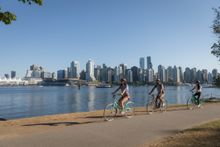
Pedal power: BC's largest city has long been one of the best biking cities in the country. Thanks to infrastructure changes that have expanded and improved cycling routes throughout the downtown core, the number of people commuting by bike has increased steadily. Cycling along the oceanhugging seawall has emerged as one of Vancouver's top visitor attractions, with small businesses like Cycle City Vancouver offering tours, bike rentals and self-guided maps leading visitors to the city's most scenic locations.
Position of responsibility: Tourism Vancouver recently created a position solely responsible for sustainable destination development, one of the first destination marketing organizations anywhere to do so. The role works closely with local tourism businesses to identify ways to reduce or eliminate emissions while cultivating a responsible model for business and tourism. Innovation accelerator: Governmental and major organizations in Vancouver are accelerating the transition to a clean economy with initiatives like Project Greenlight, a new program that connects major enterprises in Vancouver – including FortisBC, the province's largest energy provider, and TransLink, the region's transit authority – with local and global innovators whose emerging technologies can rapidly advance progress.
Winnipeg, Manitoba: Culture Forward
Major expansion: After much anticipation, Winnipeg Art Gallery's Qaumajuq (KOW-ma-yourk or HOW-ma-yourk) debuted in March, housing the largest public collection of contemporary Inuit art in the world. The world-class building, gallery and workshop space was designed by a community of artists, Indigenous advisers, partners and stakeholders. Their collective vision helped realize a gathering space that evokes the true spirit of reconciliation. Michael Maltzan, the architect who designed Qaumajuq, was inspired by an expedition to Nunavut, where the team visited Inuit communities and artists' studios. The undulating white stone of Qaumajuq's façade hovers as if floating over the glass-filled lobby – an abstract quality that recalls the vast scale of the North, as well as the carved forms of the artwork within the museum's walls. Qaumajuq's inaugural exhibition is Inua, curated by an all-Inuit team representing the four regions of Inuit Nunagat, the homeland of Inuit in Canada. The exhibition celebrates past and present Inuit artists, with stories woven through old, modern and contemporary works.
Toronto, Ontario: Work + Life
Hotel style: W Hotels' bold design and eclectic approach arrived in Toronto this spring. Boasting 255 rooms in Toronto's fashionable Yorkville neighbourhood, the hotel redefines modern luxury, taking inspiration from Toronto's social, historical and physical surroundings and embedding elements of each in rooms and public spaces. Guests are immersed in expansive indoor and outdoor gathering spaces; an indoor/outdoor lobby bar and lounge equipped with a DJ booth/recording studio; a rooftop restaurant with a glass exterior elevator; a fitness centre; and 4,800 square feet of meeting space. Fitness and wellness programming plays a significant role in W Toronto's personality, with weekly workouts, healthy cuisine and heart-pumping adventures.
Satellite city of the future: Toronto-based architectural firm Partisans has shared plans to transform Innisfil, a rural farming town, into a smart city of the future called Orbit. The envisioned community will marry rural lifestyles with the benefits of urban living, with innovative technology such as integrating the internet into streets and infrastructure, driverless cars, drone ports for last-mile delivery and green rooftops citywide. Innisfil has a history of adapting to new technologies; it was one of the first areas to pilot Uber ride-sharing.
Edmonton, Alberta: People Powered Important perspective:
Newly reopened after a $165 million enhancement, the new Indigenous Peoples Experience at Fort Edmonton Park, the largest living history museum in Canada, shares the culture, history and perspectives of local First Nations and Metis peoples. The exhibition content – which spans stories, music, artwork and text – was informed by conversations with more than 50 Indigenous Elders, historians, educators and community members, as well as
historical documents and research.
Creative incubator: Alberta's capital city is one of the youngest and fastestgrowing in Canada, and innovation plays a crucial role in shaping its diverse,
resilient and creative economy. The non-profit Innovate Edmonton was founded to unite the city's entrepreneurs, impact businesses, universities, cultural organizations, Indigenous and other groups in growing the local innovation economy and positioning Edmonton on the global stage. A recent example is University of Alberta student Delaney Lothian: Finding few resources for Indigenous language learning on the internet, she designed her own game and app that teaches people the Cree language.
Another success story is Edmonton International Airport: In spring, the airport became the first in the world to join The Climate Pledge, committing to
becoming carbon neutral by 2040.
Ottawa, Ontario: Designing the Future
Driving force: In Ottawa, federal funding of $7 million has helped to create Area X.O., a dedicated space managed by Invest Ottawa that will help the city become a world leader in selfdriving vehicle technology. Private-sector partners such as Accenture, Microsoft and Nokia, and the city of Ottawa, will support the initiative by contributing up to $10 million in equipment and services. Ottawa's cold winters and hot, humid summers provide ideal “lab” conditions for the software, sensors and other technologies needed to ensure driverless cars safely reach their destinations in all types of weather.
Tech-forward: While you can't visit Area X.O. just yet, you'll find plenty of technological innovation at the Canada Science and Technology Museum, whose immersive exhibits share the fascinating history of Canadian innovation (check operating hours before visiting).
Montreal, Quebec: Rejuvenation and Regeneration
Walking the talk: Montreal has become the first Canadian city to join the Global Destination Sustainability Index, a worldwide movement that seeks to engage, inspire and enable urban centres to become more regenerative places to visit, meet and live. Initiated by Tourisme Montréal, the program establishes benchmarks in the city's sustainability performance in tourism, meetings and events; supports a sustainability strategy for tourism; and integrates the Index's 17 Sustainable Development Goals in the visitor economy.
Living well: Recently opened Humaniti Hotel Montreal, an Autograph Collection hotel, boasts bold architecture and interior design to create an immersive “city within a building.” The zen-like ecosystem encompasses a fitness centre with equipment crafted from renewable wood; spa
treatments employing vegan and eco-conscious products; and the signature h3 restaurant sourcing ingredients from Quebec artisans and winemakers.
Halifax, Nova Scotia: Keeping It Local
Rooted in art: The new Art Gallery of Nova Scotia will welcome guests with a powerful symbol of Mi'kmaw culture when it opens along the Halifax waterfront in 2025. The design, rooted in sustainability and culture, incorporates a peaked-hat shape at the building entrance, reminiscent of the
traditional headdress worn by Mi'kmaw women. Imagined by KPMB Architects, the bold design was selected by an international jury that included a Mi'kmaw elder.
Sense of the sea: Opening on the Halifax Waterfront this fall is Muir: Marriott's first Autograph Collection hotel in Atlantic Canada, and Halifax's first five-star hotel. The 109-room property is part of Queen's Marque, a $200 million mixed-use development situated along Halifax's historic waterfront. Evoking the essence of Nova Scotia, the hotel's architecture, design and amenities take inspiration from the historic, cultural and natural forces that have shaped the province, creating a distinctly Nova Scotian hospitality experience. The hotel features an art gallery, original local art and pottery in each of its waterfront rooms, as well as an arresting art installation paying homage to the iconic Sambro Island Lighthouse guarding the entrance to Halifax Harbour. The onsite Wellness Centre is equipped with vitality and cold plunge pools, a halotherapy salt room and workout studios; while the hotel's on-site eatery Drift – along with a 'secret' guests-only speakeasy – use local, seasonal ingredients to reimagine traditional Atlantic Canada fare. Guests are also able to feel the salt air and ocean breeze on their skin by venturing out on the Muir yacht and motorboat. Muir is a gracious host, a one-of-a kind destination and a cultural beacon for Halifax and beyond.
Readers wanting more information on Canada should go to www.explore-canada.co.uk
Images :
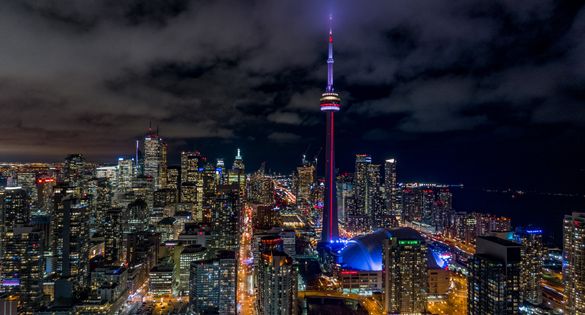
Toronto Skyline ; Credit Destination Canada
Cycling the Vancouver Seawall : Credit Tourism Vancouver/ Rishad Daroowala
Media seeking news, stories, images and video should go to www.destinationcanada/media
For more information please contact Ms. Nim Singh, Destination Canada, singh.nim@destinationcanada 0207 389 9983 (not for publication)