 22 Oct 2014

California is a land of inventive, creative personalities. Combine that with the state's ever evolving sense of style and determination to be a place of firsts, and it should come as no surprise that the Golden State is home to a remarkable assemblage of world-renowned and award-winning structures. From bridges and office buildings to opulent private homes and hotels, California offers abundant architectural inspiration. Our list of some of the most notable structures below underscores the fact that architectural styles and movements as diverse as Victorian, Spanish Mission Revival, Art Deco, Mid-Century Modern, Googie, Tiki and Modernism were either created here or refined here with their own California twist.
Northern California
Golden Gate Bridge, San Francisco
More than a mile long but in reality, almost larger than life, San Francisco's Golden Gate Bridge is not only a universally recognized symbol for the City by the Bay, but for the US as well. Named one of the “Wonders of the Modern World” by the American Society of Civil Engineers, the bridge was opened in 1937 after four years of construction. Initially the bridge was opposed by powerful special interests such as Southern Pacific Railroad, which feared for its ferry business. Eventually, local pressure and some ambitious engineers and architects including Joseph Strauss, Leon Moisseiff and Irving Morrow (who is responsible for the graceful Art Deco elements that embellish the bridge's towers), prevailed. Today, an average of more than 100,000 commuters cross the bridge daily.
Painted Ladies, San Francisco
There are Victorians, and then there are San Francisco's Painted Ladies. Undoubtedly, you've seen these extensively photographed wood and plaster divas in promotional ads, movies and TV shows set in the Bay Area. Located adjacent to Alamo Square Park, they were constructed in classic Victorian style between 1892-1896 by developer Matthew Kavanaugh. One of the most popular views is from the park itself, where these impeccably restored Victorians with their pitched roofs and showy gables are seen framed with the Financial District's skyscrapers in the background.
Transamerica Pyramid, San Francisco
Certainly San Francisco has its legacy architecture like the city's graceful Victorian and Edwardian homes. But San Francisco's growth is also charted by modern structures; none more famously than the striking, pointed silhouette of the Transamerica Pyramid. Still dominating the downtown area's Financial District skyline since its construction was completed in 1972, the building's original tenants (the Transamerica company) no longer occupy the building, but the landmark structure has evolved into a San Francisco icon. Architect William Pereira integrated the pointed profile at the request from the city and the company's CEO that the building be designed in a way that still allowed light in the streets below. The rest, as they say, is history.
Fairmont Hotel, San Francisco
Grandly perched atop Nob Hill, the imposing Fairmont San Francisco is as notable for the high-profile architects involved with its design and renovation as the momentous events which have transpired inside. Famed California architect and engineer Julia Morgan was intimately involved with the hotel's renovation after it was damaged in the 1906 San Francisco earthquake shortly before opening. In later years, the Beaux Arts hotel hosted significant events ranging from the signing of the charter to create the United Nations to the venue where Tony Bennett first sang the city's most famous ballad “I Left My Heart In San Francisco.”
California State Capitol Building, Sacramento
Floods, political opposition and even the nervous breakdown of a principal architect could not stop the eventual completion of California's capitol building. Finished in 1874 after 14 years of intermittent construction, theCalifornia Capitol echoes neo-Classical and Renaissance influences with a design heavily shaped by the US Capitol building. Designed by architects Reuben Clark and M.F. Butler, California motifs and symbols like the state flower (the golden poppy) and grizzly bear are found throughout the building which underwent a major renovation in 1977. Listed on the National Register of Historic Places, the Capitol's main feature is its 130-foot high rotunda that divides the wings where the Assembly and the Senate meet. The building also features an East Wing for the Executive branch and a museum where a fascinating collection of historic artifacts is displayed.
Carson Mansion, Eureka
Built in 1885 by lumber baron William Carson, what is considered by some experts the finest Queen Anne-style Victorian in the US took two years to build and cost a whopping $80,000 at the time. Designed by the Newsom Brothers, well-known San Francisco architects, the three-story Carson Mansion residence is a confection of gables, turrets, cupolas and wrought iron work. Just to the west of the building sits the Pink Lady, another Queen Anne commissioned by Carson for his son. Together these structures have helped Eureka's Old Town earn a listing on the National Register of Historic places. Today the former residence is owned by a private club.
Central California
Hearst Castle, San Simeon
A National and California Historical Landmark, San Simeon's Hearst Castle brings new meaning to the word opulence. The grandiose assemblage of a main mansion, separate cottages and other features like manicured gardens, winding walkways and the dazzling Neptune pool combine to create an architectural masterpiece that defies the imagination. Commissioned by publishing tycoon William Randolph Hearst and designed by noted California architect Julia Morgan, construction stretched between 1919 and 1947. Influenced by Hearst's travels through Europe, dominant elements include Baroque, Renaissance and Spanish Revival flourishes that weren't just recreations, but sometimes actual structures like ceilings bought during his trips. Some of the more impressive numbers include 60,645-square feet (the size of the main house); 165 (the number of rooms) and 61 (the number of bathrooms). Hearst's domain also included a movie theater, airfield and private zoo.
Asilomar, Pacific Grove
Set on 107-acres of beachfront property in photogenic Pacific Grove, Asilomar is yet another California architectural treasure touched by the hand of architect and engineer Julia Morgan. Designed between 1913 and 1928, the retreat center's main buildings like the Dodge Chapel Auditorium and Visitor's Lodge are classic examples of the Arts & Crafts movement done with a California perspective utilizing local wood, stone and floods of natural light. Today the facility is managed by California State Parks and is open to individual guests and groups.
Ahwahnee Hotel, Yosemite
Another California design treasure where guests can actually stay and play is the landmark Ahwahnee hotel nestled on Yosemite National Park's valley floor. Considered a masterpiece of “parkitecture” designed by architect Gilbert Stanley Underwood, the hotel's location was selected for its postcard-perfect views of iconic Yosemite sights such as Half Dome and Glacier Point. Completed in 1927, the structure's designs include influences as varied as Native American – an homage to the original inhabitants of the Valley – Art Deco, Arts & Crafts and Middle Eastern. Features like massive stone fireplaces, hand-stenciled beams and three-story high-ceilings set the backdrop for famous events like the Christmas season's Bracebride Dinner.
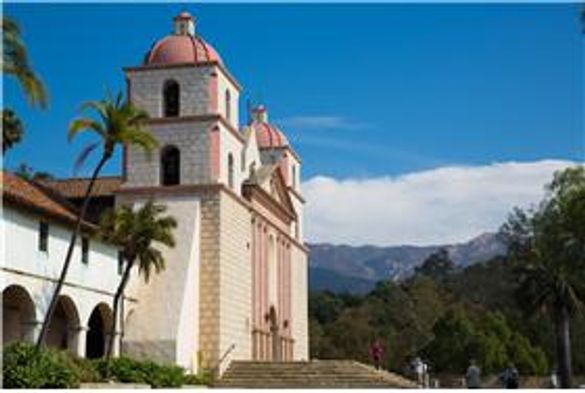
Mission Santa Barbara, Santa Barbara
Known as the Queen of the Missions, both the setting and authentically preserved architecture of this important benchmark of California history make the Mission Santa Barbara an architectural icon. Still an active Roman Catholic church operated by the Franciscan order, the mission houses valuable original artwork and religious items dating back to the mission's founding in 1786. The design itself is classic Mission-era with wide porticos and ornate twin bell towers that served as the influence of later styles such as Spanish Revival. The Huerta, an orchard-garden, is another attraction that dates from the mission's founding.
Southern California
Bradbury Building, Los Angeles
It seems only fitting that one of LA's most notable architectural landmarks is also a film and TV star. Besides earning status as a National Historic Landmark in 1977, the Bradbury Building has also been featured in numerous film and television productions, most notably the film Blade Runner, set in a post-Apocalyptic LA. Originally designed by LA architect Sumner Hunt and finished by George Wyman in 1893, the elegantly eclectic Italian Renaissance Revival Bradbury building was commissioned by mining and real estate development tycoon Lewis Bradbury. Standout elements include exquisite ornamental cast iron, open cage elevators, Italian marble staircases, gleaming wood surfaces and above it all – what were once LA's largest plate glass windows creating a glass ceiling admitting floods of natural light.
Hollyhock House, Hollywood
Frank Lloyd Wright is well-known for multiple structures across the country, but Hollyhock House was the one that brought him to California and was his first project in Los Angeles. Commissioned by petroleum heiress Aline Barnsdall and completed in 1922, her funds and his vision allowed Wright to experiment with stylized concrete, reflecting pools, interior gardens and other elements like angled Mayan Revival style walls that would become his signature. Named for a favorite flower of Barnsdall that is a recurring design motif, Hollyhock House and its surrounding 11 acres were originally conceived as an arts and theater complex and today still fulfills that purpose. Barnsdall Art Park features art workshops, a theater, farmers market and other public events. Tours of the home itself are currently closed for renovation.
Griffith Park Observatory, Hollywood
Commanding an unobstructed view over the entire Los Angeles basin from the Hollywood Hills, the Griffith Observatory not only offers an amazing perspective of present day LA, but a look into its past as well. Built by WPA crews and artisans during the Great Depression, the Observatory opened to great fanfare in 1935, a donation from city benefactor and developer Griffith J. Griffith who also donated land for 3,000-acre Griffith Park and the Greek Theatre. Featuring stylized Art Deco elements from the era, the building's architects John C. Austin and Frederick Ashley were also able to integrate fine materials such as marble, leather and copper embellishments thanks to low Depression-era prices. Managed by the City of Los Angeles, admission here is free.
Walt Disney Concert Hall, Los Angeles
Since 2003, Los Angeles can lay claim to a world-renowned architectural opus in the form of the Walt Disney Concert Hall. Designed by celebrated Pritzker prize-winning architect Frank Gehry, the LA-based architect's vision is a symphony of modernist swirls composed of stainless steel. The striking building is perched atop Bunker Hill and is seen as a symbol of the revitalization that has swept LA's downtown area the last two decades. Matching the exterior's vaunted status, the acoustics of the concert venue, designed by Yasuhisa Toyota, have been equally celebrated by musicians and audiences alike because of the Douglas fir and oak interior's tonal integrity.
Movie Colony Hotel, Palm Springs
It's not often you get to stay in a building that defines an architectural style, but a visit to Palm Springs' Movie Colony hotel promises just that. Built in 1935 by Le Corbusier protégé Albert Frey during the resort's heyday as a Hollywood hideaway, the hotel was refurbished several years ago, maintaining its original Desert Modern lines. Frey gave the building the look of a cruise ship in the desert, railings on upper levels and all. Replica period furniture, a white-on-white palette and clean lines etched by metal and glass complete the ambiance of this 16-room boutique hotel.
Mission Inn, Riverside
A National Historic Landmark as well as a California Historic Landmark, the opulent Mission Inn Hotel & Spaanchors an entire historic district in downtown Riverside. Simultaneously grand and grandiose, the 125-year-old hotel is considered the largest Mission Revival Style building in the country. In reality, the hotel's original owner, Frank Augustus Miller, incorporated many styles such as Spanish Gothic and Moorish Revival into his life's passion. Over more than a century, the results have attracted presidents, celebrities and notables drawn to the hotel's many inviting patios, elegant porticos, towers, minarets and authentic treasures like Tiffany stained glass windows incorporated into the design.