 23 Mar 2015

Preventing the extinction of ancient cultures isn't always possible when holding on to them for dear life. Sometimes, it requires meeting the modern world half way.A small Maasai community has done just that. By embracing modern-day education they hope to preserve their traditions. A Cape Town-based photographer is determined to help them succeed.
If there is one indigenous tribe that speaks to the collective imagination, it is probably the Maasai. These Nilotic, semi-nomadic and cattle-rustling residents of southern Kenya and northern Tanzania are known for their fearsome warrior reputation and intricate beadwork skills.
Like many indigenous people elsewhere, the Maasai are facing some significant pressures. The Kenyan and Tanzanian governments for instance, want these tall warriors to abandon their traditional way of life and adopt a more modern lifestyle.
Whilst most Maasai members are reluctant to give up their age-old customs and ancestral land, some are prepared to meet the government – and the modern world – half way. Take the inhabitants of a small settlement at Loita Hills. Seven years ago, they collectively decided that contemporary education should be introduced in the lives of children.
“A school was built in 2008, to give children access to education,” says Cape Town-based photographer Vladia Bajerovska, who has documented day to day life at Loita Hills off and on for the past two years. “Initially, only 20 kids attended. Now the school has 150 learners of all age groups. The idea is to give children a proper education, so they can find their place in the modern world should they want to, whilst educating them about traditional knowledge and ancient customs to keep the Maasai culture alive.”
The school's teachers educate the children mainly orally, as there are no books. “That is because there is no library. I want to change this. You can't have a school without books or library. I therefore came up with a post card concept,” says Bajerovska, who was introduced to the Maasai Academy via Hennie Marais and his wife Becca Marais. Both have been working with the school for a few years whilst revitalising a neglected beading project.
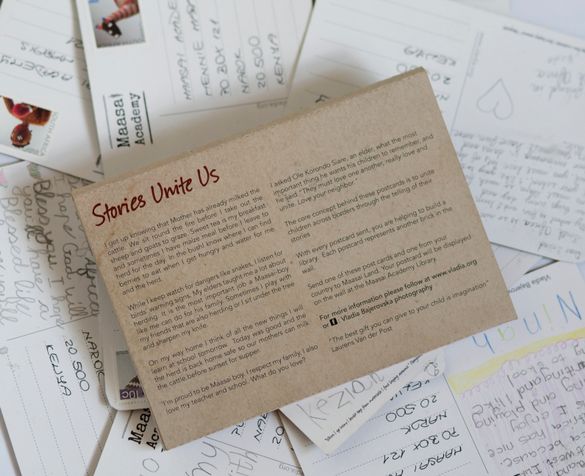
Bajerovska's initiative comprises revolves around envelopes comprising beautifully printed photographs that illustrate day to day life at the Maasai Academy. The idea is to buy the postcards, and ask a child to write a personal message on them, and send them back to the learners in Loita Hills. “The proceeds of the cards will go to the construction of a full-fledged library, of which the construction costs around R130.000,” she says. “The cards, which will go on sale on 6 March 2015, can be purchased through www.vladia.org.”
Why should anyone outside Kenya care about whether or not a remote part of an eastern African country has a library or not? Bajerovska has a simple answer. “This world has become more and more fragmented, and people have become more distant, despite the abundance of modern technology,” she says. “In the end of the day, we humans share the same planet and breathe the same air. What affects one, affects others. Apart from building this library, I want to build greater levels of global understanding and cohesion. What better way than to use and old-fashioned yet very powerful and personal means of communication?”
“People are not very different from one another,” Bajerovska continues. “Whether you live in Loita Hills or Cape Town or London, most people want the same thing: to live and let live, and provide a future to their children. And most children, regardless of their background, just want to learn, play and be kids – with other kids. And everyone loves to get a postcard!”
Distributed on behalf of:
The Maasai Academy
Contact Person: Vladia Bajerovska
Cell: 0823609387
Email: info@vladia.org
Website: www.vladia.org