 18 Jun 2013

Tracing the future of design in the Cultural Heart of Germany
It started as a small movement and became über-cool: Bauhaus is the single most influential design school of modern times. Many of the world's most eminent designers based their aesthetics on the principles of this design school, founded in Weimar in 1919. Consequently, it continues to influence the way our world looks and works, including iconic designs such as those of Apple whose founder Steve Jobs favoured Bauhaus simplicity. We've put together some ideas how to discover the roots of Bauhaus in the Cultural Heart of Germany:
Bauhaus Colour Festival
Dessau-Roßlau, where the Bauhaus School moved in 1925, has been the stage for the Bauhaus Colour Festival since 1997. This mix of experimental projects, spatial installations, music, dance and performances is played out throughout the city. The festival goes back to the 1920ties where elaborate festivities served to foster the exchange between masters and students and helped reaching out to citizens in Weimar and later on Dessau.
On 7 Sep 2013, Bauhaus Dessau
Exhibition: Man, space and machines - experimental stage team Bauhaus
For the first time, this exhibition presents the Bauhaus stage set workshop and its products, designs and concepts. Featuring exhibits from national and international private and public collections plus specifically produced reconstructions of figures, costumes, stage and theatre designs, the exhibition conveys how the stage was place and medium for a radical work of images and concepts representing a new modern subjectivity.
5 Dec 2013 to beginning of May 2014, at Bauhaus building, Gropiusallee 38, Dessau-Roßlau
Explore Bauhaus guided by students of Bauhaus University Weimar
Hugely popular since fuelled by enthusiasm and expertise are the early Bauhaus walking tours in Weimar guided by students of the Bauhaus University. Among other things, the tour takes in the university's past and present including Bauhaus founder Walter Gropius' former office which is still used by visiting professors. Walks take place five times a week and come in a short and long version.
Spend a night in a living testament to modernism
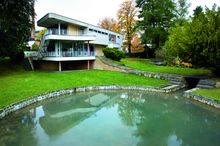
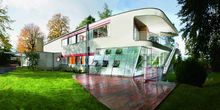
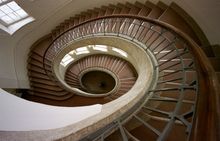
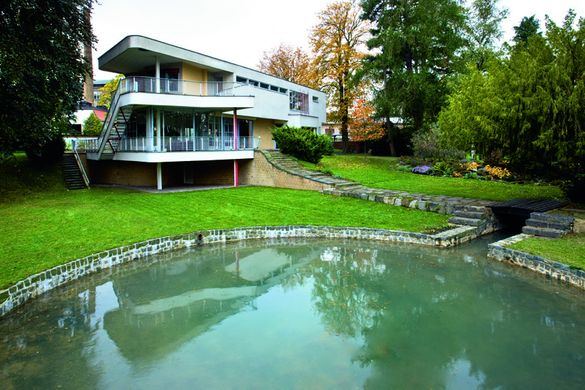
One of Germany's most important architectural creations between the world wars stands in the small Saxon town of Löbau and was built by architect Hans Scharoun whose work drew on the principles of Bauhaus. The house he built for the Schminke family, local factory owners, is mentioned in the same breath with Mies van de Rohe's Villa Tugendhat or Frank Lloyd Wright's Kaufmann House. House Schminke can be visited and architecture buffs can even spend the night.
Meet Henry van de Velde, the one who set the scene
The Cultural Heart of Germany is celebrating the 150th anniversary of Bauhaus pioneer Henry van de Velde this year with a number of exhibitions and guided tours throughout the region in Apolda, Chemnitz, Erfurt, Gera, Jena and Weimar. The Belgian architect and design genius lived in Weimar for 15 years and recommended Walter Gropius as his successor as director of the Grand Ducal Saxon School of Art. The latter was renamed as State Bauhaus Weimar and moved into premises built by van de Velde, today's Bauhaus University. And the rest is history, as they say, albeit a very current one.
Programme van de Velde Year 2013
Cultural Heart of Germany online: www.culturalheart.info
Facebook, www.facebook.com/CulturalHeartofGermany
Twitter, www.twitter.com/CulturalGermany
Press contact:
BConnects. Barbara Geier Communication Services
On behalf of Cultural Heart of Germany (Saxony, Saxony-Anhalt, Thuringia)
barbara.geier@gmail.com, phone 07983 24 21 95