23 Aug 2018

Auckland will host a month-long commemoration programme to mark the 100th anniversary of The Armistice that ended fighting on the Western Front during World War One from October 20.
The Hundred Days Offensive from August 1918 saw Allied forces finally sweep across northern France, including the liberation by the New Zealand Division of many French towns from their German captors.
“News came through late last night that armistice had been signed, and hostilities ceased at 11am. Thank God!”, wrote the commander of the New Zealand Division, Major General Sir Andrew Russell, in his diary on 11 November 1918.
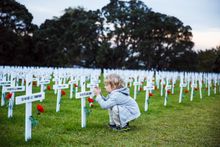
Auckland will pay homage to those who fell during the four years of World War One with the installation of the National Field of Remembrance and displays of stories of those who were lost, at Auckland Domain, from 20 October to 20 November.
There will be 18,277 named crosses, representing every New Zealander who died, installed on the northern slopes of the Auckland War Memorial Museum Tāmaki Paenga Hira and in front of the Cenotaph.
The crosses will be arranged in blocks by the year that the soldiers and nurses died, with a separate block of 1432 crosses to honour the 693 families who lost more than one child, including a dozen families who loss a pair brothers on the same day and six families that loss four members during the war.
New Zealand will be the first in the world to mark Armistice Day, with Auckland hosting a major commemorative service at The Cenotaph on Sunday, 11 November, at 11am – acknowledging the time and date the guns finally fell silent.
Mayor Phil Goff says, “The National Field of Remembrance will serve as a powerful reminder of the scale of sacrifice of the 18,277 New Zealanders who died to secure victory 100 years ago so that we may live more peaceful lives today.
“In remembering the tragedy of World War One we remember the New Zealanders who laid down their lives for their country and their mates, and commit ourselves to learn the lessons of the past and strive to create a more peaceful future.”
The National Field of Remembrance is the final, and largest, installation by the Fields of Remembrance Trust, a partnership between the Auckland RSA, National RSA and the Passchendaele Society.
Over the last four years the Trust has installed Fields of Remembrance each Anzac Day in the main centres and many communities, as well as providing crosses to thousands of schools and early childhood centres throughout the country.
“We're looking forward to welcoming the public to walk through the rows of crosses,” says Graham Gibson, Vice Chair of the Fields of Remembrance Trust and Auckland RSA President.
“It's going to be a dramatic, emotional reminder of exactly what this country gave during those four years a century ago and the first time in New Zealand such a stark memorial has been laid out.”
The Fields of Remembrance Trust is working alongside Ngāti Whātua, Auckland Council, Auckland War Memorial Museum, Auckland Tourism, Events and Economic Development, Eden Park Trust and the New Zealand Defence Force.
ENDS
Notes to editors
Special dates
- 20 October – 20 November Fields of Remembrance open to the public
- 11 November – Armistice Day Memorial Service, Cenotaph/Auckland Domain, 11am – 12noon
KEY FACTS AND FIGURES
- 18,277 lives lost
- 693 families lost more than two members = 1432 crosses
- 1 pair were brother and sister (TUBMAN) 1 pair were father and son (MALONE)
- 659 mothers lost two sons = 1318 crosses
- 30 mothers lost three sons = 90 crosses
- 6 mothers lost four sons = 24 crosses
- 12 pairs of brothers died on the same day
- 9 sets of twins died
- At the time, the total population of New Zealand in 1914 was just over one million.
- In all, more than 120,000 New Zealanders enlisted, and around 100,000 served overseas. (NOTE: FoRT includes those NZ who served with overseas units)
- Most were young men, and nearly one in five who served abroad did not return.
- More than 2200 Māori and around 460 Pacific Islanders served overseas with the New Zealand forces.
- 11 Victoria Crosses were won by soldiers serving with New Zealand forces. (NOTE: FoRT only counts those who died)
- At least 3370 New Zealanders served in the Australian or British imperial forces, winning a further five Victoria Crosses.
- In all, 550 nurses served with the New Zealand Expeditionary Force, and many others enlisted in the United Kingdom.
- More than 18,000 New Zealanders died in or because of the war, and about 41,000 men were listed as wounded. More than 2700 died at Gallipoli / Chunuk Bair and almost 12,500 on the Western Front.
- 13 All Blacks were killed in WW1, the most famous being Sgt Dave Gallaher the 1905 -‐ "Originals" All Black Captain.