 30 May 2013

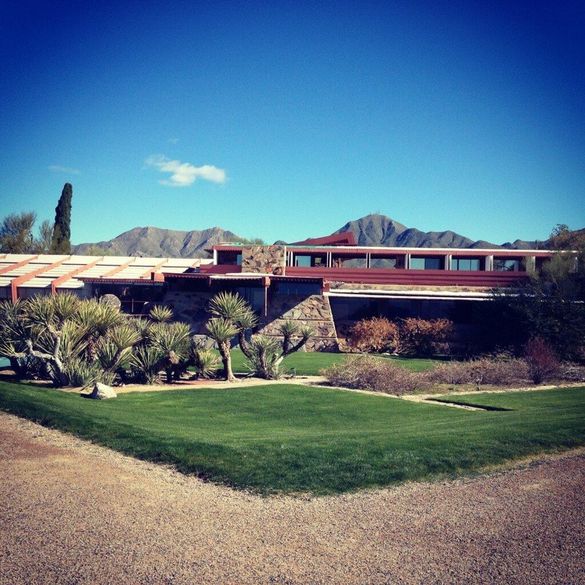
The Frank Lloyd Wright Foundation has made many renovations to Taliesin West over the years, giving visitors the opportunity to view Wright's private living quarters at the property, the last portion to be renovated and revealed to the public. The kitchen and bedrooms of Wright and his wife Olgivanna are restored to how they looked when he died in 1959. The living quarters, added by Wright in 1940, contain a living room, private bedroom and work space. The wing, adjacent to the site's famous living room, which Wright called the “Garden Room,” was remodeled to restore the masonry and structural work to their original appearances, as well as a full restoration of the interiors. Recent transformations at Taliesin West have focused on eco-friendly practices with the installation of a 250-kilowatt solar system to produce power. Eventually Taliesin West will become a net-zero facility, meaning it will produce as much or more power than it uses.
Wright's vision and influence are seen throughout Scottsdale and one of his most noted designs is the spire at the northwest corner of the Promenade(www.scottsdalepromenade.com) shopping center in North Scottsdale. Originally designed by Wright for the Arizona State Capitol building, the structure is 20 feet wide at the base and 125 feet tall, and framed with steel, painted in a copper tone, glazed with plastic, and illuminated internally at night.
One of Scottsdale's premier resort properties, Sanctuary on Camelback Mountain(www.sanctuaryaz.com), enjoys a legendary history filled not only with Hollywood celebrities, but also a storied architectural past linked to the Wright legacy. Representing the cosmopolitan side of Scottsdale with its clean lines and minimalist approach, Sanctuary often is viewed as representing a new breed of Scottsdale resort architecture. However, the reality is that this property is rooted in Scottsdale history and was originally designed by architect Hiram Hudson Benedict, a protégée of Wright.
The developers of Sanctuary also are the masterminds of the historic Hotel Valley Ho(www.hotelvalleyho.com). Originally built in 1956, the property is said to be one of the nation's best-preserved examples of mid-century architecture. Designed by Edward L. Varney and Associates, one of the most prominent architectural firms of the time, the hotel reflected Scottsdale's true cosmopolitan nature with much of the original property featuring Frank Lloyd Wright-inspired design elements. At the time, the hotel housed 180 rooms centered on a courtyard pool. An $80 million comprehensive remodel in 2005 included a rehabilitation of the original hotel, construction of a new room wing that brought the total accommodations to 194 rooms and suites, and the addition of a seven-story tower with its five upper levels devoted to residences.
Wright often is credited for the design of the famous Arizona Biltmore Resort built in 1929. In fact, he was a consultant on the project with lead designer Albert Chase McArthur. The design of the resort has become an architectural landmark and is one of Arizona's most well-known sights. Also created by Wright and sculptor Alfonso Lannelli is the Biltmore Sprites that greet guests as they arrive at the Arizona Biltmore. These geometric architectural statues were conceived in 1914 for the specific purpose of adorning and watching over Midway Gardens, once a center for entertainment, dining and music on Chicago's lakefront. Most of the Sprites met a premature and unfortunate demise during Prohibition. Years later, the remaining pieces were donated to the Arizona Biltmore where they have made their home since October 1985. Replicas of the sprites can be purchased at Taliesin West.
One of Wright's last designs, created during the final two years of his life, is the Gammage Auditorium (www.asugammage.com), which opened in nearby Tempe, Ariz. in 1964. Wright adapted the design from one he had created for the Baghdad Opera House that was originally to be part of Iraq's university complex, but the project was never completed. The design features two long ramps that extend from the second level out into the parking lot and are dotted with lamp posts of circle and half-circle designs that extend the length of the ramps and through the walls to the interior. These ramps were meant to be “arms” welcoming people to Arizona. The project incorporates 34 shades of terra cotta with accents of aqua and teal, and is meant to be as acoustically perfect as possible. Seating more than 3,000 people today, Gammage Auditorium is host to touring Broadway shows, musical and stage performances.
Vernon Swaback, a former student of Wright's, also has left an indelible mark on Scottsdale's architectural landscape. He spent more than two decades studying and working at Taliesin West and over the past 30+ years has been involved in the design of award-winning master plans for hotels, office buildings, recreational facilities and custom homes throughout the Scottsdale/Phoenix metropolitan area. His firm, Swaback & Associates, designed Spa Avania at the Hyatt Regency Scottsdale Resort and Spa at Gainey Ranch(www.scottsdale.hyatt.com). Spa Avania, derived from the Greek word for tranquility, is a 21,000-square-foot facility with 18 treatment rooms, five exterior treatment gardens, mineral pool, lotus pond, relaxation lounges and more. Swaback also has penned several books about living and building in a suburban metropolis.
Italian-born designer and visionary Paolo Soleri came to the United States in 1947 and spent nearly two years in fellowship with Wright at Taliesin West and Taliesin East in Wisconsin. During this time, he gained international recognition for a bridge design displayed at the Museum of Modern Art in New York City. In December 2010, Scottsdale became the home of the first Soleri-designed bridge ever to be built. The Soleri Bridge and Plaza in downtown is the second pedestrian bridge connecting the Scottsdale Waterfront(www.scottsdalewaterfrontshopping.com) and SouthBridge across the north and south banks of the Arizona Canal. The bridge demonstrates the importance of solar movement, and a 22,000-square-foot plaza frames it and serves as a gathering place for special events and performing arts.
Soleri's Scottsdale connections don't end there. The designer made Scottsdale his home in 1956. Since then, he's made a life-long commitment to research and experimentation in urban planning, establishing the Cosanti Foundation (www.cosanti.com), which is a not-for-profit educational organization. The Foundation's major project is Arcosanti, a prototype town for 5,000 people designed by Soleri, under construction since 1970. Located at Cordes Junction in central Arizona, the project is based on Soleri's concept of “Arcology,” architecture coherent with ecology. Arcology advocates cities designed to maximize the interaction and accessibility associated with an urban environment; minimize the use of energy, raw materials and land, reducing waste and environmental pollution; and allow interaction with the surrounding natural environment.
###
MEDIA CONTACTS:
Laura McMurchie, VP of Communications
Phone: 480-429-2253 Fax: 480-947-4523
E-mail: lmcmurchie@scottsdalecvb.com
Tatum Luoma, Director of Public Relations
Phone: 480-889-2719 Fax: 480-421-9733
E-mail: tluoma@scottsdalecvb.com