 02 Jun 2013

By Joe David Rice
Apparently not worried a bit about my sudden appearance, the black bear paused on the opposite side of the road, taking up most of the lane as if he owned the asphalt. I'd rounded a curve and quickly slowed to a stop on Arkansas Highway 21 a couple of miles south of Salus in the middle of the Ozark National Forest. This was the first bear I'd ever seen in the wilds of the state – and my pulse kicked into overdrive. He looked plenty big to me even if 20 yards separated us. He gazed my way with small dark eyes for another 10-15 seconds and then ambled west and nonchalantly disappeared into the thick woods of summer, probably never giving me another thought. But I think about him every time I make that curve, always hoping I might encounter him again or one of his offspring.
That's one reason Highway 21 ranks at the top of my list of favorite drives in the state: the prospects for seeing wildlife. Over the years I've also spotted a fox, a coyote, too many deer to remember, dozens of wild turkeys, and hundreds of elk along the route, not to mention all sorts of smaller critters.
Highway 21 winds along ridges of the Ozarks from Clarksville through the Buffalo River Valley, through Berryville and up to Blue Eye on the Missouri Border. (Chuck Haralson)
Yet this northwest Arkansas road – a good portion of which is known as the Ozark Highlands Scenic Byway – offers far more than an interesting assortment of animals. It's got geology, historic sites, vernacular architecture, serenity, hospitable folks, great fall color, and some of the nicest views in a state already known for spectacular vistas. And, in my humble opinion, it provides the finest introduction to the Ozarks you'll find anywhere.
Although Highway 21 doesn't enjoy the fame of Arkansas Scenic Highway 7 (which runs on a parallel course about 20 miles to the east) or the notoriety of Arkansas 23 (the Pig Trail National Scenic Byway, which also traverses a north-south route about 20 miles to the west), it can hold its own with those classics and any other roadway in The Natural State. Mile for mile, it may be the best of the lot.
My goal with this piece is to get you to put Arkansas Highway 21 on your own personal bucket list. I've been driving it for years over every season – and the road still retains its original charm and intrigue. Pack a picnic lunch, your walking shoes, a camera, and maybe even a pair of binoculars. Better yet, pack a suitcase and make it a leisurely trip. And consider working in a visit to Clarksville, Harrison, Fayetteville, or Eureka Springs while you're at it. Take note, however, that food and gasoline are scarce commodities throughout much of the route.
Highway 21 begins a short distance north of the Arkansas River and Interstate 40 at the eastern city limits of Clarksville. Branching off US 64, it heads more or less due north for exactly 99 miles to the Arkansas/Missouri state line at Blue Eye. For folks interested in this sort of thing, the beginning elevation of Highway 21 is approximately 480 feet above sea level. The pavement soon begins a steep and curvy climb into the heart of the Ozarks where it tops out at approximately 2240 feet – a net vertical gain of about one-third of a mile, or more than enough to make your ears pop.
Those starting a trip at the route's southern terminus might make the Pleasant Hill Ranger Station of the Ozark National Forest their first stop. Located at 2591 Highway 21 North, it's approximately 2.5 miles above the junction with US 64. The U.S. Forest Service staff can provide helpful maps and brochures Monday through Friday (8:00 am – 4:30 pm). Another half a mile or so up the road is the community of Ludwig, noted for its delicious Johnson County peaches in early to mid-summer. In fact, a plaque on an official “historical marker” under one of the peach sheds in town reads: “Ludwig – Home of the First Johnson County Peach Festival; June 26, 1938.” The University of Arkansas operates a Fruit Research Station just east of town where a team of scientists works to develop better strains of peaches, apples, nectarines grapes, blueberries, blackberries, raspberries, and even pecans.
A few miles farther to the north and Highway 21 actually enters the Ozark National Forest, a federal reserve created via a proclamation signed by President Teddy Roosevelt in 1908. Eventually encompassing some 1.2 million acres, this immense tract serves a variety of purposes: grazing, timber, wildlife habitat, watershed management, aesthetics, and outdoor recreation. Although much of the land never left the public domain, some of it had been settled and later abandoned by pioneer families unable to scratch out a living on the thin soils of the rough terrain. It's not uncommon for today's hunters and hikers to discover stone fences, chimneys, and foundations of early homesteads now going back to nature.
The first Ozark National Forest Service rangers had their hands full dealing with the famously independent mountain folks not used to government regulations. They investigated timber thieves, fought deliberately set forest fires day and night, and chased moonshiners with teams of bloodhounds – all for a salary of $900 a year. When the Chief of Operations toured the district in 1909, he recommended the use of public circulars to explain the agency's policies, but instructed his colleagues to avoid long sentences and to stick with short, common words. Even so, the relationship between federal employees and local mountaineers remained often contentious for decades.
Given that those early rangers traveled by foot or by horseback, they could hardly have imagined a nationally recognized scenic highway coursing through the rugged Ozark landscapes. Yet a short distance north of Ludwig visitors will spot the “Ozark Highlands Scenic Byway” sign just before the road begins its twisting and tortuous route up the steep slopes of the National Forest. For the next 40 miles, the roadway swings from ridge top to ridge top and never really dips into the deep hollows far below. In fact, there's not a single bridge to cross until the highway completes its long and steep descent into Boxley Valley.
Ozone is the next community of note, and it's one of two or three places in America with that interesting appellation. Tradition has it that in 1875 Mrs. Delia McCracken, the local postmistress, gave the town its memorable name because of the pureness of its air. Back in those days, the word ozone was used to describe the distinctive smell of fresh air following a lightning storm. Chances are Mrs. McCracken would not appreciate the “Ozone Alerts” and “Ozone Action Days” of the twenty-first century.
The Burger Barn at Ozone sells not only burgers but fried catfish and daily specials, and is one of the more convenient and tasty spots for a meal along Highway 21. (Joe David Rice)
Ozone lost most of its retail establishments over the years, but one exception is the Ozone Burger Barn – a rare opportunity for sustenance in the area. It'd been in business a decade or so when proprietor Tom Camardese bought the establishment in 1999. An Ohio native, Camardese had worked for several national restaurant chains before making the move to the Ozarks. He offers an amazingly diverse menu (hand-made burgers and fried catfish are specialties) with favorable on-line reviews from Yelp and TripAdvisor patrons. Dining is outside on one of the many picnic tables. Camardese says he's pretty busy year-round: hunters in the winter, canoeists/hikers come springtime, traditional tourists throughout the summer, and motorcyclists during the fall. On at least one occasion he's had bears grazing on the berries in front of his take-out window.
Three miles or so beyond Ozone is a handy public recreation area, complete with campsites, picnic tables, and “primitive” (i.e., non-flush) toilets, maintained by the Ozark National Forest. It's also the site of Camp Ozone, a Civilian Conservation Corps compound dating from the early 1930s. The camp, one of 106 located in Arkansas, housed approximately 200 young, previously unemployed men who constructed roads, hung telephone lines, planted trees, and fought fires during the dark days of The Great Depression. Today, the rows of barracks are long gone, but several monuments commemorating the workers at Camp Ozone can be found under the towering pines.
The Ozark Highlands Trail, a 218-mile footpath roaming across seven northwest Arkansas counties, conveniently crosses Highway 21 at Camp Ozone. Anchored by Lake Fort Smith State Park on its western end, the trail passes through some of Arkansas's most remote and scenic landscapes before ending far to the east at the Grinders Ferry access (US Highway 65) on the Buffalo National River.
Six miles up the road is the community of Salus which straddles the Johnson/Newton county line. South of the town is an abandoned fire lookout tower perched atop Devil's Knob. The tower is locked up and fenced off, but there's still a good view from its base. However, the rough and narrow route to the top (Johnson County Road 5598) isn't recommended for city cars. For those curious about the demise of fire towers, advancing technology put them out of business. Today's fire patrols are typically performed by airplane, rendering the lonely spotters and their lofty perches obsolete.
Another six miles north on 21 is the town of Fallsville. Arkansas Highway 16 merges from the west, next to a unique building (formerly a cannery) with interesting architectural details. As for Fallsville, the name is most likely due to its geography: steep slopes fall off to most every side of the community. The Big Piney Creek originates immediately below Fallsville to the east and the Mulberry River begins just to the south. Meanwhile, the Buffalo National River heads up north of town. The lone retail establishment seems to be open intermittently.
Highways 16 and 21 share pavement for a little over eight miles to Edwards Junction where 16 continues east and 21 turns sharply north. Pastoral settings and wonderful panoramic views are frequent along the way. Many visitors are surprised that the surrounding mountains are all virtually the same height, with no one peak standing above the others. That's because the Ozarks are not a mountain range in the truest sense of the words, but represent a dissected plateau. Eons ago this land was actually the bed of a shallow sea. Following an uplifting process, the lands have been eroded for countless centuries – resulting in the deep valleys common along the route. Fossilized remains of sea shells and other sea creatures are regularly found in the area.
Adventurous travelers will want to check out The Glory Hole, a unique geological formation between Fallsville and Edwards Junction. What we have here is a special treat from Mother Nature. A small creek flowing south through the Ozark National Forest has carved a hole through a layer of solid rock near the edge of a bluff – and the water cascades into a shallow cave below. It's a great photo op, especially in the spring when water roars through the cavity or on a frigid winter day when the falls are frozen.
While there's no signage for The Glory Hole, it's fairly easy to find. Set your odometer at Fallsville and travel approximately 6.2 miles northeast up Arkansas 21. There's a small, graveled pull-out just off the highway on the right, big enough to hold a couple of cars. Park here and begin walking downhill, following an old logging trail. About a quarter of a mile into the hike, the primitive road forks. Bear to the right and continue down the trail crossing the creek as you go. The trail lands at the top of the bluff line and The Glory Hole is dead ahead. Beware of slippery conditions – especially during the wet months of spring – and make sure to keep a careful eye on any youngsters. Roundtrip, it's about a two-mile hike – so dress appropriately and take water. And your camera!
There's no longer a sign marking Edwards Junction, but it's the spot where Highway 21 requires a left-hand turn to the north while Arkansas 16 continues east. Highway 21 winds through the Ozark National Forest, makes a quick venture into Mossville, and then exits national forest lands (and loses its scenic byway status) before dropping into what's known as Boxley Valley. As the road begins its descent, the Smith Creek Nature Preserve will be in the deep valley to the right. This 1,226-acre tract protects one of the Buffalo River's beautiful spring-fed tributaries. The Arkansas Nature Conservancy regularly leads field trips where participants can explore the watershed's fascinating collection of rock formations, cascades, and native plants (check out www.nature.org/arkansas).
At the bottom of the 2.8 mile-grade into Boxley Valley, the highway crosses the western section of the Buffalo River Trail, a popular hiking and backpacking trail which essentially parallels the mountain stream. The trailhead for this 36-mile path is immediately to the left a short distance before the highway passes over Smith Creek. With several relatively short segments in the area, the trail offers opportunities for just about any skill level.
A little over a mile beyond the “Boxley Valley Historic District” signage, Highway 21 crosses the Buffalo National River. Established by an act of Congress in 1972, the park protects a 135-mile riparian corridor encompassing nearly 95,000 acres. The stream is not far from its headwaters region at this location and resembles a creek more than a river – although skilled paddlers negotiate its rapids when water levels are appropriate, most often in the winter and early spring months.
For those desiring an off-the-beaten-path experience, take a turn onto Cave Mountain Road at the north end of the bridge – and set your odometer. A narrow, graveled route, it quickly climbs up the steep hillside and leads to a couple of points of interest. The first is Bat Cave, an underground complex currently closed by the National Park Service due to a disease affecting bats. The parking area is 0.7 miles up the hill. History buffs might enjoy knowing the cave played a role in the Civil War, supplying saltpeter which Confederate forces used to manufacture gunpowder.
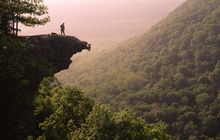
The next is Whitaker Point, quite likely the subject of more posters, advertisements, book covers, and post cards than any other locale in The Natural State. The Flickr website alone includes over 260 shots of this fascinating geological anomaly. Parking is on the right at 6.1 miles at a sign marked “Wilderness Access.” The easy-to-moderate trail begins across the road and takes a mostly downhill course for about 1.5 miles before the distinctive bluff known as Whitaker Point comes into view. Pay close attention to children and acrophobia sufferers.
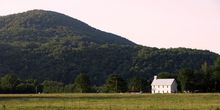
Seven-tenths of a mile north of the Buffalo River bridge, Arkansas Highway 21 passes through what remains of the Boxley community. Off to the left is the Boxley Baptist Church, one of the most photographed churches in the state. Next to it is the Walnut Grove Cemetery which includes graves of members of the families which settled here generations ago. Down the road and on the opposite side is the former general store/post office and beyond it are the remains of an old steam-powered sawmill.
Settlement in the Boxley area began around 1830, mostly with families moving in from Tennessee and the Carolinas. The town is named for William Boxley, a merchant from Springfield, Missouri, who relocated into valley about a decade later. The National Park Service acquired most of the properties within the valley during the mid-1970s as a part of its charge to preserve the landscapes and cultures of the Buffalo River. Some landowners sold their tracts outright and others retained title but deeded conservation easements to the federal government.
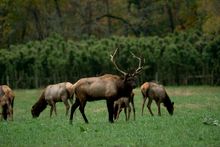
A short distance north of Boxley, Highway 21 swings sharply to the left and begins a long climb out of the valley while Arkansas 43 continues north toward Ponca. This 4.3-mile stretch of Highway 43 is famous for elk herds grazing in pastures along the river, particularly during the winter months – and is a worthy detour. It also passes the entrance to Lost Valley, a former state park and now a campground and trailhead operated by the National Park Service. With its caves, waterfalls, and looming bluffs, the two-mile roundtrip hike in Lost Valley is a special treat. Food and gasoline can be purchased at Ponca, located at the junction of highways 43 and 74, and visitors will also enjoy the Arkansas Game & Fish Commission's Elk Education Center. The Ponca low-water bridge has been a traditional put-in point for Buffalo River canoeists for over half a century.
Now, back to Arkansas 21. Approximately four miles north of its junction with Arkansas 43, gravel roads angle off on both sides of the highway. A right turn (to the north) and a one-third mile drive will lead travelers to the Elkhorn Church, a handsome and photogenic structure dating from 1900. The other option, the left-hand turn (to the south), goes to Sweden Creek Falls Natural Area, a 136-acre preserve owned and maintained by the Arkansas Natural Heritage Commission. Clear your odometer and drive slightly over 3.0 miles to a gate on the right side of the dirt road. Park in the graveled lot next to the gate and then follow a series of blue blazes down the easy-to-moderate trail to an 80-foot waterfall that's truly spectacular during the wet months. Smaller falls, rock shelters, and sandstone glades will be seen along the route.
Continuing north on 21, the highway soon enters Madison County (named for President James Madison). Five miles later it reaches Kingston, a quaint Ozark community located near the banks of the Kings River (of which Sweden Creek is a tributary). The town has an interesting arrangement of one-way streets around its tiny square. Several retail establishments along with one of the most picturesque banks in the state make up the compact commercial district.
Two Civil War skirmishes occurred near Kingston in 1863. In early January of that year, 300 men from the First Iowa Cavalry captured a large Confederate saltpeter works southeast of town and destroyed warehouses, steam engines, boilers, and half a ton of saltpeter. The second incident, in November and another Union victory, led to the retreat of 650 Confederate troops who marched south toward Clarksville.
As Arkansas 21 departs Kingston, it continues northward on a 7.4 mile course parallel to the Kings River and, in fact, crosses the waterway twice. The north-running stream, a tributary of the White River, presents a scenic and serene landscape of pastures and small farms. When water levels are good, the river is an enjoyable float trip although most canoeing takes place further downstream, especially between Marble and Berryville.
Following its junction with US 412, a major east-west corridor across northern Arkansas, Highway 21 jogs to the right (east) for 0.3 mile before branching off and again heading north. The short stretch of pavement shared by highways 21 and 412 is a portion of one of several “Trail of Tears” routes through the state. The Trail of Tears marks the tragic journeys of five Native American tribes – Cherokee, Choctaw, Creek, Chickasaw, and Seminole – which were forced to relocate from their homes in the southeastern US and move across Arkansas to Indian Territory (present-day Oklahoma) as a result of the Federal Indian Removal Act of 1830.
Highway 21 passes through rolling countryside and several small communities such as Omega, Metaltown, and Cabanal as it nears Berryville. A couple of miles south of town it crosses Osage Creek, a major tributary of the Kings River and a float stream in its own right.
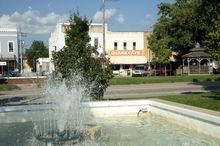
Berryville, one of two seats of government for Carroll County (which is named for Charles Carroll, one of the country's founding fathers and the last surviving signer of the Declaration of Independence), is a prosperous community of 5,356 residents. With a bookstore, soda fountain, the Carroll County Heritage Center, antique shops, and other retail outlets located on an attractive Public Square, its downtown area offers something for nearly everyone and is definitely worth a visit. Just a block away is the Saunders Museum with an eclectic collection of firearms, knives, and Victorian knickknacks.
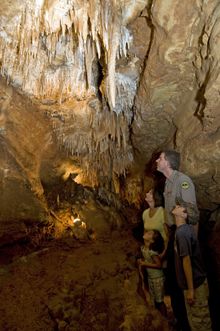
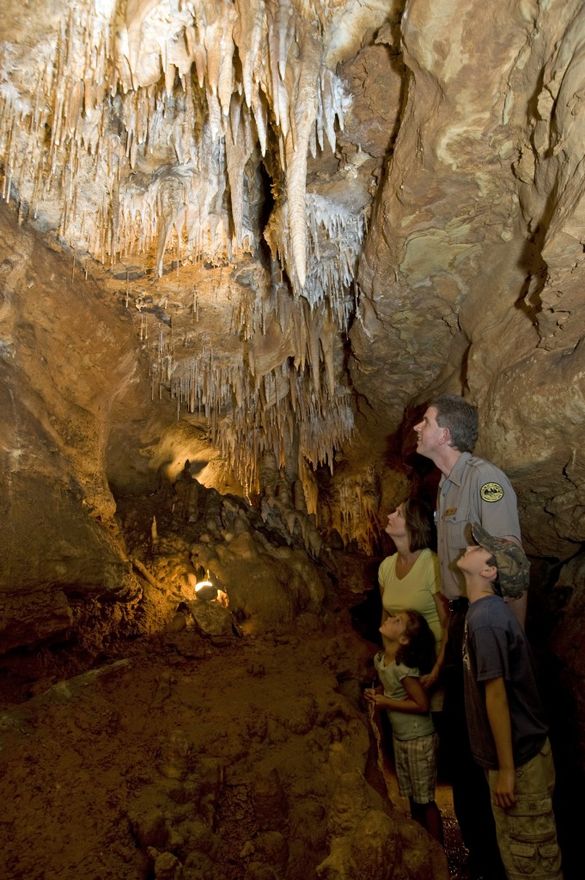
Heading north out of Berryville on the last 17-mile leg of its journey to the Arkansas/Missouri state line, Arkansas 21 meanders across a rural landscape dotted with small farms, pastures, and the ubiquitous chicken houses of the state's northwestern corner. About halfway through this last stretch of highway is one more surprise: Cosmic Cavern. Discovered by prospector John Moore in 1845, the cave includes a wonderful array of stalactites, stalagmites, flowstone, and some of the longest soda straw formations in the Ozarks. For over three decades, this commercial cave has been owned by the Randy Langhover family. Options include an hour and 15 minute tour on paved walkways or – for those seeking a genuine hardhat adventure – a wild cave tour into the dark and muddy recesses of the cavern complex.
Oak Grove is the next community of note, and it's the largest of a dozen such named locales in the state. A few miles beyond Oak Grove lies Blue Eye, the final and northernmost town on the 99-mile length of Arkansas Highway 21. Arkansas claims 30 residents of the bi-state community while the Missouri side had 129 at the last census.
So, there you have it: a little over 3,000 words attempting to describe why Arkansas 21 is my favorite drive in The Natural State. I hope you'll be able to experience the route – or at least portions of it – sometime in the near future.
And, if you still need convincing, think about this: the average traffic count on Arkansas Highway 21 in Newton County is about 350 vehicles a day. Meanwhile, Interstate 40 at Clarksville carries about 30,000 daily. In other words, for every vehicle you'd encounter on Highway 21, you can expect 85 on the interstate. In short, you can relax and truly enjoy a road less traveled.