 11 Sep 2012

• The name Waco has been spelled at least 32 different ways, including Wacco, Wachos, Huaco, Hueco, Wacoah, Honechas, Houchas, Quchaco, Quaineo, Quintico, Wacha, Wacoes, Waecoe, Waeko, Wiko, Weko, and Weeco.
• There is no truth to the rumor that Dr Pepper soft drink is made with prune juice.
• Darwin the gorilla, a giant statue on Austin Avenue, sports new outfits throughout the year to honor special holidays and events.
• “The Waco Door” sculpture by famous Wacoan Robert Wilson weighs more than six tons. It provides the perfect gateway to the sculpture walk at Art Center Waco.
• Telephus Telemachus Louis Augustus Albertus Johnson, who died in Waco in 1875, was originally buried in historic First Street Cemetery. His remains were later reinterred in Oakwood Cemetery, which laid to rest the myth that he was buried sitting at a poker table with a bottle of whiskey in one hand and a six-shooter in the other.
• In 1879, Waco became the first town in Texas and the second in the United States (after Omaha, Nebraska) to legalize prostitution. The Reservation, as the vice district was known, extended from Washington Avenue to Jefferson Avenue, and from the Brazos River to 2nd Street. It was closed in 1917 during World War I, when the U.S. Army agreed to locate Camp MacArthur in Waco on the condition that prostitution be outlawed.
• In 1972, Baylor won the Southwest Conference football championship for the first time in 50 years.
• In 1978, the first of many mammoth skeletons was discovered near Waco. It is now one of the most important paleontological sites in the world.
• Beaver, bear, and buffalo still roamed the area when surveyor George B. Erath laid out the new town of Waco Village back in 1849. Lots facing the square cost $10, others $5. Land beyond this area sold for $2 to $3 per acre.
• Early Waco settler and merchant George Barnard was a natty dresser, ordering his clothing from Lockwood & Dubois in New York City. He paid an outrageous $35 each for dress coats, $7.50 to $9 for silk vests, and $15 for cashmere pants. In 1830, he began to wear silk underwear.
• Waco’s first daily newspaper, the Waco Examiner, started in 1867.
• Waco was known as the “Athens on the Brazos” during the 1880s, as it was fast becoming the hub of education in the Lone Star State. In 1881, Paul Quinn College moved to Waco from Austin; in 1882, a city tax was levied to fund the Waco Public Schools; and in 1886, Waco University and Baylor University consolidated locations in Waco.
• The invention of Dr Pepper at the Old Corner Drug Store in Waco in 1885 preceded the invention of Coca-Cola by one year.
• William L. Prather of Waco, president of the University of Texas (UT) in 1900, often admonished his students that “the eyes of Texas are upon you.” Inspired by these words, student John Long Sinclair wrote lyrics to the tune of “I’ve Been Working on the Railroad” that eventually became the school song for UT. The song was first sung on May 16, 1903.
• During the blizzard of 1899, the temperature tumbled to 10 degrees below zero, and people ice-skated on the Brazos River.
• The Pacific Hotel that once stood at the corner of 4th Street and Franklin Avenue was the first hotel in Waco to install an elevator.
• The Hippodrome Theater, opened in 1914 as a select road show house, spent much of its life as “Hulsey’s Hipp,” operated by E. H. Hulsey to offer major vaudeville attractions and movies.
• In 1874, the editor of the Waco Examiner reported that, “The stench on Austin Avenue arising from an accumulation of mud and other filth is, under the warm rays of a spring sun, fast becoming a nuisance. The attention of the City Fathers is invited to that odorous locality.” Paving of Waco streets did not begin until 1903, starting with Austin Avenue, where the mud was ankle deep from 8th Street to the City Square.
• The Waco Navigators, a professional baseball team, won the Texas League championship in 1914, 1915, and 1916.
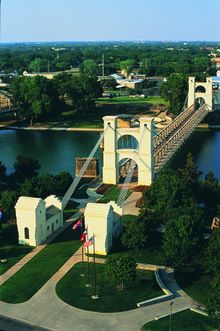
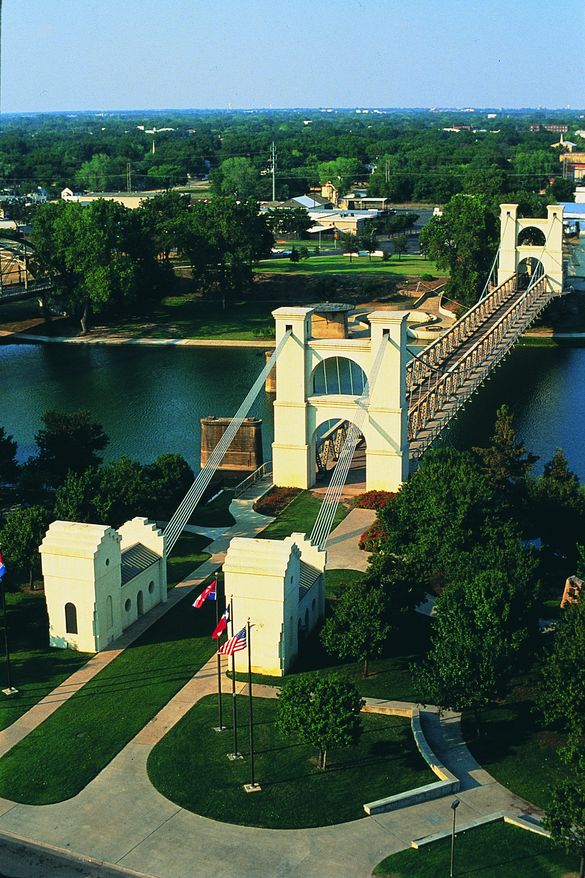
• In 1970, 100 years after its completion, the Waco Suspension Bridge became the first Waco edifice placed on the National Register of Historic Sites.
• Waco is one of only two cities in the country that has a radio station whose call letters spell out the name of the city.
• The first sermon preached in Waco Village in 1849 was given by a Methodist missionary. Today, Waco is home to more than 200 congregations representing 40 denominations and faiths.
• Waco’s first hotel was built in 1849 when Shapley Prince Ross, one of Waco’s founders, built a log hotel on the corner of 1st Street and Bridge Street, the site of the present-day Hilton Waco. The log hotel burned in 1871.
• McLennan County produced six Civil War Generals and sent more than 2,200 troops to fight for the Confederacy out of a population of about 8,000. Gravesites for some of these generals can be found at the 1st Street Cemetery in Fort Fisher Park.
• The Chisholm Trail, leading to Wichita, Kansas, and the Shawnee Trail, leading to Abilene, both crossed the Brazos River on the Waco Suspension Bridge. By 1871, between 600,000 and 700,000 steers had passed over the bridge, and the cattle drives continued until 1885 when the trail closed.
• Jacob de Cordova, one of Waco’s founders, was Jewish. In 1869, a Hebrew Benevolent Society was founded, and B’nai B’rith helped construct the first synagogue in 1879.
• More than 2.7 million bricks made from Brazos River sand went into the construction of the Waco Suspension Bridge before its completion in 1870.
• Waco was home to the largest inland cotton market in the world in 1890, receiving 60,000 bales annually by wagon and 150,000 bales by rail.
• More than eight million Texans visited Waco from 1894 to 1930 to attend the month-long Texas Cotton Palace Exposition.
• The Masonic Grand Lodge of Texas, located in Waco, was built in 1904 with contributions of $1 from every Mason in the state.
• The 1953 Waco tornado was the most devastating tornado in Texas history in terms of death and injury, with 114 people killed and more than 1,000 injured.
• Waco’s 416-acre Cameron Park has some of the most technical and challenging mountain bike trails in the state.
• The southwest part of Waco is located on the edge of the Balcones Fault, the same geological formation that carved the Texas Hill Country. Across the Brazos, on the northeast side, is rich, black farmland called the Blacklands Region in the geology of Texas. From the top of Lover’s Leap in Cameron Park, one can see the vast geological differences from one side of the Brazos to the other.
• Waco was the same size as Dallas in 1870 and the same size as Austin in 1880.
• Cargill Foods of Waco raises, processes, and sells more than eight million turkeys
per year.
• Seventy-five percent of the world’s Snickers Bars are made in Waco.
• Waco is the birthplace of more Texas governors than any other city. Governors born here include Richard Coke, Sul Ross, Pat Neff, and Ann Richards.
• William Cowper Brann (1855-1898) was the brilliant, vitriolic writer and publisher of the Iconoclast, a monthly newsletter with a national circulation. Brann called his publication
“a journal of personal protest” and “a literary Gatling gun.” Brann was killed in a duel with Tom Davis in downtown Waco and is buried in Oakwood Cemetery. A bullet hole mars his tombstone, on which his name does not appear. In fact, the only word on the stone is “TRUTH.”
• Waco artist Kermit Oliver is the only U.S. artist to design for Hermès in Paris.