 24 Sep 2004

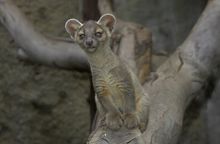
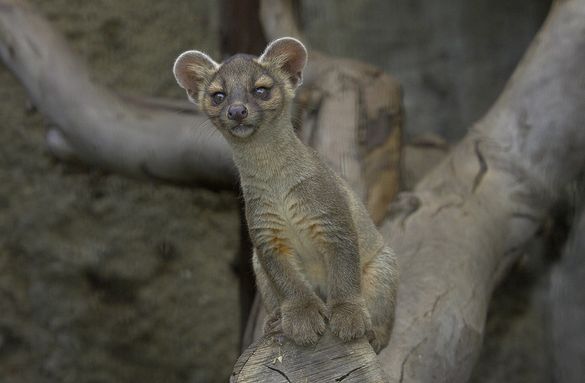
For the first time in 10 years a fossa gave birth to three cubs at the San Diego Zoo. The 10-week-old cubs have recently emerged from the den to make their debut.
The dam (mother) and her three offspring � two unnamed females and one male � are very energetic. The healthy cubs spend the day following the adult female while taking time to play and explore. They immediately became expert tree and rock climbers, though they still take a few minor tumbles.
Fossas are only found in the forests of Madagascar where they are the island�s largest carnivores. They are now considered an endangered species.
The fossa may be confused by appearance as a member of the cat family. However, this species is from the civet family known as viverridae. Fossas eat insects, amphibians, reptiles and small mammals.
The fossa family can be seen on exhibit at the San Diego Zoo�s Kiwi Trail. A pair of adult fossa can also be seen in Cat Canyon.
The 100-acre San Diego Zoo is operated by the not-for-profit Zoological Society of San Diego. The Zoological Society, dedicated to the conservation of endangered species and their habitats, engages in conservation and research work around the globe. The Zoological Society also manages the 1,800-acre San Diego Zoo�s Wild Animal Park (more than half of which has been set aside as protected native species habitat) and the Center for Reproduction of Endangered Species (CRES), and is working to establish field stations in five key ecological areas worldwide.
###
Media Contact: Paul Garcia +1 619-685-3291 pgarcia@sandiegozoo.org