 06 Jan 2026

MEDIA DAY: 23rd February 2026. A Tale of Two Tapestries at Reading Museum hosted by Dr David Musgrove (HistoryExtra.com, BBC History Magazine, BBC History Revealed) and Matthew Williams, Museum Manager, Reading Museum. More details below
……………………………………………………………………………………………………………………………………………………………………………………………………………………………………
The Bayeux Tapestry is one of the world’s most famous pieces of medieval art. It is 70 metres long, and chronicles the legendary tale of the Norman conquest of England, when William the Conqueror invaded and defeated King Harold Godwinson. In 2026 and for the first time ever, visitors can see both Britain and Normandy's Bayeux Tapestries in England in the same year.
'England should have a copy of its own'
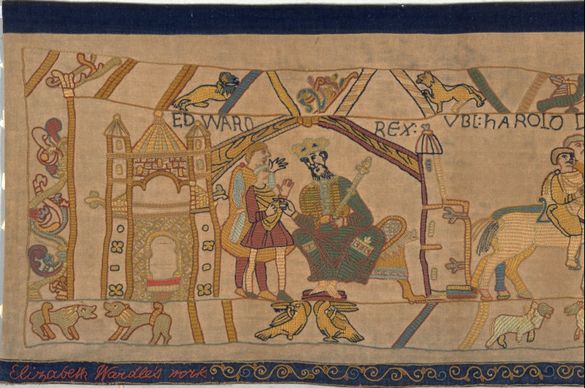
In the late 19th century, an extremely ambitious project was undertaken by a society of Victorian embroiderers to recreate the Bayeux Tapestry in full, painstakingly reproducing every single detail, stitch-by-stitch, so that the Tapestry's timeless story could be enjoyed by the people of Britain. The ambitious project that was completed in just over a year. Today, this artwork, known as Britain’s Bayeux Tapestry, is held at Reading Museum and displayed in a specially designed Bayeux Gallery which is free to access during Museum opening hours.
The Society went to great efforts to make Britain's tapestry as accurate as possible - but there are a few uniquely Victorian additions. In the borders there are several naked men but in the Victorian replica one man's modesty has been protected with pants. The women embroiderers were not responsible for this prudish addition as is often repeated - they had simply copied them from the set of photographs that had been ‘cleaned-up’ by the male staff at the South Kensington Museum, now called the Victoria & Albert Museum, London.
Reading, home of Britain's Bayeux Tapestry and burial place of William the Conquerer's Son
Britain's Bayeux Tapestry was first displayed in Leek in 1886 and toured the world before finding its permanent home in Reading, Berkshire in 1895, when it was bought and gifted to the town by the former Mayor, Alderman Arthur Hill. It was a fitting addition to Reading's collections as in 1121 William the Conqueror's youngest son King Henry I had founded Reading Abbey, where he was buried in 1136.
In 1993, a new Bayeux Tapestry gallery was opened at Reading Museum. The tapestry was carefully conserved and remounted as a continuous strip in a specially designed display case so the entire tapestry could be seen in one gallery. Today, visitors to Reading Museum can see the Bayeux Tapestry gallery and the work of the skilled Victorian women as well as discovering the story of the Norman Conquest. Entry to the museum is free.
MEDIA DAY: A Tale of Two Tapestries, 23rd February 2026, 11.00am - 1.15pm
Reading Museum (2 mins walk from Reading Station / Reading Station is 23 minutes from London Paddington)